
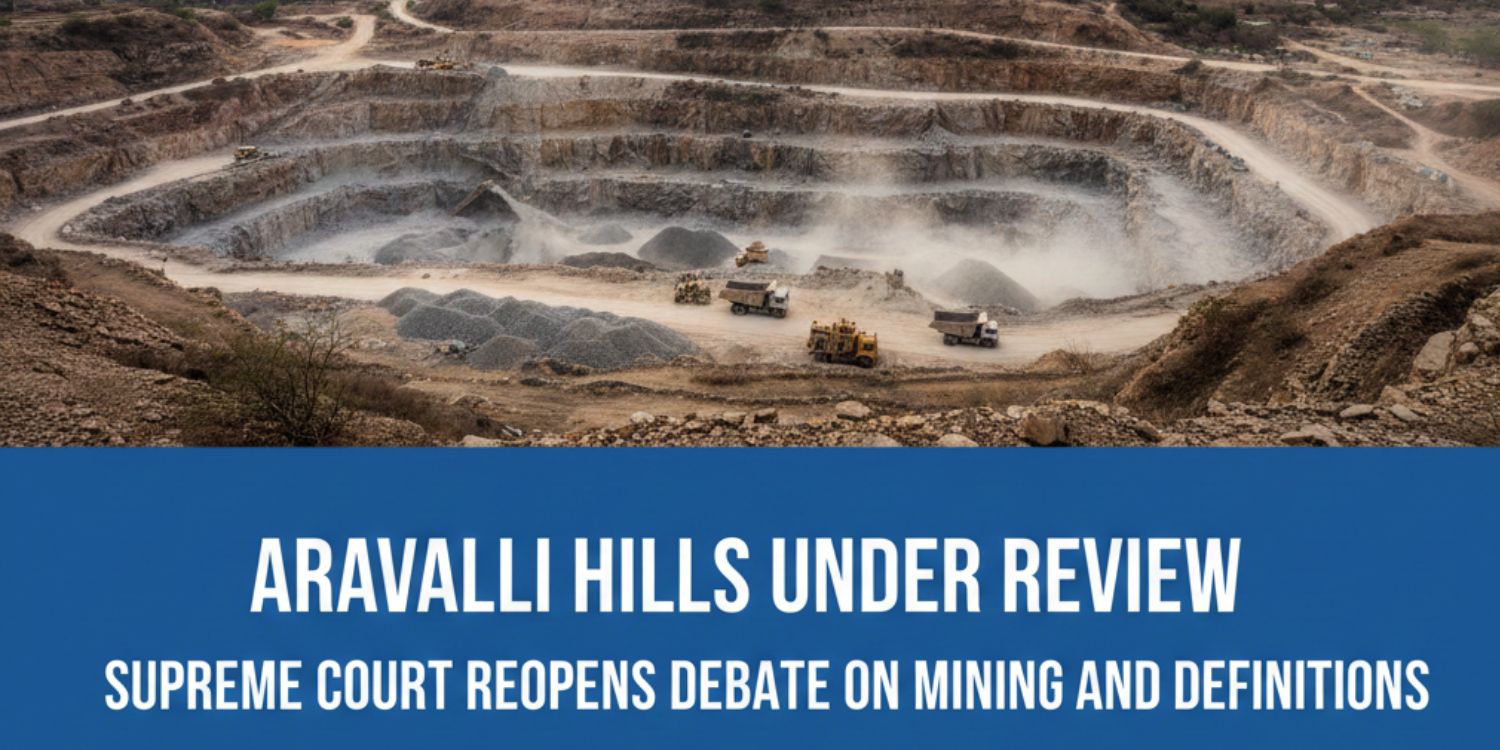
The Supreme Court of India is hearing a suo motu case concerning issues related to the definition and protection of the Aravalli Hills stretching across Delhi, Haryana, Rajasthan, and Gujarat, amid growing public concern over mining activities in the region.
A Bench comprising Surya Kant, along with Justices J K Maheshwari and A G Masih, is hearing the matter. In May 2024, while dealing with cases related to illegal mining in the Aravallis, the Supreme Court noted that different States had adopted varying definitions of the “Aravalli Hills” and “Aravalli Ranges.” To address this inconsistency, the Court constituted an expert committee to examine the issue and suggest a uniform definition for regulatory purposes.
The committee recommended that any landform in the Aravalli districts with an elevation of 100 metres or more, from the local relief, be classified as an Aravalli Hill. It further defined the Aravalli Range as two or more Aravalli Hills located within a proximity of 500 metres, measured from the outermost point of the lowest contour line on either side. This parameter covers only around around 40-60% of the landform, causing ancient environmental treasure at the risk of destruction.
In November this year, a Bench led by then Chief Justice B R Gavai, along with Justices K Vinod Chandran and N V Anjaria, accepted the committee’s recommendations, including the prohibition of mining in core or inviolate areas of the Aravallis. However, the Court declined to impose a complete ban on mining, observing that an absolute prohibition could encourage illegal mining, mafia activity, and criminalisation.
Following the November ruling, concerns have been raised that the revised definition may reduce protection for certain parts of the Aravalli region by excluding some landforms from regulatory safeguards. Amid public demonstrations and environmental apprehensions over the implications of the judgment, the Supreme Court has taken suo motu cognisance of the matter and is now examining the issues afresh, the hearing started on 29th December 2025 and the next hearing will be on January 21, 2026.