
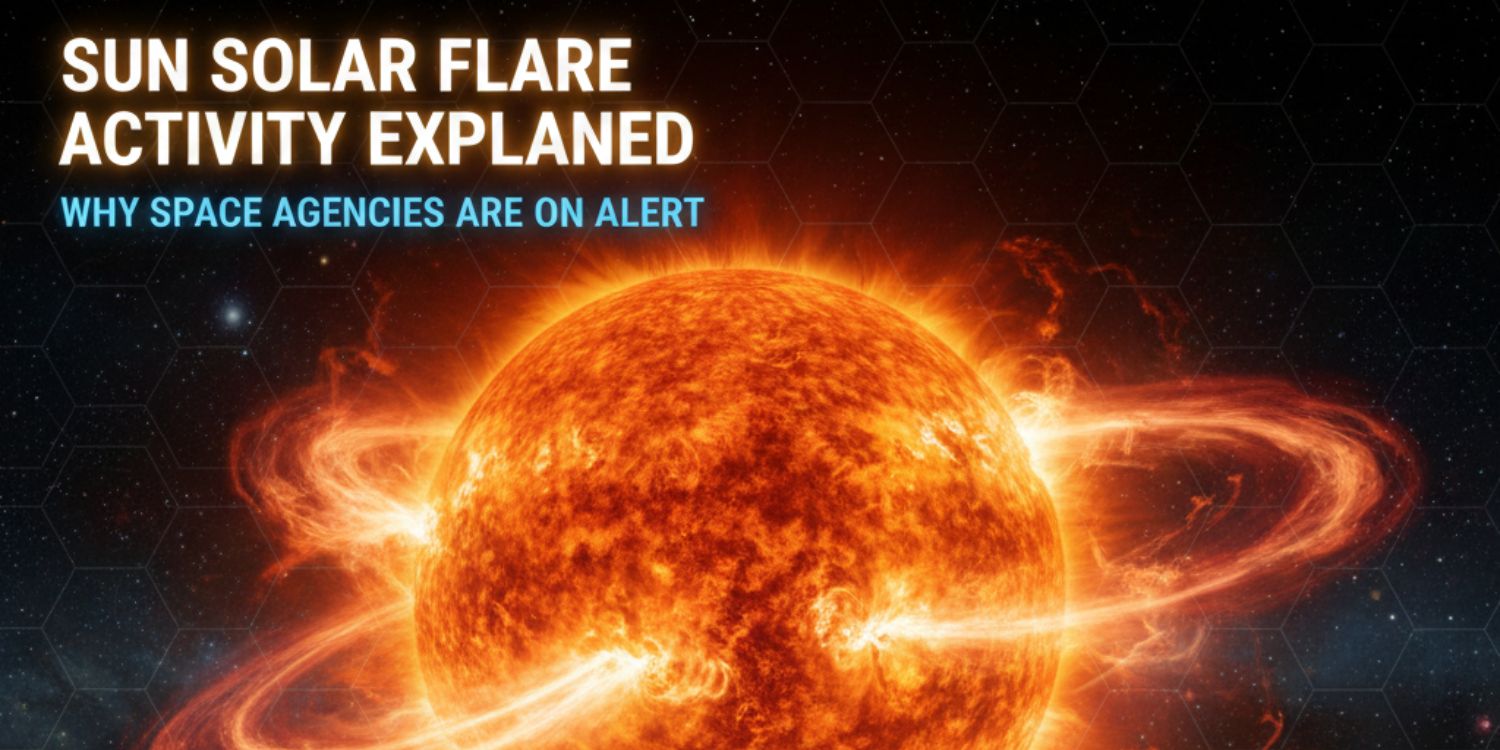
The Sun has been emitting a series of powerful solar flares since February 1, prompting space agencies to closely monitor potential impacts on Earth’s communication and satellite systems. Scientists have confirmed that several of these eruptions fall under the M-class and X-class categories, which are among the strongest types of solar flares recorded.
According to space weather monitoring agencies, the heightened activity is linked to highly active sunspot regions currently facing Earth. While no immediate damage has been reported, authorities have warned that such flares can temporarily disrupt radio communications, satellite operations, and navigation systems, particularly in regions directly exposed to solar radiation.
Agencies including ISRO and NASA are tracking the developments in real time, as intense solar flares can affect aviation communications, maritime operations, and GPS-dependent services. Similar solar activity has been observed during periods when the Sun approaches the peak of its natural activity cycle.
Scientists have emphasised that while these solar events pose no direct threat to human life on Earth, their technological impact can be significant, especially in an era increasingly dependent on satellite-based infrastructure.
What Are Solar Flares?
Solar flares are sudden, intense bursts of energy released from the Sun’s atmosphere. They occur when twisted magnetic fields near sunspots suddenly snap and realign, releasing enormous amounts of energy in the form of electromagnetic radiation, including X-rays and ultraviolet radiation.
This energy travels at the speed of light and reaches Earth in about eight minutes. Solar flares are classified by strength into categories, A, B, C, M, and X, with X-class flares being the most powerful.
Why Can Solar Flares Cause Radio Blackouts?
When the radiation from a strong solar flare reaches Earth, it intensifies ionisation in the ionosphere, the upper layer of the atmosphere that plays a crucial role in radio communication.
High-frequency radio signals, commonly used by aircraft pilots, emergency services, maritime operators and amateur radio networks rely on the ionosphere to reflect signals over long distances. During intense solar flares, excessive ionisation can cause these signals to be absorbed or scattered, leading to temporary radio blackouts on the sunlit side of the planet.
Such disruptions can last from a few minutes to several hours, depending on the strength of the flare and ongoing solar conditions.
Why Space Agencies Are Monitoring Closely
Beyond radio blackouts, strong solar flares can interfere with satellite communications, reduce GPS accuracy, increase atmospheric drag on satellites in low Earth orbit.
With solar activity expected to remain elevated in the coming months, space agencies continue to issue advisories and update forecasts to minimise disruption to critical systems.