
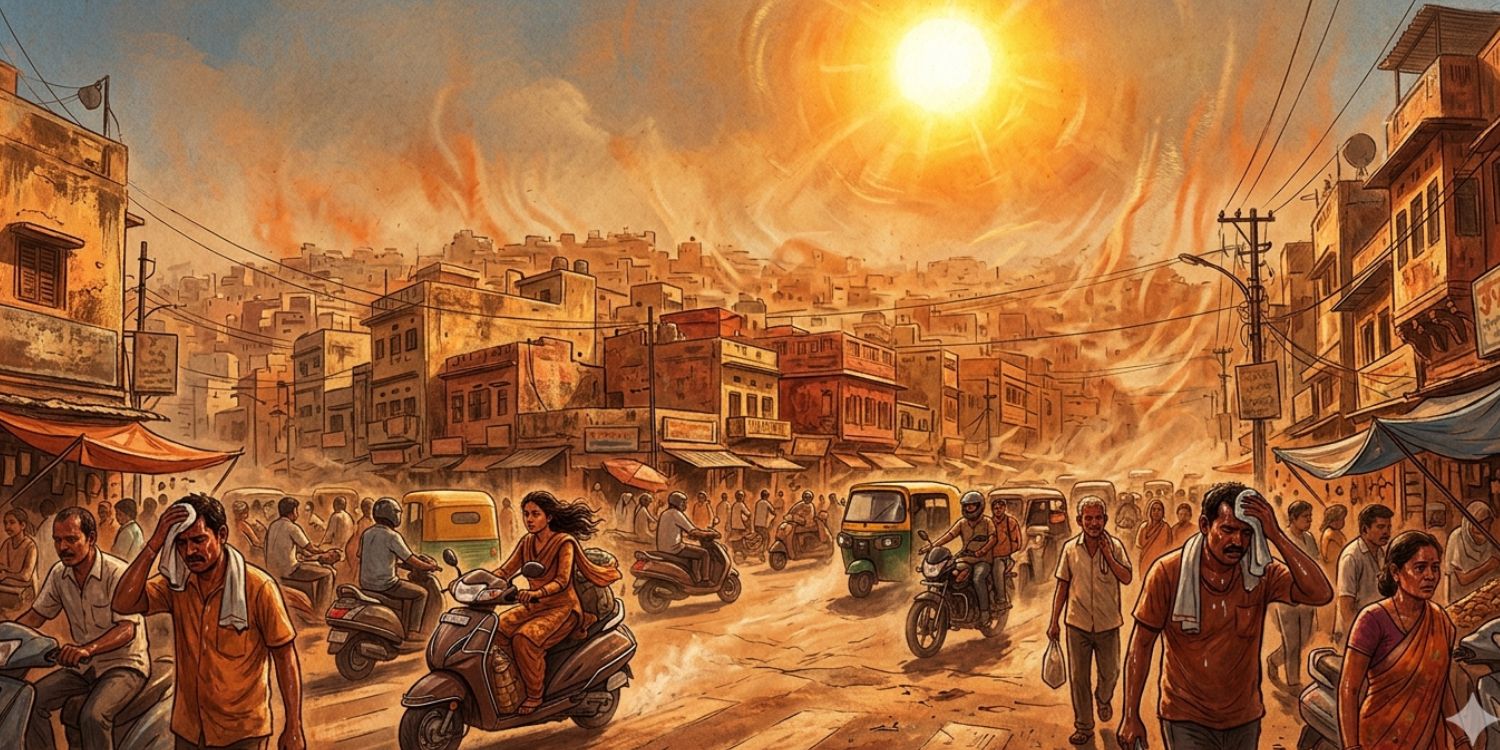
While you sit there googling heatwaves and wondering why it suddenly feels like peak June in early May, it hits you, maybe all those climate change warnings weren’t exaggerations after all. India’s unusually early and intense summer in 2026 isn’t random; it’s the result of multiple overlapping climatic and environmental factors. What feels like we “skipped” spring is actually a compressed seasonal shift, where winter exited abruptly and pre-monsoon heat stepped in earlier, stronger, and far more aggressively than usual.
A primary factor is the long-term impact of climate change, which is increasing baseline temperatures across the subcontinent. This has led to a measurable rise in both daytime and nighttime temperatures, with heatwaves arriving earlier (April instead of May–June) and lasting longer across wider regions.
A second critical driver is the potential development of El Niño conditions in 2026. El Niño is associated with warmer Pacific Ocean temperatures, which weaken India’s monsoon system and reduce cloud cover. This results in higher solar radiation reaching the surface, intensifying heat and prolonging dry spells.
Meteorologically, the absence of western disturbances, weather systems that typically bring rainfall during late winter and early spring, has removed a key cooling mechanism. Without these systems, north and central India experienced minimal pre-summer rainfall, accelerating heat buildup.
Additionally, weak convective activity has limited cloud formation and localized thunderstorms, both of which usually moderate temperatures during seasonal transition periods. The result is uninterrupted solar heating and rapid surface warming.
The India Meteorological Department (IMD) has already forecast above-normal heatwave days across most regions in 2026, confirming that the current conditions are part of a broader climatic trend rather than an isolated event.
Urbanisation further amplifies the crisis through the urban heat island effect, where concrete infrastructure absorbs and re-radiates heat, keeping cities significantly warmer than surrounding rural areas, especially at night.
Maybe it’s finally time we rethink how easily we cut down those canopy trees, because now, every time you step out, you’re not looking for a destination, you’re just looking for shade. That small patch under a tree suddenly feels like luxury. Every long drive feels better when nature shows up, when roads are lined with green instead of just concrete. And somewhere between new buildings, flyovers, and disappearing lakesides, you realize those quiet, breezy moments in nature might soon be something we only look back on, not experience.