
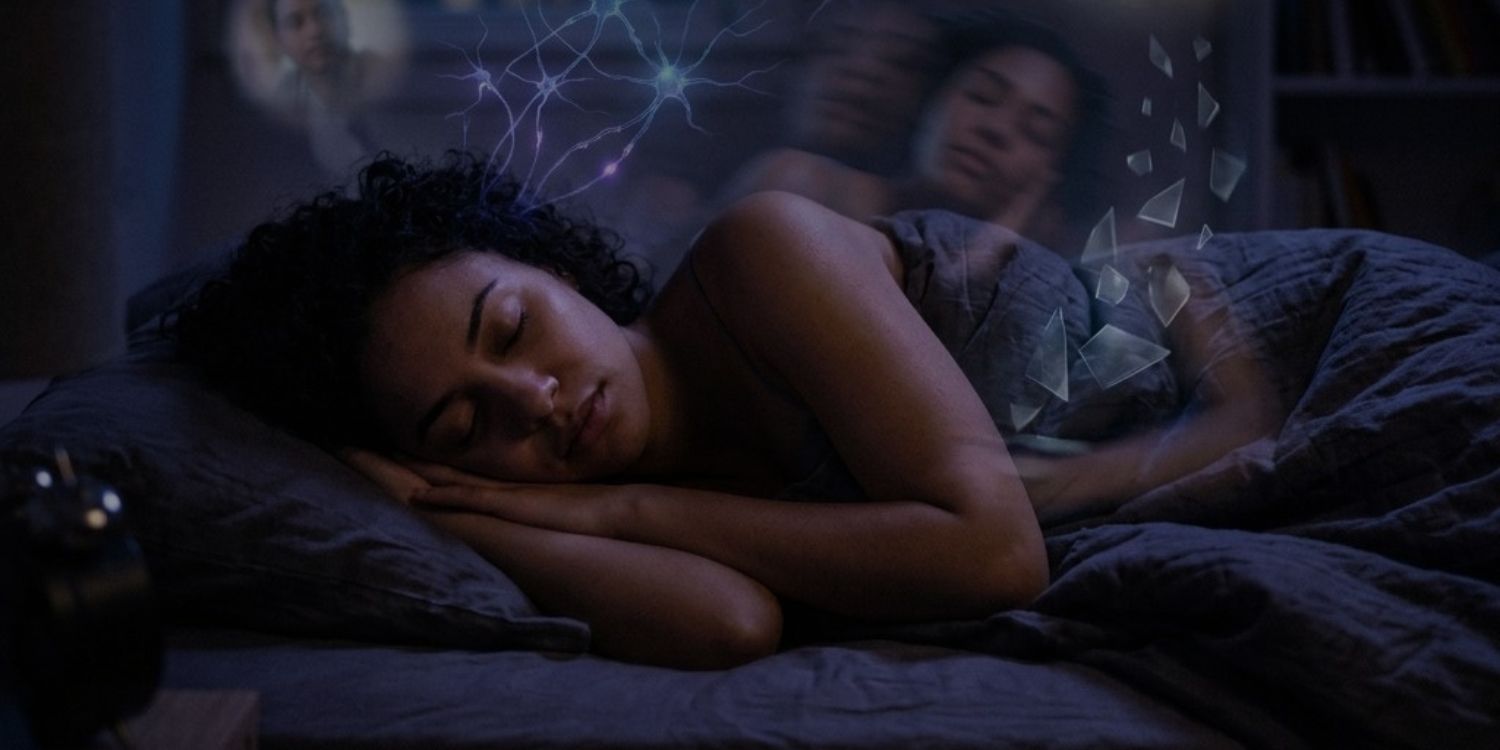
Ever had an instance where after a long tiring day, you go to sleep and suddenly dream of falling and wake up with a sudden jerk? What exactly was that dream? And why do you dream only when your body is resting?
Dreaming is perhaps the most intimate illusion the brain creates, a state where reality is suspended, yet never questioned. Each night, as the body withdraws from the external world, the mind does not fall silent. Instead, it turns inward, generating experiences that can feel as vivid, as emotional, and at times as convincing as waking life itself.
This state unfolds most prominently during rapid eye movement (REM) sleep, a phase in which the brain becomes paradoxically active. Electrical patterns begin to resemble wakefulness, sensory regions light up, and yet the body lies still, disconnected from the unfolding narrative within. It is here that dreams take shape, not as random fragments, but as constructed experiences, shaped by memory, emotion, and imagination. The mind, freed from external input, becomes both the author and the audience.
What makes dreams so compelling is not merely their imagery, but their conviction. Within a dream, the improbable rarely feels implausible. This is largely because the brain regions responsible for critical reasoning and self-awareness are subdued, while those governing perception and emotion remain active. The result is a reality that is immersive but unquestioned, a world that feels real precisely because the part of the mind that might doubt it is temporarily offline.
Occasionally, however, that balance shifts. In lucid dreaming, the dreamer becomes aware of the illusion while still immersed within it. This awareness can be fleeting or sustained, and in some cases, it allows for a degree of control over the dream’s direction. Neurologically, this suggests a partial re-engagement of higher-order cognitive regions, reintroducing self-awareness into a state that typically lacks it. It is, in many ways, a rare intersection, where consciousness observes itself within its own creation.
While the mind is active, the body exists in a carefully regulated state. During REM sleep, most voluntary muscles are temporarily paralysed, a phenomenon known as REM atonia. This is not a malfunction but a safeguard, preventing the body from enacting the vivid scenarios of the dream. Breathing and heart rate continue, though often irregularly, subtly echoing the emotional currents of the dream itself. The body, in essence, remains grounded even as the mind wanders freely.
Yet this separation is not always absolute. Sleep talking, for instance, emerges when fragments of motor activity slip through this paralysis. Words, often disjointed and involuntary, may surface without awareness, reflecting the ongoing narrative of the dream. It is a reminder that the boundary between mind and body, though generally well maintained, is not impermeable.
Time, too, behaves differently within dreams. A sequence that feels expansive and prolonged may, in reality, occupy only a few minutes. Most dreams occur in cycles, growing longer as the night progresses, with later REM periods extending up to half an hour. Yet the subjective experience of time within a dream is shaped not by clocks, but by the brain’s internal pacing; fluid, elastic, and often deceptive.
There are moments, however, when the transition between dreaming and waking reveals its fragility. Sleep paralysis is one such instance, a state in which the mind awakens, but the body remains under the influence of REM atonia. The result is a disconcerting mismatch: awareness without movement. Often, this state is accompanied by vivid hallucinations, as remnants of the dream continue to intrude upon waking consciousness. The experience can feel intensely real, even threatening, precisely because the brain has not yet fully relinquished its dream-generating mechanisms.
Dreaming, then, is not merely a nightly occurrence. It is a window into the architecture of consciousness itself, one that shows how easily the mind can blur the line between the imagined and the lived, and how, even in stillness, it remains profoundly, relentlessly active.