
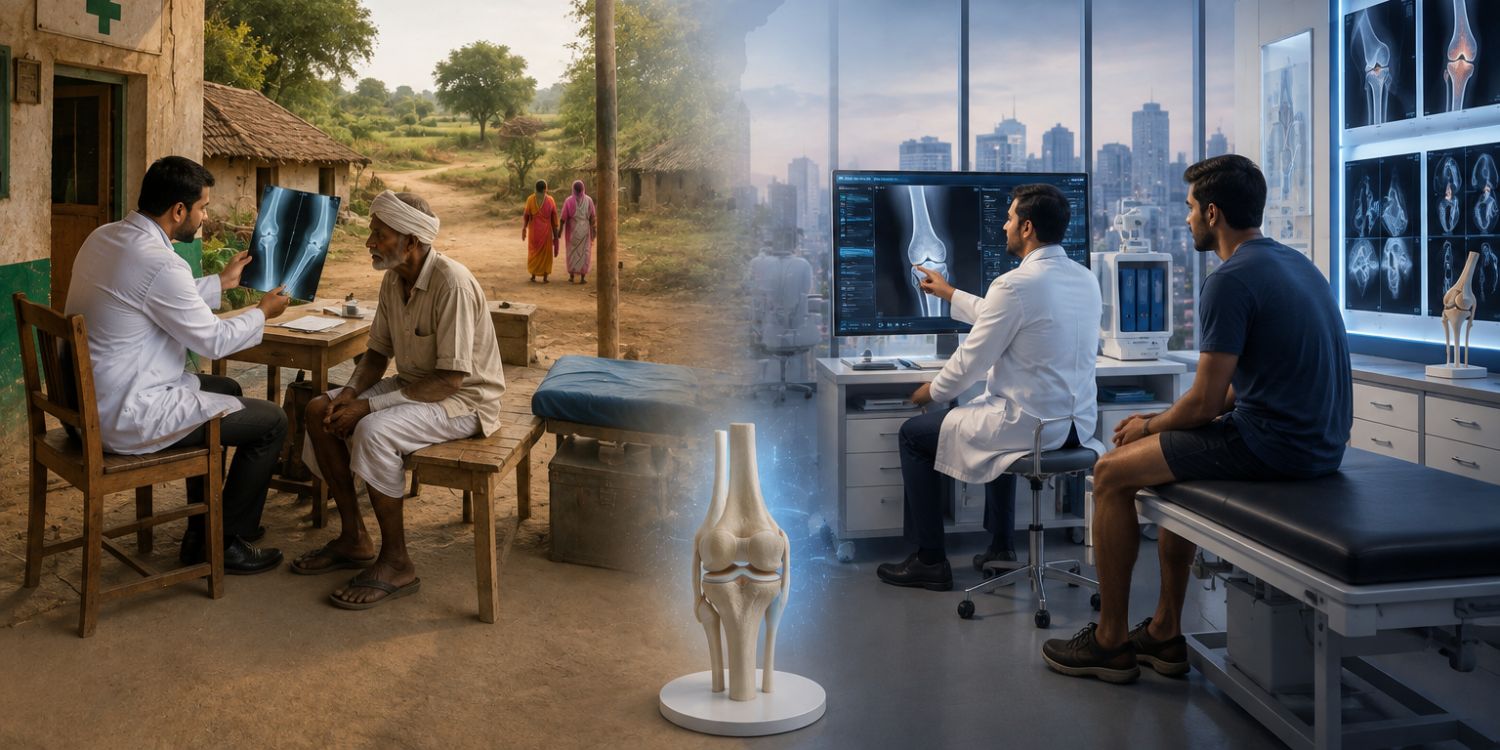
India’s orthopaedic advances, robotic surgery, 3D-printed implants, AI-assisted planning, are transforming outcomes in its metros. But step outside the city limits, and the picture changes dramatically. The gap isn’t just about technology; it’s about access, timing, and ultimately, quality of life.
| Parameter | Urban India | Rural India |
| Specialist availability | Dense concentration of orthopaedic surgeons, often multiple per hospital | Severe shortage; many districts share one specialist across several villages |
| Diagnostic infrastructure | MRI, CT, DEXA scans widely available | Often limited to basic X-ray, if that; DEXA scans for osteoporosis screening are rare |
| Time to treatment | Fractures and injuries typically treated within hours | Delays of days are common due to travel distance and referral chains |
| Surgical technology | Access to robotic-assisted joint replacement, arthroscopy | Largely dependent on conventional open surgery techniques |
| Post-op rehabilitation | Structured physiotherapy and rehab centres nearby | Minimal or no formal rehab support; recovery often unsupervised |
| Awareness & prevention | Growing awareness of bone health, screening, early intervention | Osteoporosis and joint issues often go undiagnosed until severe |
| Cost of care | Higher absolute cost, but insurance and payment plans more accessible | Lower cost of care, but often paired with high travel and lost-wage burden |
| Emergency trauma response | Trauma centres equipped for polytrauma and complex fractures | Basic stabilization only; patients frequently transferred to cities, losing critical time |
The real cost of the gap
The consequences aren’t abstract. A hip fracture that would be treated same-day in a metro hospital might mean a multi-hour ambulance ride, a delayed surgery, and a far worse recovery outcome in a rural setting. Delayed treatment of trauma cases significantly increases complication rates, a gap that costs mobility, and sometimes lives.
Bridging the divide
Telemedicine consultations, mobile diagnostic units, and government schemes to place specialists in district hospitals are slowly narrowing the gap. But real progress will require sustained investment, not just in equipment, but in training and retaining orthopaedic talent willing to practice outside major cities.
India’s orthopaedic story in 2026 is one of two systems, moving at very different speeds.