
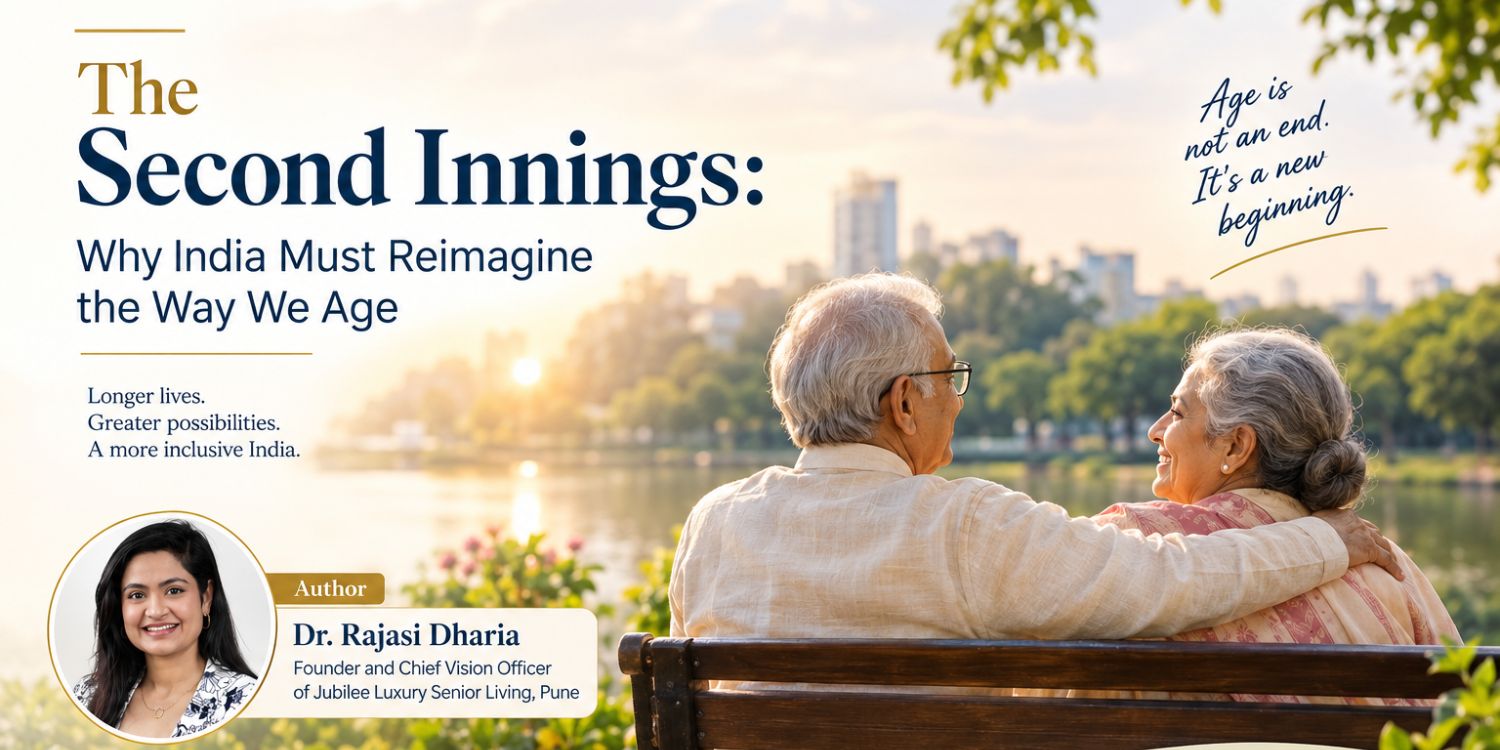
There is a moment many Indian families eventually arrive at, although very few are prepared for it. A mother who has managed an entire household for decades suddenly needs someone nearby at night. A father who once travelled the world now spends long afternoons alone because his children live elsewhere. A fiercely independent couple begin wondering what would happen if one of them fell ill.
And then comes the question nobody quite wants to ask: What happens next?
For too long, India has had only two emotionally acceptable answers: the family must somehow manage everything at home, or the senior must move into what we have traditionally called an ‘old age home.’ Even the phrase feels like a conclusion. We need to change that. Senior living can be a second home for a second innings.
My interest in senior living became personal while I was trying to understand what the right environment for my grandmother would look like. As a doctor and healthcare administrator, I knew what good clinical care involved. But as a granddaughter, my questions were different.
Would she be happy there? Would someone remember how she liked her tea? Would she have people to talk to over lunch? Would she still feel like dressing up for an evening programme? Those questions taught me something fundamental: looking after an older person and enabling an older person to live well are not the same thing.
When Love Is Expected to Become an Entire Care System
In India, caregiving and family duty are deeply intertwined. But we have also created an impossible expectation that love alone should provide everything an ageing person may eventually need.
A daughter can love her mother deeply and still not know how to manage multiple medications or safely assist her after a fall. A son living abroad may speak to his father every day and still worry about an emergency at 2 a.m.
Families are not failing. The needs have simply become larger than what one person or household can sustainably provide.
Professional caregiving should therefore come in not instead of the family, but around it. When nursing support, medication management, nutrition, rehabilitation and emergency preparedness are handled reliably, the family relationship can breathe again. A daughter can go back to being a daughter. A husband can once again be a companion rather than a full-time caregiver.
Home, Hotel and Hospital
When I think about contemporary senior living, I return to three words: Home. Hotel. Hospital.
Home is identity: privacy, familiarity, freedom and belonging. Hotel is hospitality: thoughtful service, comfort and the small details that make daily life easier. Hospital is preparedness: nursing support, medication management, physician oversight, rehabilitation and emergency protocols when required. But residents should not wake up feeling as though they live in a medical facility. The hospital should remain backstage, not in the lobby.
That is also where my understanding of luxury has changed. At eighty-five, luxury may mean knowing that someone notices when you skip breakfast, having help available before you ask twice, or knowing that someone trained is nearby at midnight.
Most importantly, it is knowing that tomorrow still has something to look forward to.
Beyond Safety
Safety is essential, but a safe life can still be an empty one. Wellbeing in later years extends beyond accommodation, meals and medication. It includes physical, emotional, intellectual, social, spiritual, environmental and vocational or occupational wellbeing.
Physical wellbeing may mean physiotherapy or confidence in one’s mobility. Emotional wellbeing means being heard. Intellectual and social wellbeing grow through curiosity, conversation and friendship. Spiritual wellbeing may mean prayer or reflection, while environmental wellbeing comes from accessible, safe and comfortable spaces.
And then there is purpose. A retired teacher does not stop having something to teach. A banker does not lose decades of wisdom on retirement day. An artist remains an artist even if her hands tremble slightly.
Older adults need opportunities not only to participate, but also to contribute. One of the quietest losses in ageing can be the feeling of becoming invisible.
The Small Signs Matter
Some of the moments that stay with me most are tiny changes. A resident who initially says ‘your dining room’ begins saying ‘our table.’ Someone who came for a short stay starts asking what is planned for Friday. A daughter notices that her mother has started dressing up again before an evening activity.
None of these outcomes appears in a medical chart, yet they tell us something important: the person has not merely been cared for. They have begun to belong.
Technology can strengthen this ecosystem through better records, alerts and communication, but it should create more time for human attention, not replace it.
A Choice, Not a Crisis
Perhaps the biggest cultural shift will happen when Indian families begin exploring senior living before they desperately need it. Not after a fall. Not after caregiver burnout. Not when an emergency suddenly makes independent living impossible.
But while an older adult is still able to ask: Where would I enjoy living? What kind of community would I like around me? What would make my life easier, fuller and more interesting?
Senior living then stops being somewhere a person is “sent to.” It becomes a considered life choice, where independence is protected by support rather than diminished by it.
The shift we need is not only architectural. It is philosophical. We need to move from guilt to choice, from caregiving to enabling, and from merely adding years to life to adding life to those years.
Ageing is not an illness. It is another chapter of being alive. If we can create environments with the warmth of home, gracious hospitality, clinical reassurance and genuine community, perhaps the question will no longer be where our elders should spend their remaining years.
It will be: How beautifully can they live them?
Author:
Dr. Rajasi Dharia – Founder and Chief Vision Officer of Jubilee Luxury Senior Living, Pune
Author Bio
Dr. Rajasi Dharia is the Founder and Chief Vision Officer of Jubilee Luxury Senior Living, Pune. A medical doctor with a Master’s in Hospital Administration and specialised training in Senior Living Management, she has worked across healthcare operations, medical law, infection prevention and elder care. Her work focuses on creating dignified ageing environments that combine professional care with independence, purpose and community. She has also been recognised among BW Healthcare World’s 40 Under 40.
*********************