
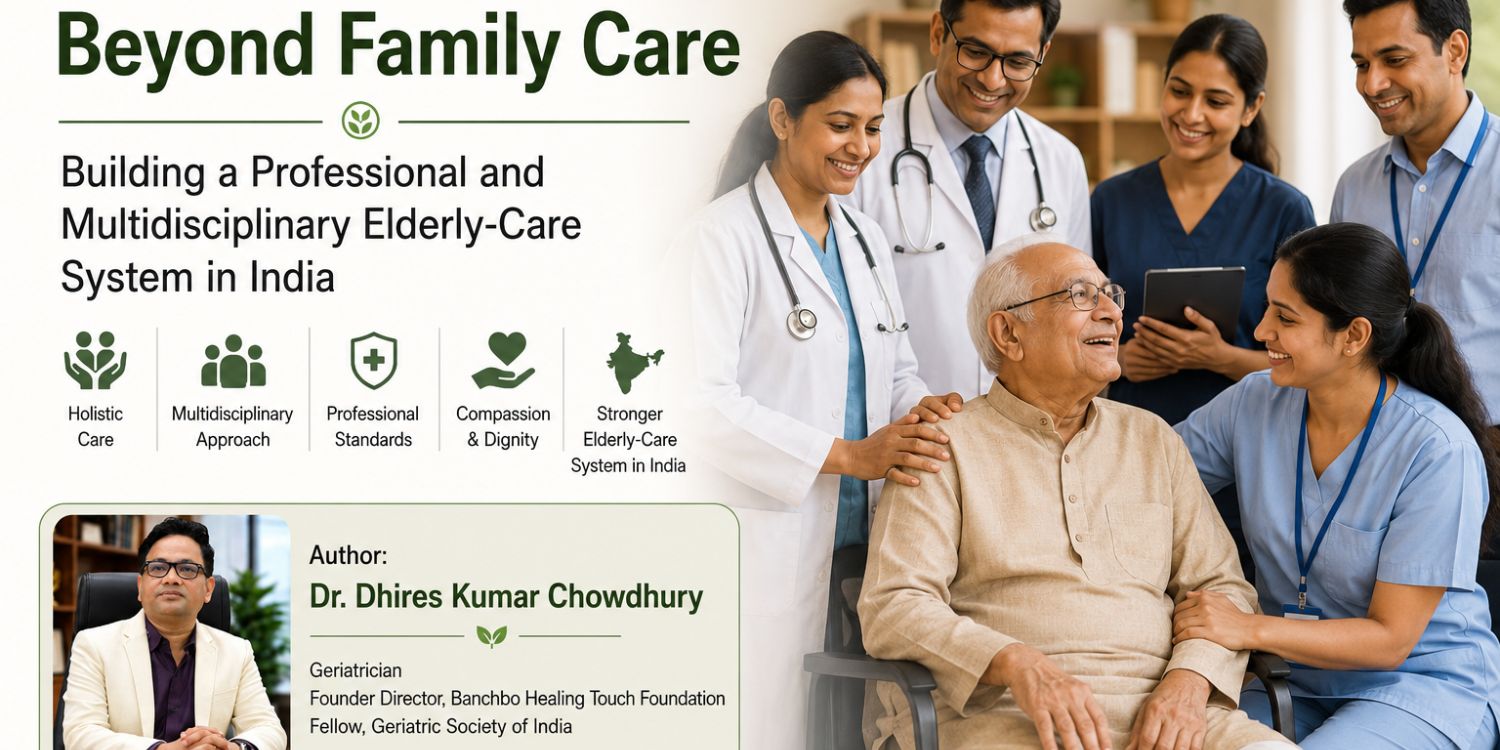
India is ageing—and ageing rapidly. But the more important question is not simply how many older people India will have in the coming decades. The real question is: who will care for them, where will that care be provided, and how can we ensure that it remains accessible, accountable, affordable and person-centred?
For generations, elderly care in India has largely been regarded as a family responsibility. The family remains, and should remain, an important pillar of support. However, smaller families, migration, urbanisation, changing employment patterns, increasing longevity and the growing prevalence of multimorbidity are making it increasingly difficult for families alone to meet the complex and long-term needs of older adults.
This does not mean replacing family care with institutional care. India needs to move towards a care continuum in which professional services complement and strengthen family caregiving.
From Family Responsibility to Shared Responsibility
Traditional family support works reasonably well when an older person remains relatively independent. The situation changes dramatically when an individual becomes frail, bedridden, mobility-restricted, cognitively impaired or dependent on others for basic activities of daily living.
Older adults living with Parkinson’s disease, stroke-related disability, dementia, Alzheimer’s disease and multiple chronic illnesses often require continuous supervision and coordinated care. Their needs may include nursing, physiotherapy, occupational therapy, nutritional guidance, psychological support, rehabilitation, caregiver assistance and regular medical monitoring.
Expecting one family member—often an untrained spouse, son, daughter or daughter-in-law—to coordinate all these requirements indefinitely is neither realistic nor sustainable.
The emerging model therefore has to be family-centred but professionally supported.
Home Is Often the Best Place for Long-Term Care
Hospitals remain indispensable for acute illness, diagnosis and specialised treatment. But they are not always the most appropriate environment for long-term geriatric care.
For many home-bound older adults, repeated hospital visits can be physically exhausting, psychologically distressing and financially burdensome. Appropriate care delivered at home can provide greater continuity while allowing professionals to understand the older person’s actual living environment, functional limitations, medication practices, family circumstances and social vulnerabilities.
My own experience of more than two decades in community geriatric and long-term care has reinforced this understanding. Since 2007, through Banchbo Healing Touch Foundation, we have been directly involved in providing comprehensive support to more than 1,900 older adults, under direct supervision rather than through a franchise-based model.
This experience has demonstrated both the enormous need and the significant gaps in India’s existing care ecosystem.
Multidisciplinary Care Must Become the Norm
Geriatric care cannot be reduced to a single doctor’s consultation.
An older person with diabetes, hypertension, arthritis, cognitive impairment and mobility problems may simultaneously require medical management, nursing care, physiotherapy, nutritional intervention, psychological support and assistance with activities of daily living.
Therefore, multidisciplinary—or, where appropriate, multispeciality—home-based geriatric care must become an integral component of India’s healthcare system.
The objective should not merely be to treat diseases, but to preserve function, independence, dignity and quality of life.
Technology can support this transformation through tele-consultation, remote monitoring, digital health records and home diagnostics. But technology cannot replace a trained caregiver’s presence, empathy, observation and human connection.
The future should therefore be technology-enabled care, not technology-replaced care.
The Caregiver Workforce: The Missing Link
One of the most urgent challenges is the shortage of adequately trained caregivers.
Caregiving for a frail or dependent older person is not simply a matter of goodwill. It requires knowledge and practical skills—including safe mobility and transfers, prevention of pressure injuries, nutrition and hydration, infection prevention, dementia-related behavioural issues, basic emergency response and medication-related precautions.
My association with the Healthcare Sector Skill Council (HSSC) as a Task Force Member for the Eastern Region, together with direct engagement in Old Age Care training through Banchbo School of Human Skill Development, has reinforced a fundamental lesson: India does not merely need more caregivers; it needs better-trained caregivers. Our educational initiatives, including collaboration with Ramakrishna Mission Vidyamandira Bose House Campus, have further highlighted the importance of systematic skill development.
There is a clear paradox: families desperately need caregivers, yet comparatively little attention is being given to creating a large, skilled and dignified professional caregiving workforce.
Policy and Regulation Cannot Wait
The growth of home-based elderly care also raises questions of regulation, quality assurance and accountability.
India needs a clearer policy framework covering training standards, competency, supervision, service delivery, documentation, safety and grievance redressal. An appropriate regulatory or coordinating mechanism, with government endorsement, could establish minimum standards while protecting older adults and their families from poorly trained or unregulated services.
At the same time, regulation must not make care prohibitively expensive.
The three essential principles should be:
Accessibility. Accountability. Affordability.
Without affordability, professional care will remain limited largely to economically privileged families. Without accountability, families cannot confidently assess quality. Without accessibility, millions of older people—particularly outside major cities—will remain excluded.
Bridging the Urban–Rural Divide
Professional home-based geriatric services remain concentrated largely in cities, while rural and semi-rural communities often face shortages of healthcare professionals, rehabilitation services, trained caregivers and emergency support.
Public–Private Partnerships (PPP) could offer a practical way forward. Government agencies, credible NGOs, healthcare organisations, training institutions and community-based organisations could jointly develop locally appropriate models of elderly care.
Such partnerships should not simply replicate urban models in rural settings. They must reflect local social structures, resources and cultural realities.
Building a Culture of Care
Long-term change will also require a change in how society perceives elderly care work.
Caregiving should be recognised as a skilled occupation, not merely as low-paid domestic assistance. Young people should be encouraged to consider geriatric care as a meaningful career, supported by appropriate training, certification, career progression and social dignity.
Age-related education should also find a place in school and higher education curricula. Understanding ageing, empathy towards older people and intergenerational relationships can gradually help create a more age-sensitive society.
A National Care Continuum
India does not need to choose between family care and professional care. It needs to build a system in which both work together.
The future of elderly care should encompass prevention, early intervention, primary healthcare, rehabilitation, home-based care, hospital care, palliative care and long-term support, connected through an organised continuum.
The demographic transition gives us little reason to postpone this conversation. We know that the number of older adults will increase, longevity will bring greater complexity of care, family structures are changing and caregiver dependency is increasing.
What remains is the collective decision to build the infrastructure, workforce and policy framework required to respond.
After more than two decades of working in community geriatric and long-term care, one conclusion is increasingly clear to me: the next major challenge in Indian healthcare is not merely adding years to life, but ensuring that those additional years can be lived with dignity, safety, independence and appropriate human support.
Professional home-based elderly care should therefore no longer be viewed as an optional or peripheral service. It is becoming an essential component of India’s healthcare and social-care architecture.
The time has come to move beyond family care—not away from family, but towards a shared, professional, multidisciplinary and accountable system of care.
Author:
Dr. Dhires Kumar Chowdhury
Geriatrician
Founder Director, Banchbo Healing Touch Foundation
Fellow, Geriatric Society of India