
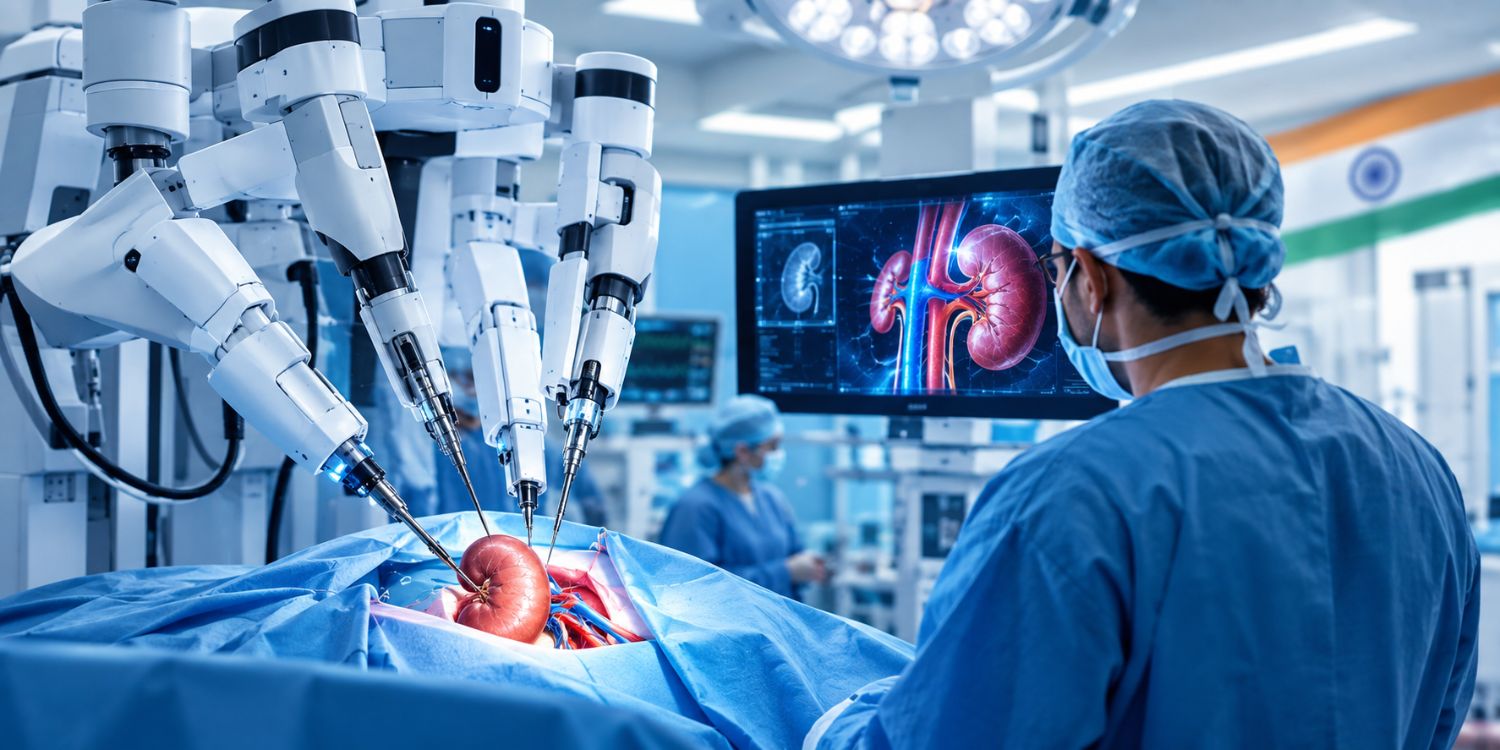
For years, robotic surgery in India was linked with premium private hospitals, advanced technology and costs few families could afford. That picture is starting to change, and kidney transplantation is one of the clearest examples.
In September 2025, surgeons at AIIMS New Delhi performed a robotic kidney transplant on a 45-year-old man with kidney failure, which the institute described as the first in a government hospital. The operation used the Da Vinci Xi robotic system and took about four hours. The donor kidney was placed through a 4-5 cm incision in the pelvis, and the robot was used to connect it to the patient’s blood vessels and bladder. His creatinine dropped to 1.2, and he went home after 10 days. AIIMS was not alone in this work. Government Medical College and Hospital, Nagpur, also reported completing a robotic kidney transplant in July 2025, free of cost.
Why robotics matters in transplantation
A conventional kidney transplant usually requires a large abdominal incision. That can mean more pain after surgery, slower mobility and a longer hospital stay. Robotic assistance gives surgeons magnified 3D vision and wristed instruments that can make fine movements in tight spaces. The benefits for patients are practical: smaller incisions, less blood loss, fewer wound complications and faster recovery. These advantages matter most for patients who are obese or have diabetes, since they face higher wound risks with open surgery and are becoming more common among transplant candidates in India.
The cost question
The most important part of this development is affordability. According to AIIMS, a robotic kidney transplant there costs around ₹25,000, compared with several lakhs in corporate hospitals. In a country where most families pay for healthcare out of pocket and a transplant can cost ₹5-15 lakh or more, that difference decides whether many patients can have this surgery at all.
The challenges ahead
Scaling up will not be simple. Robotic systems are expensive to buy and maintain, and they need specially trained teams of surgeons, anaesthetists and nurses. Studies have noted longer operating times and the need for highly skilled teams to keep these procedures safe. For most public hospitals, the bigger barrier is still the shortage of donor organs. A robot cannot fix India’s low deceased-donation rates.
That is why technology must go hand in hand with systems. Training programmes, shared regional robotic centres, stronger deceased-donor networks and continued focus on paired “swap” transplants all need to grow together. The robot is a tool; what really matters is the nephrologists, surgeons and transplant coordinators who make each transplant possible.
A signal of intent
Robotic transplants in public hospitals also send a wider message: advanced surgical care does not have to be reserved for those who can pay private-hospital prices. If government institutions can offer precision surgery at a fraction of the cost, the gap between public and private healthcare starts to close. For India’s growing number of kidney failure patients, that could be the most important change of all.