
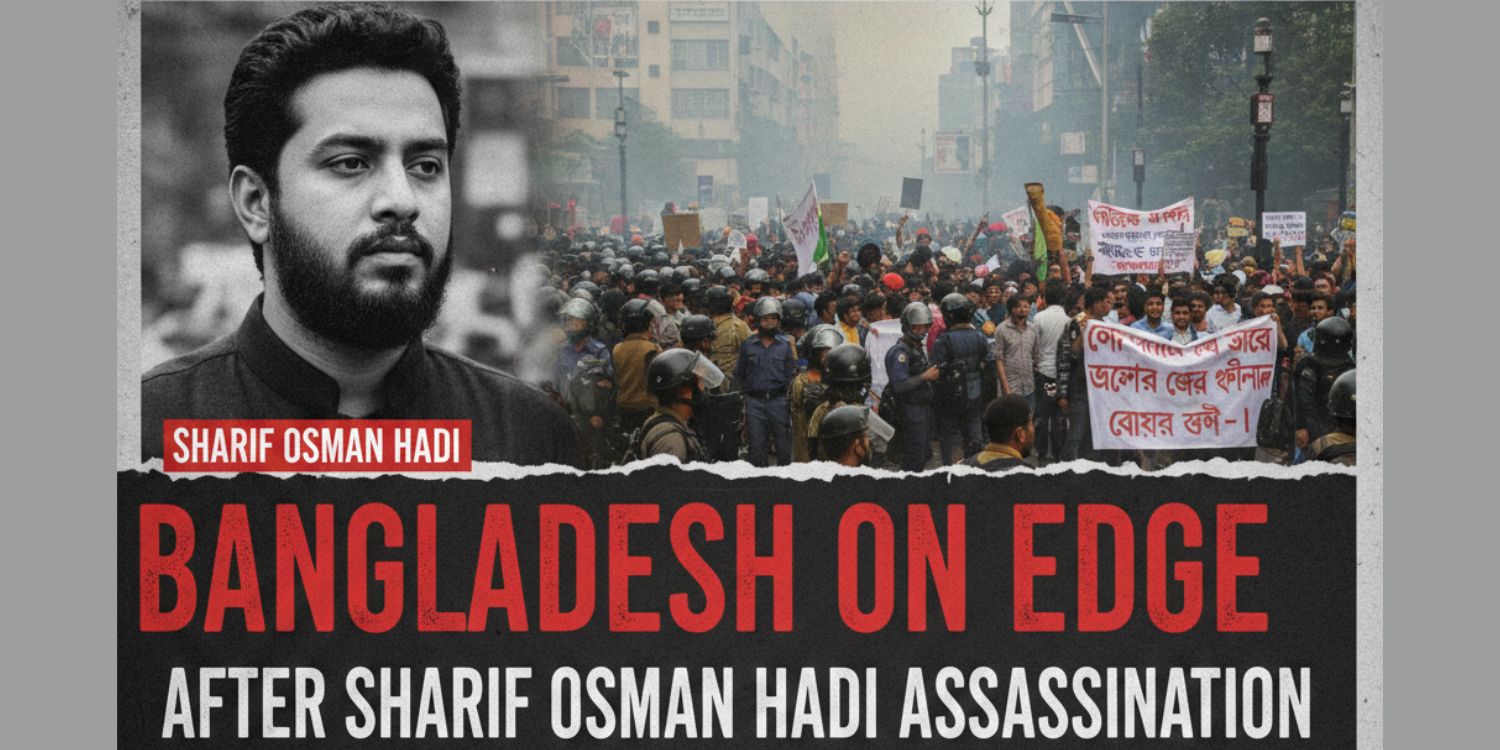
After the assasination of a prominent Youth Leader, Sharif Osman Hadi, Bangladesh struggles through widespread unrest and violent protests.
Hadi, a prominent political activist and the convener of the Inqilab Mancha movement who played a key role in the 2024 pro-democracy uprising that led to the ouster of former Prime Minister Sheikh Hasina, was campaigning for the 2026 elections as an individual candidate for the Parliamentary elections in Dhaka and was shot by unidentified killers on December 12 and succumbed to his injuries on December 18. Almost immediately, thousands of protesters took to the streets of Dhaka and other cities with sheer anger and demanding justice. The situation also escalated to the protestors chanting anti-India and anti-establishment slogans.
Why Anti-India?
A strong anti-India narrative has emerged across Bangladesh after Sharif Osman Hadi’s assassination, driven both by his political identity and the beliefs held by many of his supporters. Hadi had built his reputation partly on openly criticising what he described as Indian political hegemony and interference in Bangladesh’s internal affairs. His long-standing opposition to New Delhi’s influence made him a symbolic voice for nationalist groups, and his death has intensified those sentiments.
Following his assassination, protestors have circulated allegations and rumours that the attackers may have fled to India, and that Indian agencies could be protecting or sheltering them. These claims remain unverified but continue to spread rapidly through social media and street movements. Protestors gathered outside Indian diplomatic sites, chanting anti-India slogans and accusing New Delhi of meddling in Bangladesh’s politics. Critics understand that this anger is rooted much deeper than Hadi’s death, but also in Bangladesh’s broader political history, where suspicion over Indian influence has long been a recurring theme. For many protestors, the assassination has become proof emotionally rather than factually that India is shaping outcomes in Bangladesh and, possibly, shielding those responsible for Hadi’s killing.
The Progression of Violence
What began as demonstrations quickly escalated into violent actions, with mobs attacking and setting fire to the offices of major media outlets such as Prothom Alo and The Daily Star as a sign of protest against political bias and perceiving the media publication houses to be a part of the opposition party, the protestors set the building ablaze while trapping journalists inside and forcing both publications to suspend operations. Cultural institutions, political offices and even symbols associated with the former regime have been vandalised, prompting heavy security deployment, including in front of Indian diplomatic missions.
The unrest shows no signs of abating, continuing day by day as authorities struggle to restore order ahead of the February 2026 general elections and calls for calm and transparent investigations into Hadi’s assassination.