
Authors:
Ms. Gayatri Kovvuri and Dr. Ninad Patwardhan
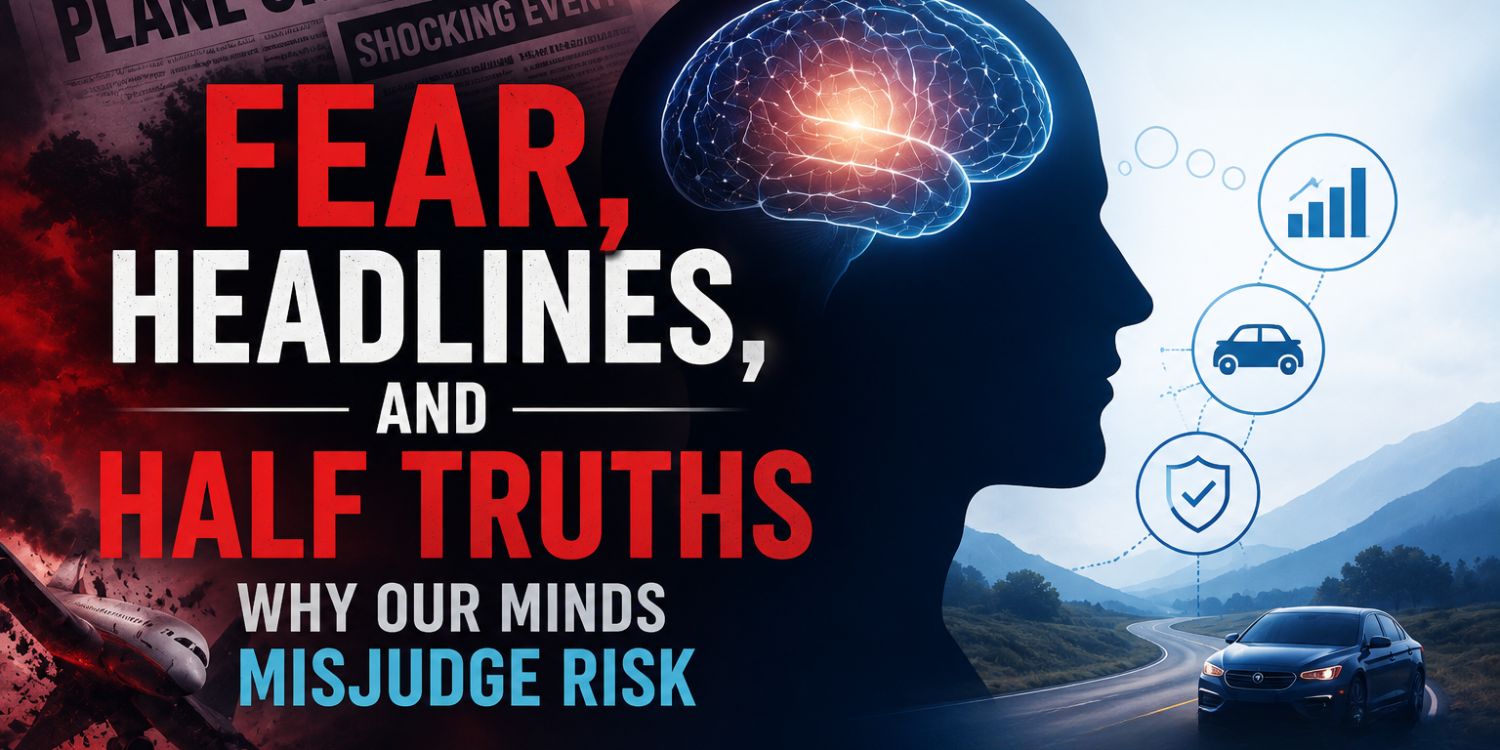
Imagine waking up to news reports shouting about an airplane crash. The videos start filling your social media feeds, TV channels play them again and again for hours, and everyone starts wondering whether it is safe to fly at all. And then ask yourself: will you still be hesitant about boarding a car the following day, knowing that driving is much more dangerous than air travel? You probably won’t, because we don’t fear danger, but rather what’s easy to imagine.
This is exactly the reason why one of the most dangerous threats we face as a society is not misinformation but how we process information inside our minds. Availability bias, introduced by Tversky and Kahneman in 1973, is a phenomenon where people tend to assess probability of events by how easy they are to remember. In today’s media driven society, availability bias is silently working behind many of our judgments and choices.
This is not a case of lack of intelligence among humans. Rather, heuristics are an integral part of our lives because it is impossible for a person’s mind to think through every piece of information. Under conditions of uncertainty and pressure, humans use mental short cuts in making instant decisions. For most part, these mental short-cuts help immensely. However, when memories replace facts, risks are no longer seen in their proper context.
The case of transportation can be illustrated in this context. The literature has demonstrated that the danger of a road trip is far greater than that of air travel when it comes to the risk of losing one’s life for every mile travelled (Sivak et al., 1991). However, many people are still more afraid of flying than travelling by car due to sensational news about plane crashes but not ordinary road accidents. In the light of the recent airplane crash of Air India Boeing 787, several news networks and social media were busy showing the visuals of the plane crash. To many people, it was enough to make flying seem very scary, although in reality the statistical probability of airplane accidents was no different than before. However, road accidents happen daily and do not get as much coverage; hence, they do not generate such worry in the public eye. The news is obviously always geared toward unusual stories since they grab more attention.
Digital media platforms have magnified this trend, with algorithms amplifying emotions such as outrage and fear in order to maximize the consumption of content. Kuran and Sunstein (1999), explained this trend using the example of availability cascades, in which frequent discussions have the ability to make questionable fears seem like genuine and common dangers irrespective of any statistics. People use “risk as feelings” as opposed to reasoning in risk evaluation (Loewenstein et al., 2001). Particularly, negative emotions lead people to view the environment as riskier compared to people with no emotions at all (Johnson & Tversky, 1983). The question is: Are our decisions based on information or are we simply afraid?
According to the affect heuristics concept, scenarios that are connected to negative emotions are automatically perceived as riskier despite any evidence to the contrary (Finucane et al., 2000). Notably, availability and affect are interdependent. Availability and affective heuristics work together, resulting in the emotional availability of an event leading to its impact on risk perception (Pachur et al., 2012). Likewise, the affective presentation of news can increase danger perception among viewers (Sjöberg and Engelberg, 2009). Essentially, the shocking experience is memorable, and memorability translates into fear.
These implications go much deeper than perception itself. Post September 11th terrorist attacks, many people opted for travel by car instead of airplanes owing to heightened fear levels. People made choices that were associated with fatalities due to the misperception of safety, which shows how dangerous such misperceptions are (Gigerenzer, 2004). The same situation occurs in stock markets when investors tend to make poor decisions based on current information rather than long term data (Lei, 2025).
On the other hand, it would be an injustice to label these tendencies as irrational. The reason behind the development of the availability bias is that it allows for effective decision making under uncertain conditions. It would not be practical for people to assess all risks with mathematical formulas before taking action. The true problem is that our environment uses such tendencies against us.
For this reason, responsibility needs to be shared. Journalists must report along with providing some context; policy makers need to be upfront about risks and not try to scare people; education systems must enhance statistical and media literacy. People must examine whether their fears arise from probabilities or repetitions.
Ultimately, the real danger might not be those disasters that are portrayed in front of our eyes but rather the unseen biases behind how we respond to such events. If humanity wants to be able to make wiser choices, it should understand that memories are no proof, emotions are not odds, and that the size of the headlines does not equate to risk.