Elon Musk is widely regarded as one of the most influential technology entrepreneurs of the 21st century. Born in South Africa in 1971, he is currently the world’s richest person, with a net worth estimated between roughly $676 billion and over $850 billion in early 2026, largely driven by his stakes in Tesla and SpaceX.
Unlike traditional billionaires who inherit wealth or focus on a single industry, Musk built his fortune by repeatedly creating companies that solve large-scale, high-risk global problems from sustainable energy to space exploration and artificial intelligence.
The Strategy Behind Musk’s Success
Musk’s success did not come from diversification alone but from a repeatable strategic formula. First, he targets industries that are stagnant but critically important to humanity; transportation, energy, space, communication, and AI. Second, he reinvests profits from earlier ventures into newer, more ambitious projects. Third, he adopts vertical integration, meaning his companies build their own core technologies rather than relying on suppliers.
Another key factor is his long-term vision. While most entrepreneurs optimize for short-term profitability, Musk designs companies around decades-long missions such as colonizing Mars, accelerating renewable energy adoption, and advancing human-machine intelligence. This mission-driven approach attracts top engineering talent and massive investor confidence.
Elon Musk’s Major Companies and Its Valuation
1. Tesla, Inc.: Tesla is the world’s most valuable EV manufacturer and a global leader in AI-driven automotive technology.
Valuation: ~ $1.4 trillion market capitalization
Share Price: Around $410–$420 (2026)
Specialization: Electric vehicles, autonomous driving, energy storage, solar products, AI robotics.
2. SpaceX (including Starlink & xAI integration): SpaceX dominates global launch services and is expected to become the most valuable private company in history.
Valuation: ~$800 billion to $1.25 trillion (post-merger estimates)
Private Share Price: About $421 per share in secondary sales
Specialization: Rocket launches, satellite internet (Starlink), space exploration, AI infrastructure.
3. xAI: xAI focuses on developing advanced AI technologies integrated across Musk’s ecosystem.
Valuation: ~$230–$250 billion
Share Price: Private company (not publicly traded)
Specialization: Artificial intelligence models, large language systems, AI research
4. X Corp (formerly Twitter): It serves as a real-time data engine powering AI training systems.
Valuation: ~$45 billion including debt
Specialization: Social media, digital communication, AI data platforms
5. Neuralink: Neuralink aims to merge human cognition with AI technology.
Valuation: ~$9–10 billion
Specialization: Brain-computer interfaces, neural implants
6. The Boring Company: It focuses on solving urban traffic through tunneling technology.
Valuation: ~$7 billion
Specialization: Underground transportation tunnels, infrastructure engineering
How Musk Built a Global Tech Empire
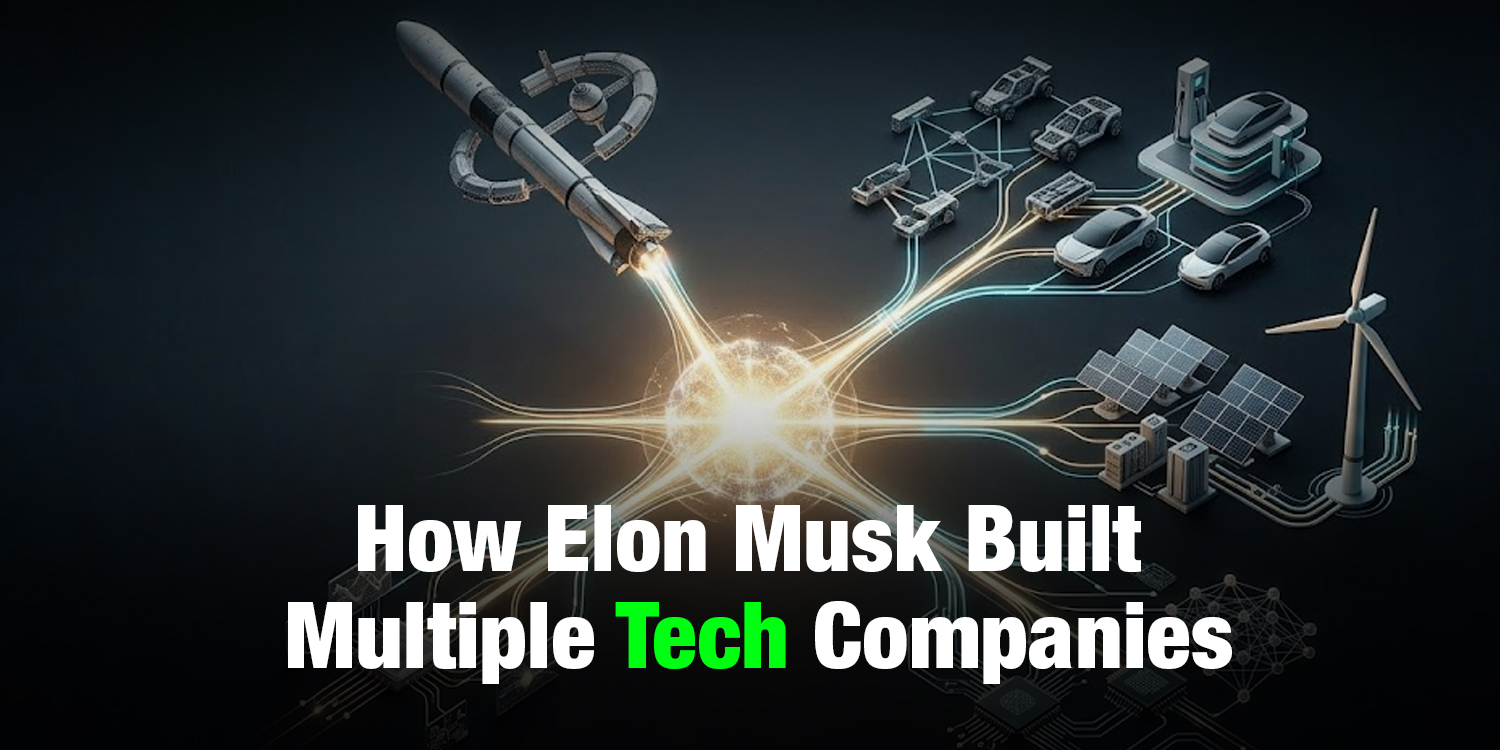
Elon Musk’s empire is not a collection of unrelated businesses but an interconnected technological ecosystem. Tesla advances AI and energy, SpaceX enables global connectivity, xAI develops intelligence systems, and X provides data infrastructure. This strategic integration creates a powerful innovation loop that continuously multiplies value.
Ultimately, Musk’s greatest strength lies in his willingness to pursue “impossible” problems with relentless execution. By combining visionary thinking, engineering depth, and calculated risk-taking, he has built one of the most influential technology empires in history, securing his place as one of the most celebrated and transformative geniuses of the modern era.