
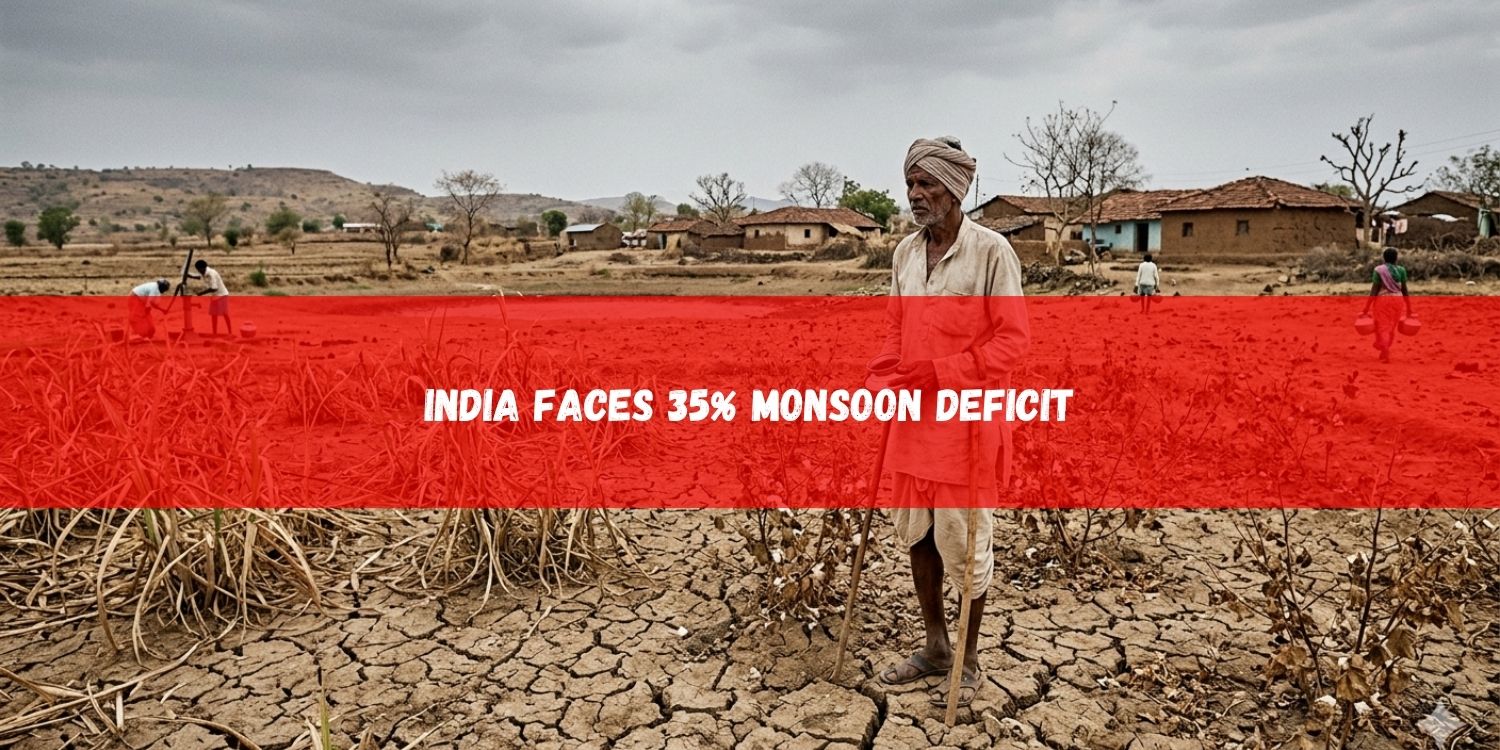
India is currently facing a 35% deficit in southwest monsoon rainfall, raising concerns over agriculture, water availability, and the broader economy as the crucial rainy season struggles to gain momentum.
The shortfall comes amid a stall in the monsoon’s northward progress, particularly over parts of Maharashtra, the Konkan coast, and central India, where rainfall has remained significantly below normal for several days.
According to meteorological assessments, the deficit is unevenly distributed across regions. While northwest India has recorded near-normal or slightly above-normal rainfall, other regions are witnessing sharp shortages, including central India (–63%), eastern and northeastern India (–43%), and the southern peninsula (–14%).
The delayed advance of the monsoon, already behind its typical schedule, has intensified concerns around delayed sowing of key kharif crops such as rice, pulses, and oilseeds, which are heavily dependent on timely rainfall. Broader economic implications are also being closely watched, given the monsoon’s central role in supporting rural livelihoods and food supply chains.
Weather experts attribute the weak progression to unfavourable atmospheric conditions, including disruptions in typical monsoon patterns and the emerging influence of El Niño, which is historically associated with suppressed rainfall over India.
The coming weeks, particularly early July, are expected to be critical in determining whether the monsoon can recover and narrow the deficit. A continued shortfall could have cascading effects on agricultural output, inflation, and overall economic stability.