
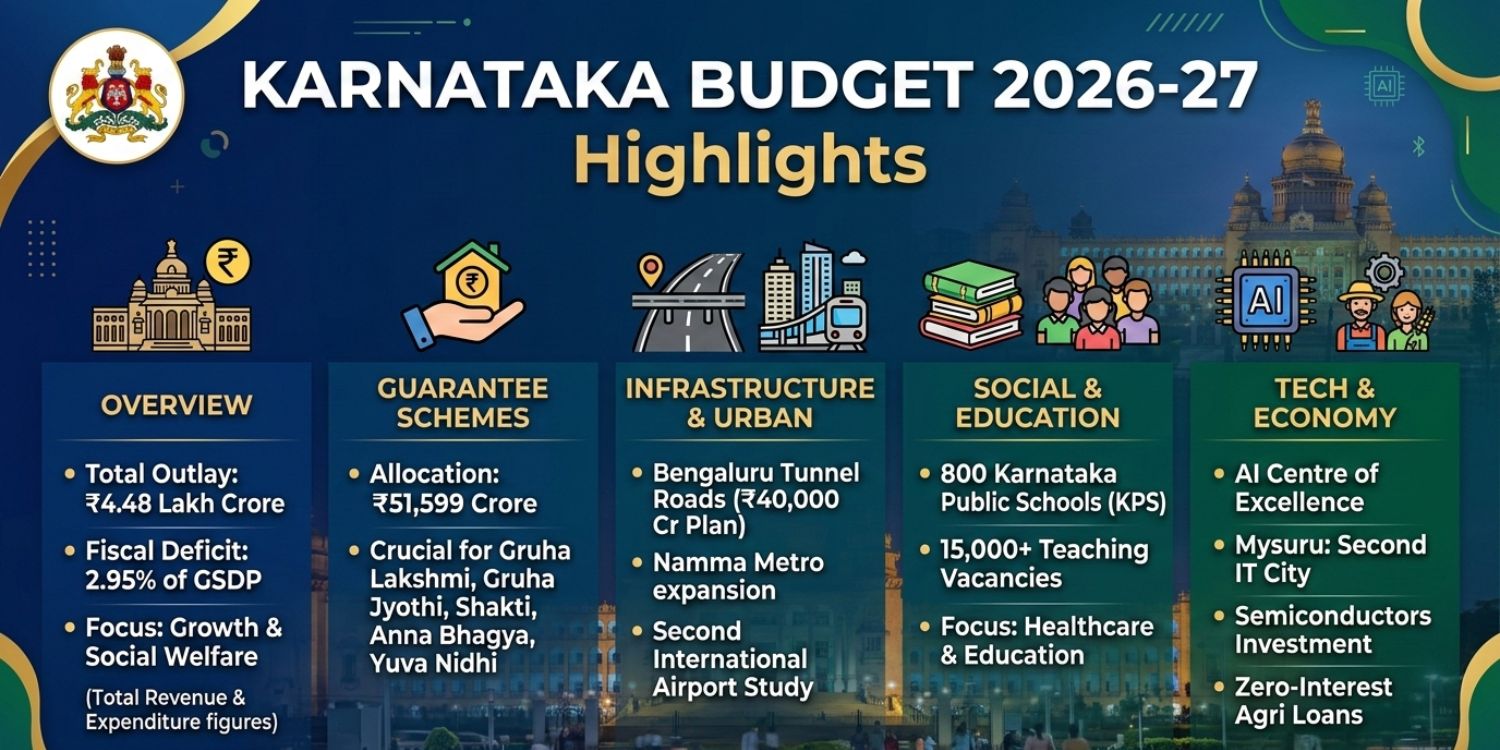
The Karnataka government, led by Chief Minister Siddaramaiah, has presented its Budget for the financial year 2026-27 with a strong focus on economic growth, infrastructure expansion, and welfare commitments. The budget outlines the state’s strategy to sustain high growth while addressing regional development and social welfare priorities.
One of the key economic highlights is Karnataka’s projected Gross State Domestic Product (GSDP) growth of 8.1%, exceeding the national growth estimate of about 7.4%. The state economy is estimated to reach ₹17.2 lakh crore at constant prices, supported by strong performance across sectors including agriculture, manufacturing, and services.
The budget also signals an ambitious fiscal strategy, with the state targeting ₹2.2 lakh crore in revenue for FY 2026-27, representing a 13.5% increase over the revised estimate of ₹1.94 lakh crore for 2025–26. However, the government has not proposed new taxes, raising questions among analysts on whether increased consumption or future revisions may be required to meet the target.
Push for Technology and Regional Development
A major announcement in the budget is the government’s plan to develop Mysuru as Karnataka’s second major IT hub, a move aimed at reducing pressure on Bengaluru while expanding the state’s technology ecosystem. Mysuru already hosts over 30,000 IT professionals across nearly 100 companies, and further investments in technology infrastructure and aerospace manufacturing are expected to accelerate regional economic growth.
In addition to IT expansion, the budget includes investments in healthcare and tourism infrastructure in Mysuru, including the upgrade of the Sri Jayadeva Institute of Cardiovascular Sciences to a 600-bed facility costing ₹180 crore.
Social Welfare and Public Infrastructure
The state continues to prioritise welfare initiatives. A record ₹44,632 crore allocation has been earmarked for Scheduled Caste and Scheduled Tribe welfare programmes, covering education, housing, and economic support schemes.
The transport sector also received significant attention, with ₹5,300 crore allocated to the Shakti scheme, which provides free bus travel for women. The government also plans to introduce 5,000 new buses, including 4,000 electric buses, as part of its public transport expansion strategy.
In education, the state announced plans to fill 15,000 teaching posts and upgrade 800 Karnataka Public Schools, signalling a push to strengthen public education infrastructure.
Law Enforcement and Public Safety
The budget also proposes the establishment of an Anti-Narcotics Task Force with an allocation of ₹10 crore, aimed at tackling rising drug trafficking concerns in cities like Bengaluru. Approximately 6,000 drug-related cases are registered annually in the state, highlighting the urgency of stronger enforcement.
Political and Fiscal Debate
Despite the wide-ranging initiatives, the budget has faced criticism from opposition leaders who argue that it is increasingly “debt-driven” and lacks a clear roadmap for repayment, underscoring the ongoing debate around fiscal sustainability.
Outlook
Overall, Karnataka’s 2026-27 budget reflects a balancing act between economic expansion, welfare spending, and regional development. With ambitious revenue targets and a renewed push for technology and infrastructure, the state aims to consolidate its position as one of India’s leading economic and innovation hubs.