
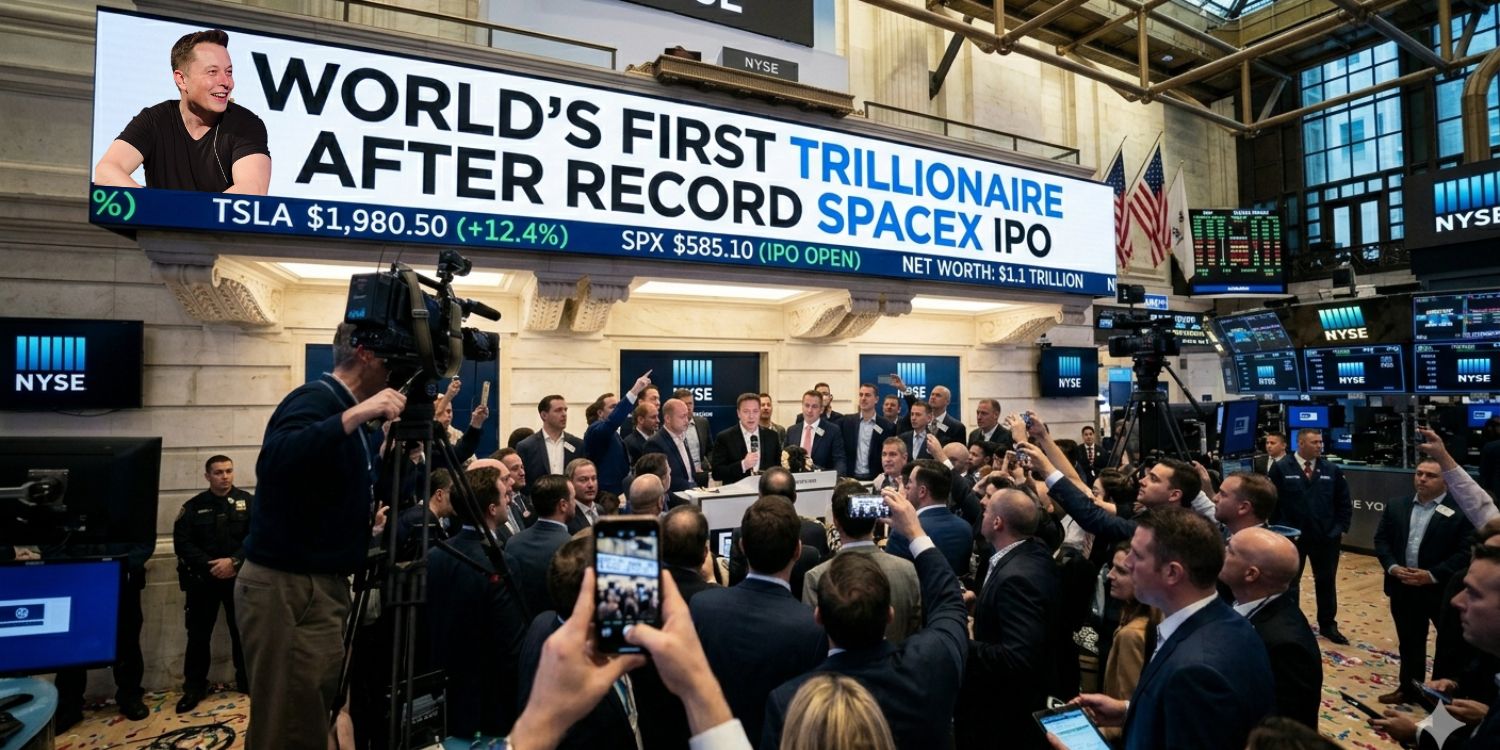
Elon Musk has become the world’s first trillionaire following the blockbuster initial public offering (IPO) of SpaceX, marking a historic moment in global financial markets.
The rocket and satellite company raised a record $75 billion through its public listing, with shares priced at $135 each, valuing SpaceX at approximately $1.7–1.8 trillion, the largest IPO in history.
The surge in valuation has propelled Musk’s net worth beyond $1 trillion, with a substantial portion, estimated at over $800 billion, linked to his stake in SpaceX.
The listing reflects strong investor confidence in SpaceX’s expanding footprint across multiple sectors, including space transportation, satellite internet through Starlink, and artificial intelligence ventures. Analysts have described this phenomenon as an “Elon premium,” where Musk’s track record and ambitious vision continue to drive elevated valuations.
SpaceX’s IPO has also rewritten traditional market norms. The company set its share price ahead of the investor roadshow and allocated a notable portion of shares to retail investors, while maintaining Musk’s controlling stake through a governance structure that ensures long-term strategic control.
Despite the milestone, concerns remain among some analysts regarding the company’s high valuation and recent financial performance, including reported losses tied to its expansion into AI and other capital-intensive projects.
The listing is widely seen as a turning point not only for SpaceX but also for the broader technology and aerospace sectors, potentially reshaping how large-scale, innovation-driven companies access public markets.