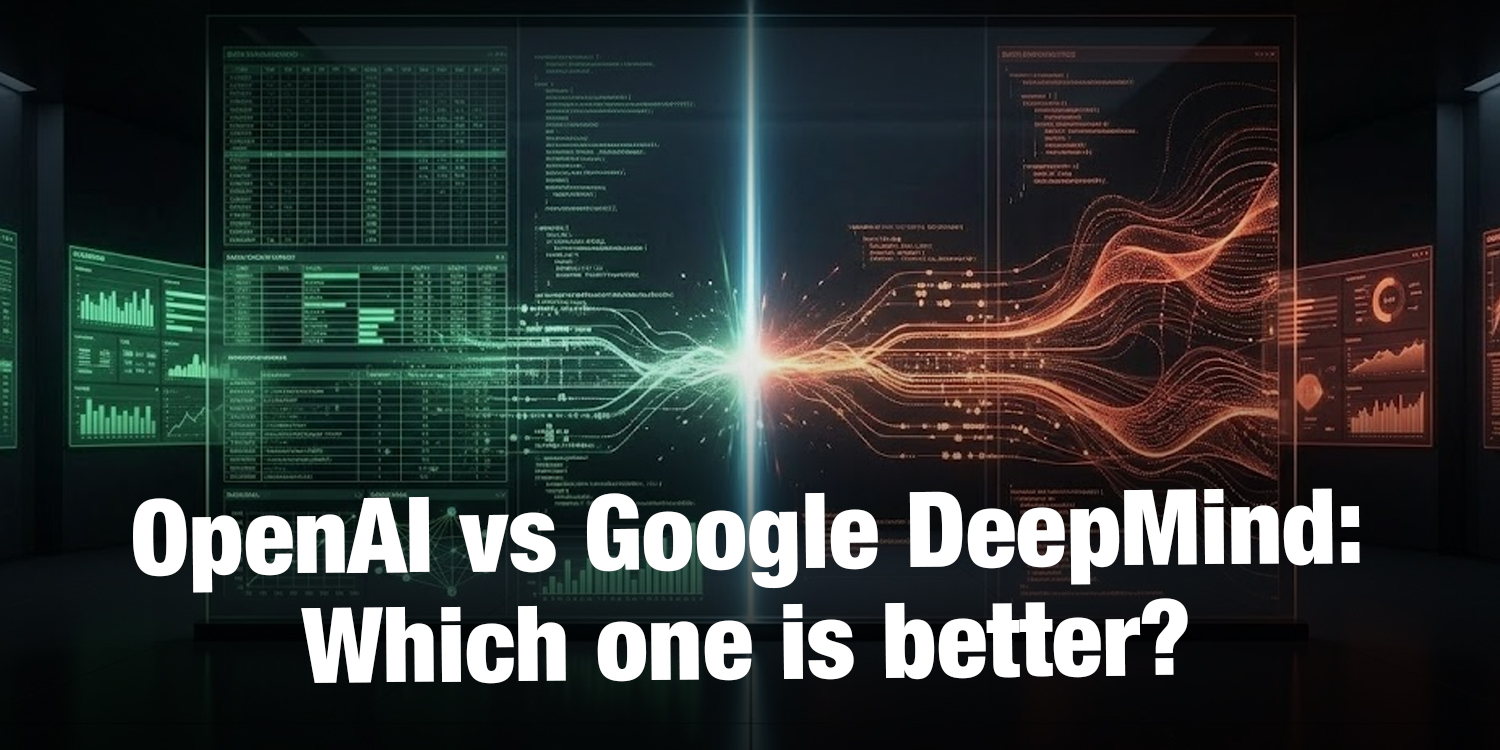
The global artificial intelligence race today is defined by two dominant forces: OpenAI and Google DeepMind. From powering generative chatbots to solving advanced scientific problems, both organizations are shaping the future of AI, but they do so with very different philosophies, strengths, and technological advantages.
Meet the Architects of Modern AI Innovation
OpenAI, founded in 2015, focuses on building general-purpose AI systems that are widely accessible to businesses, developers, and consumers. Its GPT family of models has become synonymous with conversational AI and enterprise AI deployment.
Google DeepMind, formed through the merger of DeepMind and Google Brain, prioritizes cutting-edge research and deeply integrated AI systems embedded across Google’s ecosystem from search to cloud infrastructure.
Both companies sit at the forefront of the AI revolution, where over 80% of enterprises now use or plan to adopt AI assistants for operational tasks.
Latest Models and Key Features
OpenAI: GPT-4.1 and Successor Models
OpenAI’s flagship GPT-4.1 introduced major improvements in coding, reasoning, and long-context comprehension. It can process up to 1 million tokens of context, enabling it to analyze vast datasets simultaneously.
The model also shows about 21% improvement in coding performance compared to earlier versions.
OpenAI’s strength lies in structured reasoning, instruction following, and human-like conversation quality.
Google DeepMind: Gemini 3.x and 2.5 Pro
Google’s Gemini models emphasize native multimodal capability; meaning they process text, images, audio, and video seamlessly.
Gemini 2.5 Pro also supports a 1-million-token context window, with expansion toward 2 million tokens planned.
Recent updates like Gemini 3.1 Pro focus on improved reasoning and multi-step problem solving.
Strengths: Where Each Excels
OpenAI advantages:
- Superior creative writing and conversational quality
- Strong coding and instruction accuracy
- Extensive developer ecosystem and APIs
Google DeepMind advantages:
- Native multimodal processing
- Real-time data integration
- Deep integration with Google services
Performance Differences
In benchmark studies, Gemini demonstrated higher citation accuracy and correctness than GPT-4 in some research contexts.
However, GPT models typically perform better in common-sense reasoning and structured problem solving.
Which Is Better for What Work?
- Content creation & writing: OpenAI leads
- Software development: Both strong, Gemini slightly ahead in some coding benchmarks
- Multimedia workflows: Gemini dominates
- Enterprise automation: OpenAI widely preferred
- Real-time search & analytics: Google excels
Industry Applications Across Fields
Both systems are transforming sectors:
- Healthcare: diagnostics and research analysis
- Finance: predictive analytics and fraud detection
- Education: tutoring and automated evaluation
- Media: content generation and editing
The Verdict: Innovation Over Rivalry
The OpenAI vs Google DeepMind debate ultimately depends on the use case. OpenAI leads in usability, conversational intelligence, and developer adoption, while Google DeepMind excels in multimodal capabilities and ecosystem integration.
As AI evolves rapidly, the true winner may not be one company, but the accelerating innovation created by their competition.