
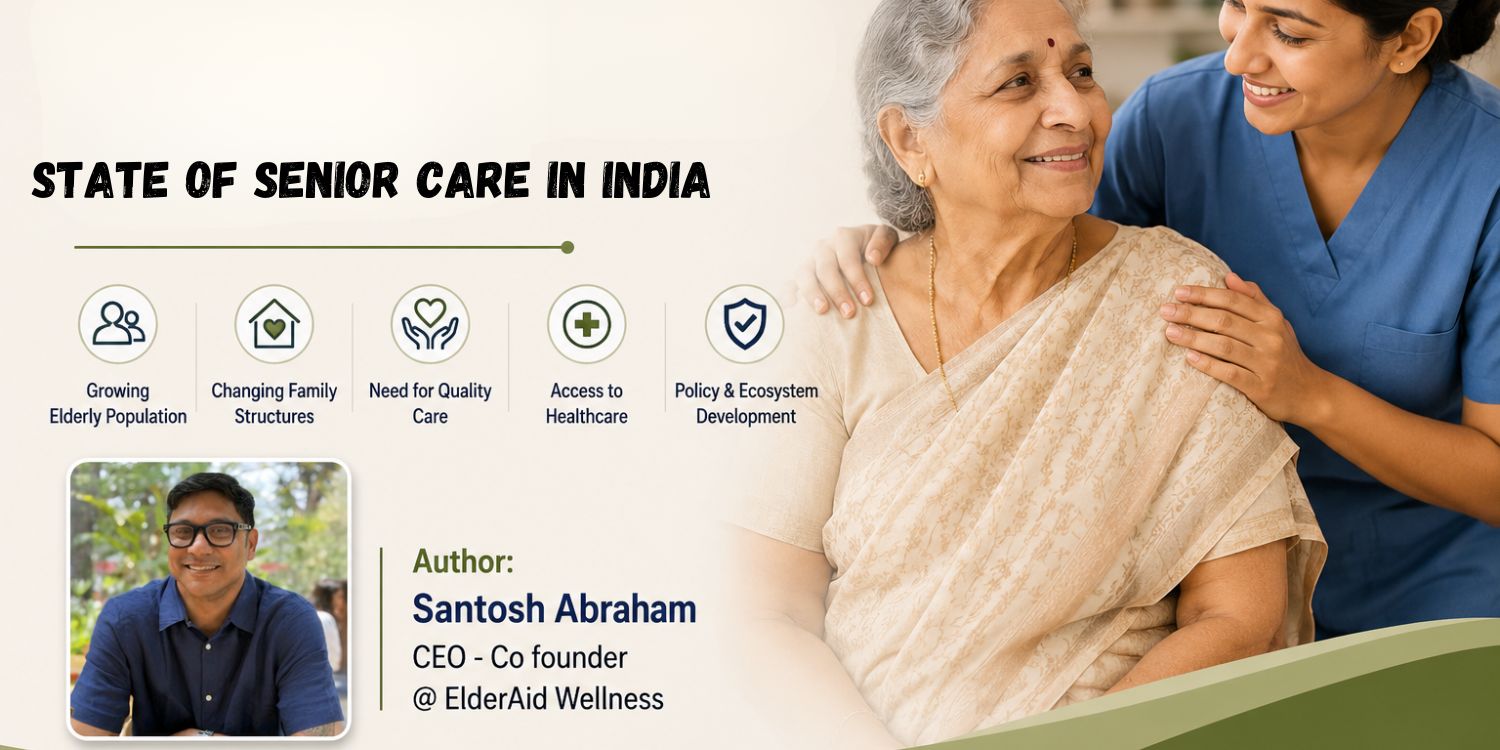
A NITI Aayog report of 2024 on the State of Senior Care in India estimated the sector at $7 billion, expanding rapidly over the prior five years, with the elder-care sector described as entering a growth phase. The market focus is shifting from institutional care toward in-home care as professional home-care services become more organised. Metros like Mumbai, Delhi, and Bengaluru dominate due to better infrastructure and disposable income, Coimbatore is also a big market for assisted living facilities. From govt policy perspective, the Union Budget introduced in February 2026 put special focus on elderly care, including a plan to train 1.5 lakh caregivers — separately described as a plan to train 1,00,000 allied professionals over five years plus a caregiver programme for over 1.5 lakh multi-skilled caregivers. NABH and the Ministry of Social Justice and Empowerment have introduced Accreditation Standards for Care Homes. The challenges faced by the sector is multi fold, no 1 being Caregiver shortage – the sector’s most-cited bottleneck. Building and retaining a workforce that can provide consistent, empathetic and continues care, since elder care is relationship-driven and training at scale takes time and effort. No 2. Affordability – 75% of seniors lack pension cover and inpatient out-of-pocket spending remains high, making eldercare an expensive proposition. No 3. Stigma and trust – most families still view professional eldercare with skepticism, preferring traditional family-based care despite its practical limits etc
The Elder care sector saw the technology adoption surge post covid
Telemedicine has become a key tool for seniors with mobility issues or chronic conditions, letting them consult doctors from home instead of making frequent, strenuous hospital trips. However, adoption is mostly in urban areas and depends on the older adult’s ability to use the app or having children assist them.Wearables and remote patient monitoring (RPM) — Smartwatches and similar devices now track vitals like heart rate, blood pressure and oxygen levels, and many include fall-detection sensors that automatically alert caregivers or emergency services. There are also devices that helps the family to track dementia/alzhaimers patients available in the market. Now we have camera’s with sensors that can detect falls, AI based products that assess gait and predict potential falls, IoT and AI enabled smart home systems can automate lighting, temprature control, emergency response etc to make safer living conditions. We also have automated pill boxes, devices that can do multiple health checks etc Currently the Tech play is mostly in the diagnostic and monitoring side of care and limited to premium segment, we need to have these tech and products more accessable to make the market grow exponentially.
Here are my thoughts on the pros and cons of family caregiving versus professional caregiving
For a family caregiver, there is a strong emotional connection and personalisation which helps in creating trust and communication. Family members often already know routines, preferences, and medical history without needing an onboarding period. This works best in a joint family system or where there is a person who is available dedicated for the caregiving or multiple persons manage the family members on a rotation basis.Family caregivers do it with a sense of purpose and meaning with full heart and it’s definitely more cost effective. Studies have found family caregivers,often women report poor health and tiredness from increased caregiving stress, and juggling work and caregiving strains both the caregiver’s and the elder’s quality of life. While professional caregivers bring in more expertise in cases of critical illness, family caregivers wont be able to do much; a professional caregiver ( nurse ) will be in a much better position to handle such cases. Pro care helps the family maintain continuity and provides assistance with procedures like ECG/Echo, catheterization, or IV injections. The flip side is a pro caregiver may not be able to understand the nuances,, patients comfort levels and family dynamics to hit the ground running. The cost for a pro care can be very expensive, depending on the required care, and in most cases, it’s an out-of-pocket expense not covered by inssurance. Pro care will be more proactive and in a better position to anticipate next steps while family caregivers are mostly reactive which is not good for the patient in the long run.
Author:
Santosh Abraham
CEO – Co founder @ ElderAid Wellness