
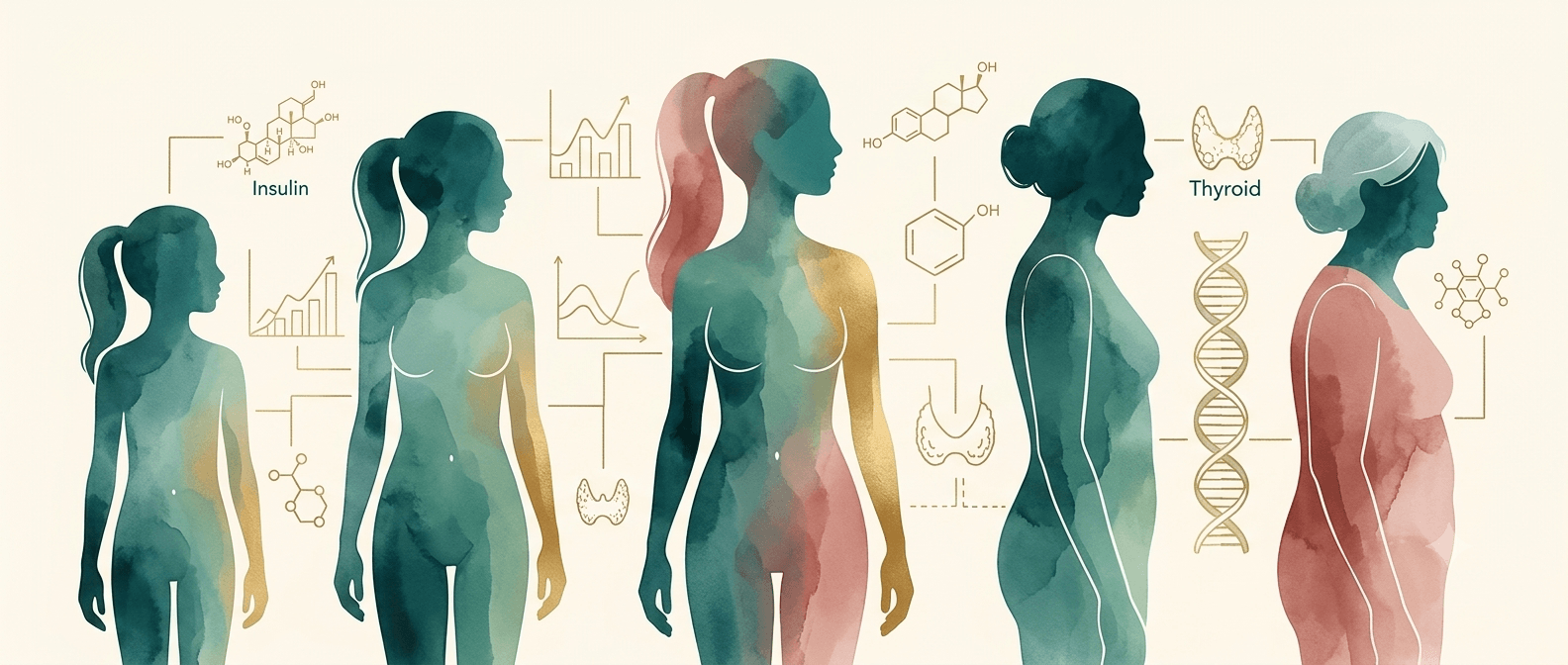

A lady walked into my clinic recently, at perimenopausal age, with bleeding issues. She had been diagnosed with diabetes and high blood pressure in the previous month. Her lipids in the blood tests were not in a good range. She was having hot flashes. She looked at me and said, “Doctor, you remember me, I don’t understand what is happening.?”
I had delivered her daughter in this same clinic, when she was thirty. A large-for-gestational-age infant — we had to do a caesarean. A nice four-kilo baby girl. I looked past her, at the young girl standing beside her. Fifteen, maybe sixteen. The daughter smiled at me. I smiled back but with something uncomfortable within me. We spoke for a few minutes, and they left. But she stayed in my mind long after.
This lady had not seen me since then. Not after the delivery, not after the gestational diabetes, not after the large baby — she was lost to follow-up like most mothers do. She was busy with her life. She never needed a doctor, and she was surely glad of that. Now, during the perimenopausal transition, it had all caught up with her at once. And her daughter — in her teens, seemed like a high BMI, showing signs of PMOS with darkening of the neck skin— was already at risk, standing at the start of the very same road.
It kept me thinking: What happens when follow-up is lost?
It has been my routine practice to call mothers back at six weeks, for postpartum tracking of blood pressure and blood sugars. But post-delivery it is not taken as seriously as it should by most women and families in India.
The body does whisper before the storm. And it is in our hands to be responsible for hearing it in time. Barker’s theory on Fetal origin of Adult disease has described this sequence. A young mother who develops gestational diabetes, delivers a baby who is large for gestation. That baby girl likely grows up carrying the same predisposition — often dismissed as simply a “family pattern,” a heavy build that runs in the family, rather than recognised as a red flag. She reaches adolescence overweight, with signs of PMOS. And unless this cycle is interrupted by intervention somewhere, she will likely become the next mother in this same story, in the coming years. The intrauterine exposures in addition to the genetic, behavioural and social factors influence the cardiometabolic health of the daughter adversely.
This vicious circle needs to be broken! And that was what has kept me thinking, “These factors may increase the risk, but Timely intervention can change the trajectory of the child’s future.”
In May 2026, Polycystic ovarian syndrome has been renamed PMOS i.e. Polyendocrine metabolic ovarian syndrome. It expands the view of looking at these girls from a wider angle — not only as an ovarian problem, but as a whole-body metabolic and endocrine one. Metabolic meaning affecting the Lipids, sugars, blood pressure, weight, liver function and predisposes these women to increased cardiovascular risks like ischemic heart disease and stroke in their life course.
The prevalence of PMOS in India is already high — around 1 in 5 girls. Clinicians are seeing girls with irregular periods and signs of hyperandrogenism: excess androgen hormones showing up as hair loss, hirsutism (unwanted hair growth), acne, and acanthosis (darkened, thickened skin, often at the neck). Their lifestyle compounds it — globalisation, competition, stress, social media in the form of increased screen time, late-night use, cyberbullying, body-image distress, reduced physical activity, and exposure to misinformation, alongside increasingly poor sleep hygiene. Add to that shifting dietary habits and environmental triggers, where distorted nutrition is becoming the norm.
Mental health issues and loneliness are also growing in concerning numbers among teens and young adults, compounding everything above rather than standing apart from it.
There is a bone health cost too, one that rarely gets discussed. Close to 95 percent of a woman’s peak bone mass is already built by the time she turns 18–20 — yet how many teenagers or young adults are giving that any real thought? Without meaning to, we may be creating a generation of women who carry poor bone health, disturbed lipids, and elevated blood sugar into their forties — the fractures, the back pain, the muscle pain, and the cardiovascular issues we are already seeing far too early.
Then, when these same girls reach the stage where they want to conceive, without any preconception counselling or correction along the way, they carry this same loop into the next generation.
It is, in effect, a complete recipe: genetic predisposition, poor intrauterine programming, and no dedicated follow-up through adolescence to reduce risk and improve health. And if that recipe goes wrong and isn’t corrected in time, we have, in a real sense, missed a window of opportunity.
Menopause – the other end of the spectrum that is relatively ignored
The world now has a huge population entering menopause, set to spend more than one-third of their life in this phase. It is not only about periods stopping. It is mental health, bone health, genitourinary health, and sexual health, all together — with again a poor health network support system and poor awareness and sensitivity towards their care.
The action window
A missed follow-up opportunity is not a missed lifetime opportunity.
The human body is remarkably responsive to correction at every stage — risk can be modified through nutrition, physical activity, sleep, psychological support, and evidence-based medical care, at any point in a woman’s life. The same vigilance that’s needed in adolescence holds true in the perimenopausal period and beyond, but catching it young goes the furthest.
Adolescent health is not only acne, period problems, or height and looks — it is bone health and mental health as much as anything else, and it deserves to be treated that way. That means a multidisciplinary, protocol-based approach to care and follow-up, given the same seriousness we already give any other developmental milestone, nutrition, or immunisation.
An ideal continuum of care would run from adolescence, through pregnancy, and into menopause — with, inside that continuum, a dedicated vertical specifically for adolescents.
This needs real awareness among families, parents, educational institutions, and policymakers, treating metabolic and endocrine health seriously enough to place teens and young adults into a standing category of inclusive care.
Thought for research
Clinicians are observing more presentations and diagnoses related to fibroids and endometriosis in younger girls although the extent to which this reflects a true rise in incidence versus improved recognition remains an important research question.
We need research into this too — not only better diagnostics, but genuine Indian data to understand why we are facing what is, quite simply, a silent epidemic of metabolic and endocrine issues. And this is not only about girls. It runs through families, which further emphasises that it deserves a serious, sustained outlook.
The wave of action
There is a need for a nationwide framework and I would be more than willing to contribute to build this kind of a clinic-based model as a pilot, evaluated for feasibility, equity, clinical outcomes and cost-effectiveness. A venture in a sense directed to breaking a metabolic and endocrine cycle that doesn’t stop with one woman, but moves through her family and, eventually, through the population as a whole.
The aim is not to label every girl or predict every woman’s future. It is to identify risk early, support families and create systems that remain available after pregnancy, during adolescence and through midlife.
India has the largest adolescent and young population in the world. If this wave has to start somewhere, I don’t see where it could start better than here.