
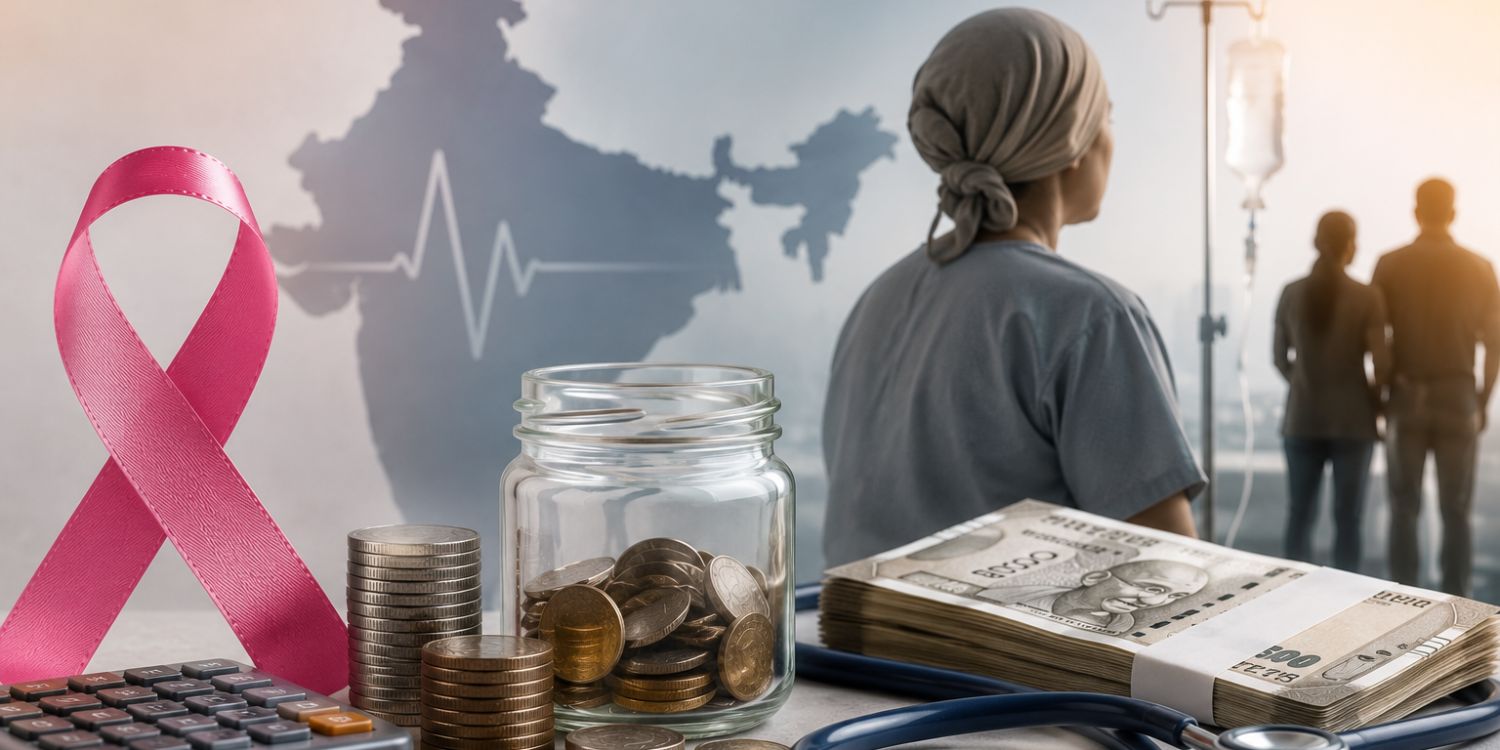
A cancer diagnosis in India rarely stays a medical event for long. For most families, it quickly becomes a financial one too. Depending on the type and stage of cancer, total treatment costs in 2026 typically range from about 2.5 lakh rupees to more than 20 lakh rupees. Advanced cases involving newer therapies can cross 30 lakh rupees.
Why the Bill Grows So Fast
Cancer treatment is rarely a single expense. It stretches across surgery, chemotherapy, radiation, diagnostics, and long follow-up care, often over many months. A single PET-CT scan, needed for staging and planning, costs between 15,000 and 30,000 rupees on its own. Newer options add further strain. CAR-T cell therapy costs 30 to 50 lakh rupees in India. That is still far cheaper than the 3 to 4 crore rupees it costs abroad, but it remains out of reach for most households.
Non-medical costs add up too. Cancer centers are unevenly spread across the country, so many patients travel long distances and pay for lodging near hospitals. Caregivers often give up income to stay with patients. None of this shows up in a hospital bill, but it shows up in a family’s finances.
Who Actually Pays
India’s healthcare system leans heavily on out-of-pocket spending. Roughly 49% of total health expenditure in the country is paid directly by patients, not by insurance or the government. For cancer specifically, monthly out-of-pocket spending on inpatient and outpatient care has been estimated at 37% and 49% of a household’s monthly consumption spending. Government health spending sits at around 1% of GDP. Economists have estimated that raising it to 3% could cut out-of-pocket expenses by close to 30%.
The consequences are well documented. More than three-quarters of Indian households with a cancer patient face what researchers call catastrophic health expenditure, meaning treatment costs consume a large share of household income. Close to 44% of families end up borrowing money or selling assets to pay for care. In some regional studies, that figure runs even higher, with well over 60% of patients pushed into catastrophic spending.
What Insurance Covers, and What It Doesn’t
Government schemes have expanded access on paper. Ayushman Bharat PM-JAY offers coverage up to 5 lakh rupees at empanelled hospitals and now reaches over 50 crore people. But insurers themselves acknowledge the gap. Recent claims data suggests a health cover of at least 15 to 25 lakh rupees is increasingly necessary for advanced-stage cancer, well above what most policies or PM-JAY provide. Coverage caps often fall short for newer treatments like immunotherapy, leaving patients to cover the difference themselves.
Cancer type also affects financial exposure. Claims data shows meaningful cost variation across breast, oral, cervical, prostate, and blood cancers, with pancreatic and liver cancers among the most expensive to treat.
A Budget Line, Not Just a Health Line
The Union Budget 2026 renewed its focus on making cancer care more affordable, a sign that policymakers see this as more than a hospital problem. For now, though, the arithmetic remains difficult. Treatment can run for months, insurance often falls short, and public health spending remains thin. For most Indian families, surviving cancer and staying financially afloat have become two separate battles, fought at the same time.