
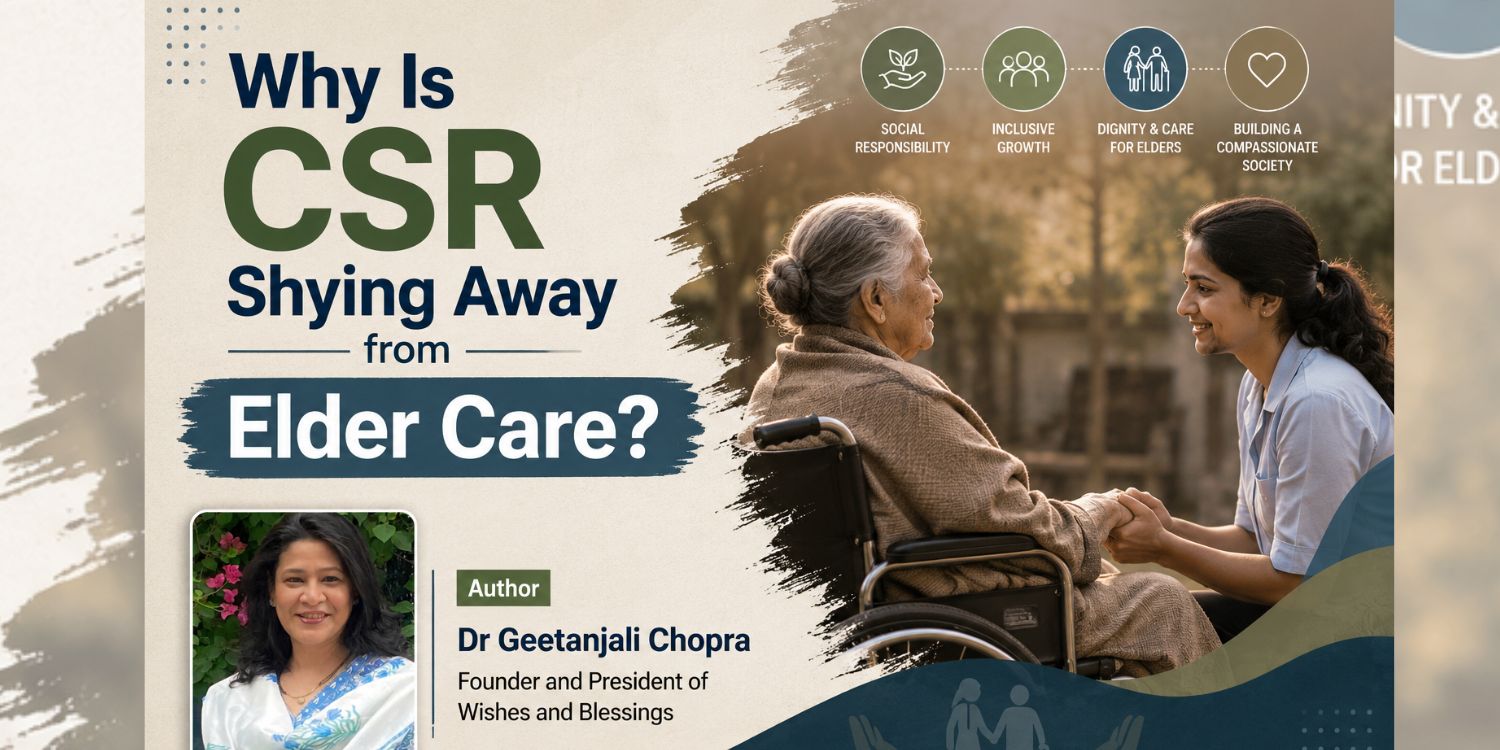
India stands on the precipice of a silent demographic transition. The nation is ageing at an unprecedented pace, currently home to nearly 153 million senior citizens—a figure projected to double by 2050, the country is set to house the world’s largest elderly population in the upcoming decades. Yet, as the numbers swell, so do the fractures in our social fabric, cases of elder abuse, neglect, abandonment and social isolation are steadily increasing, reflecting the growing vulnerabilities faced by older persons across the country. The demand for institutional and community-based support has never been greater. Yet despite this demographic shift and the urgent need, the sector receives barely 0.3 per cent of total Corporate Social Responsibility (CSR) expenditure, even though it has been recognised as an eligible activity under Schedule VII of the Companies Act, 2013 since its inception. As India’s social priorities evolve, an important question deserves attention: why is one of the country’s fastest-growing social challenge receiving so little corporate support?
Why Elder Care Remains on the Margins of CSR
The limited CSR investment in elderly welfare is not necessarily a reflection of a lack of corporate concern. Rather, it stems from the way CSR programmes are designed, evaluated and communicated.
One of the primary reasons lies in the increasing emphasis on measurable outcomes. Modern CSR frameworks place considerable importance on quantifiable impact. Education programmes can report the number of children enrolled, healthcare initiatives can measure patients treated, and livelihood projects can count individuals trained or employed. Elder care, however, often focuses on outcomes such as improved dignity, emotional well-being, reduced loneliness and better quality of life. These are meaningful indicators, but they are far more difficult to measure and standardise at scale.
A second challenge lies in the fragmented nature of elder care itself. Unlike sectors such as education or healthcare, where standardised reporting indicators have gradually evolved, elderly welfare spans healthcare, nutrition, mental health, assisted living and community engagement. The absence of widely accepted reporting frameworks often makes it difficult for companies to compare programmes or demonstrate impact with the same level of confidence as other CSR interventions.
Competition from other highly visible social causes further reinforces this imbalance. CSR investments naturally gravitate towards programmes that offer high visibility and easily communicable results. Education, healthcare, environmental sustainability and rural development generate measurable outcomes and compelling narratives for annual reports and sustainability disclosures. Elder care, by contrast, is centred on continuous support rather than one-time interventions. As a result, despite the growing need, it often struggles to compete for corporate attention and funding.
Do these facts make elder care less deserving?
The answer is a clear no.
India’s changing demographics make elder care more urgent than ever before. Every year, the demand for long-term care, assisted living, healthcare services and emotional support continues to grow. Yet organisations working in this sector often operate with limited financial resources.
This imbalance also reflects a broader misunderstanding of development itself. Development cannot be measured solely by the opportunities created for younger generations. It must also be reflected in how a society cares for those who have spent decades contributing to its progress.
A society that measures progress only by the opportunities it creates for its young, while overlooking the well-being of its elderly, leaves its values behind in the race of development.
The Way Forward: Bringing Elder Care into the CSR Mainstream
As India moves towards becoming an ageing society, elder care requires greater institutional recognition within the CSR framework.
One possible and much needed policy intervention could be the introduction of a provision under the Companies Act requiring eligible companies to earmark between five and ten per cent of their CSR expenditure for programmes supporting senior citizens, either directly or through partnerships with credible organisations working in elderly welfare. Such a provision would provide much-needed financial stability to organisations already working in elder care while encouraging more NGOs to enter a sector that remains critically underserved.
Alongside funding, there is also a need to develop standardised impact metrics for elderly welfare. Indicators relating to healthcare access, nutritional improvement, mental well-being, social participation and independent living can provide companies with clearer frameworks to assess impact while strengthening transparency and accountability across the sector.
A Responsibility That Cannot Be Deferred
Corporate Social Responsibility was introduced to strengthen India’s social development by addressing challenges that markets alone cannot resolve. As the country prepares for a future shaped by an ageing population, elder care can no longer remain an afterthought within corporate giving.
The question is not whether senior citizens deserve greater attention, but whether our development priorities are keeping pace with India’s changing realities or not.
Those who spent decades building families, communities and contributing to the nation’s progress should never be treated as second-class citizens simply because they have grown old. Ensuring that they age with dignity, security and care is not merely an act of compassion—it is a measure of how responsibly India chooses to develop.
Author:
Dr. Geetanjali Chopra
Founder and President, Wishes and Blessings
Dr Geetanjali Chopra is the Founder and President of Wishes and Blessings, a Delhi-based dignity first NGO working to improve the lives of underserved communities across India. With an academic background spanning Journalism and International Relations, and professional experience in academia, research and journalism, she established Wishes and Blessings in 2014, driven by her desire to spread happiness and create opportunities for all, irrespective of age, gender or location. Under her leadership, the organisation has grown to over 29 centres across nine states, working across education, healthcare, elder care, skill development and emergency relief, and has touched the lives of more than 90 lakh individuals.