
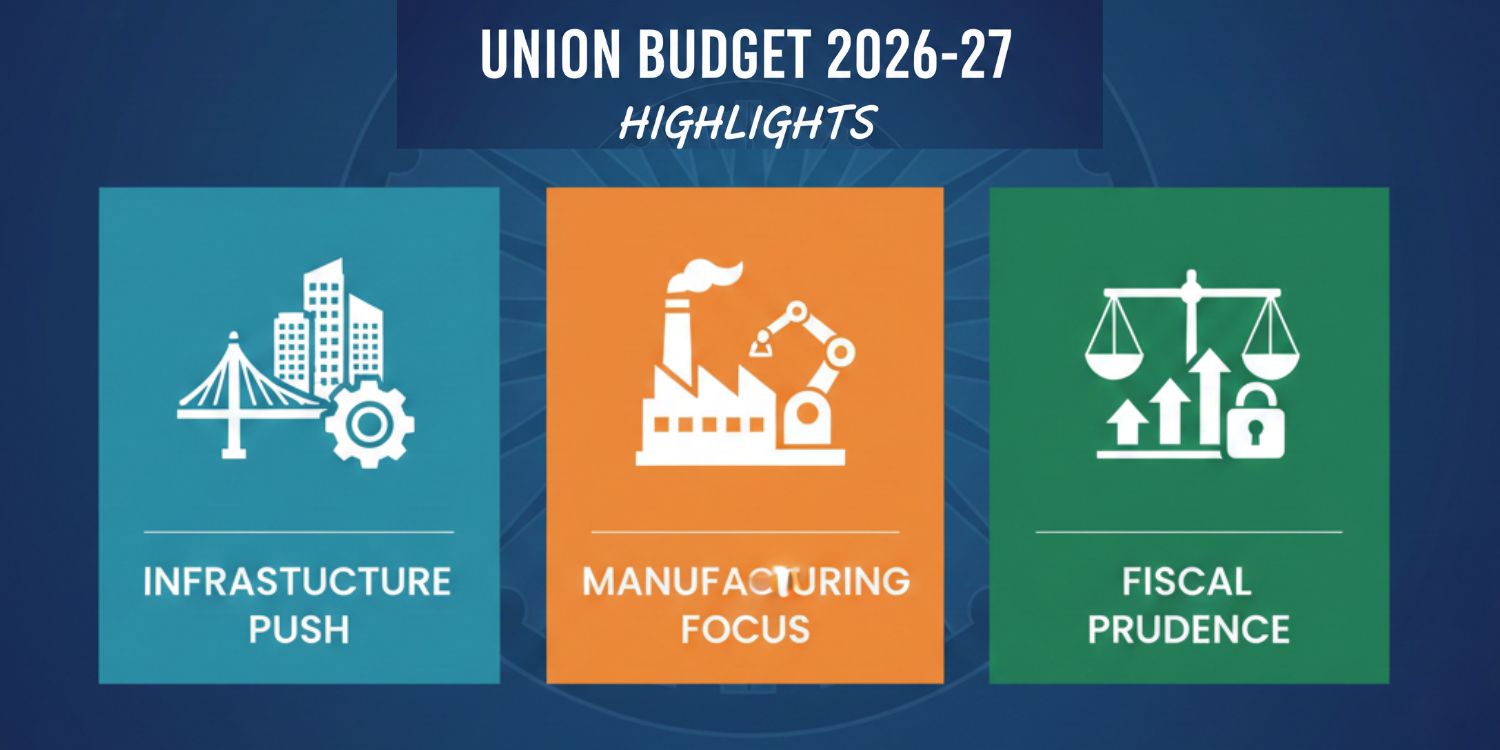
New Delhi, February 1, 2026 – Finance Minister Nirmala Sitharaman on Saturday presented the Union Budget 2026-27 in Parliament, outlining the government’s fiscal priorities for the coming year with a strong emphasis on infrastructure investment, domestic manufacturing, and long-term economic resilience amid global uncertainty.
The total expenditure for FY 2026-27 has been pegged at approximately ₹53.5 lakh crore, marking an increase of about 7- 8% over the previous year. A key highlight of the Budget is the record capital expenditure (capex) allocation of ₹12.2 lakh crore, an increase of over 11%.
Infrastructure and Connectivity
Infrastructure remains the centrepiece of the Budget. The government announced increased allocations for roads, railways, urban infrastructure, and logistics, aimed at reducing transportation costs and improving economic efficiency. Seven high-speed rail corridors connecting major industrial and economic hubs were announced, alongside expanded funding for freight corridors and inland waterways.
Manufacturing and Strategic Sectors
The Budget reinforced India’s push to become a global manufacturing hub. A major announcement was the launch of India Semiconductor Mission 2.0, with substantial funding to support chip fabrication, design ecosystems, and supply-chain development to avoid dependence on importing. The government also announced support measures for biopharma, advanced manufacturing, capital goods, and strategic minerals, aiming to reduce import dependence and strengthen India’s position in global value chains.
Taxes and Fiscal Position
No changes were announced in personal income tax slabs, maintaining continuity for taxpayers. The focus instead remained on simplification and compliance, with preparations underway for the rollout of the Income-Tax Act, 2025, effective April 1, 2026.
The fiscal deficit for FY 2026–27 is projected at around 4.3% of GDP, reflecting a calibrated approach that balances higher capital spending with fiscal discipline. States will continue to receive 41% of the divisible pool of central taxes.
Agriculture, MSMEs, and Social Sectors
Agriculture and allied sectors received continued support, with allocations focused on high-value crops, rural infrastructure, and technology-enabled farming. MSMEs were targeted through credit support, skilling initiatives, and measures to improve ease of doing business. The Budget also announced enhanced funding for healthcare, education, and skill development, including exemptions on select medical imports and investments in STEM education infrastructure.
What Does This Mean To You?
For most citizens, the immediate impact of Budget 2026-27 will be felt less through tax changes and more through jobs, prices, and access to services. With no changes to income-tax slabs, household tax liabilities remain stable. However, the large infrastructure push is expected to generate employment opportunities across construction, manufacturing, logistics, and allied sectors, particularly in urban and semi-urban areas.
Improved transport and logistics infrastructure could gradually lower costs of goods and services, as supply chains become more efficient. Investments in manufacturing and strategic industries are likely to create higher-skilled jobs, especially for young professionals entering technology, engineering, and industrial sectors.
For rural households, continued support to agriculture and agro-processing may translate into better income stability, especially where infrastructure and market access improve. Increased healthcare and education spending is expected to enhance access and affordability, though the impact will unfold over time rather than immediately.
Overall, Budget 2026-27 signals continuity rather than disruption, prioritising long-term growth, employment generation, and economic stability over short-term populist measures. However, The Union Budget 2026-27 once again raises a familiar and uncomfortable question: who is India’s economic growth really serving? While the government has doubled down on infrastructure, manufacturing, and capital expenditure, the absence of meaningful expansion in social welfare spending exposes a deeper structural imbalance in how public money is distributed.
At its core, the Budget reflects a narrow interpretation of development, one where growth is channelled disproportionately into a few large sectors with the assumption that benefits will eventually “trickle down.” Roads, rail corridors, semiconductor missions, and industrial incentives dominate allocations, while sectors that directly shape everyday life, public healthcare, education quality, nutrition, mental health, and employment security, remain relatively underfunded.
This raises a fundamental concern about wealth distribution. Tax revenues collected from a broad base of citizens are increasingly absorbed by government operations, debt servicing, and large-scale capital projects, many of which primarily benefit corporates, contractors, and capital-intensive industries. Meanwhile, the social infrastructure that sustains the workforce, schools, hospitals, public health systems, and social safety nets, continues to rely on incremental or stagnant funding.
The government’s defence is fiscal prudence. With deficit targets to meet, social spending is portrayed as financially risky due to its recurring nature. But this framing ignores a crucial reality: underinvestment in social welfare is not fiscally neutral, it is economically costly. Weak healthcare systems reduce productivity. Poor education outcomes limit workforce quality. Inadequate social protection deepens inequality and suppresses consumption.
Equally troubling is the Centre’s growing tendency to shift responsibility to states through tax devolution, without ensuring that funds translate into outcomes. The result is uneven access to essential services, depending largely on geography rather than need.
The Budget’s unspoken assumption is that growth will solve inequality later. History suggests otherwise. Without deliberate redistribution, growth tends to concentrate wealth, not spread it. The real question the Budget avoids is not whether India can grow, but whether it can grow without leaving most of its taxpayers behind.