
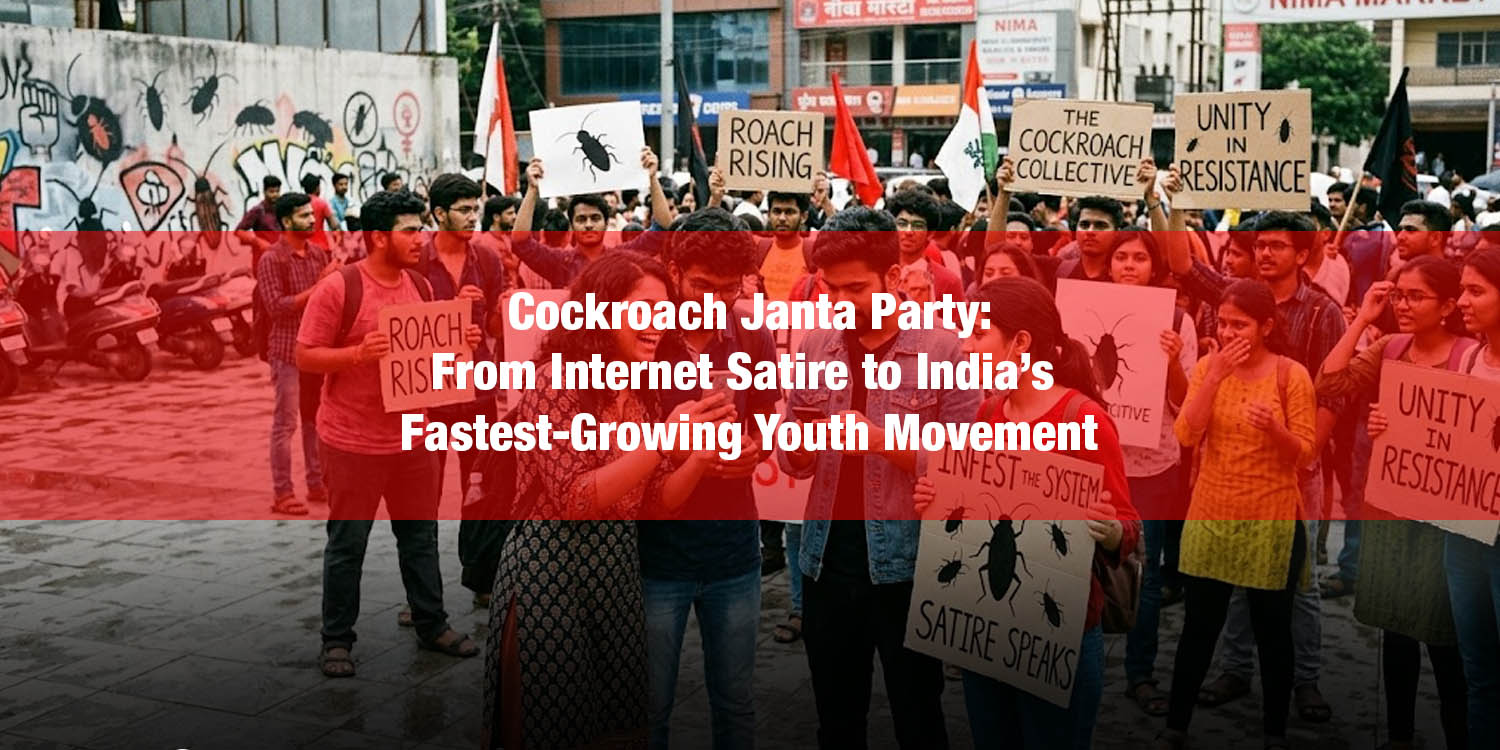
What began as an offhand remark has rapidly evolved into one of India’s most unexpected digital-political phenomena. The “Cockroach Janta Party” (CJP), a satirical online movement, has captured national attention, reflecting a deeper undercurrent of youth frustration, political disillusionment, and the power of internet culture.
Genesis: Protest Disguised as Satire
The origins of the Cockroach Janta Party can be traced to controversial remarks attributed to Chief Justice Surya Kant, in which unemployed youth were allegedly likened to “cockroaches.” The comment triggered widespread backlash online. Instead of conventional outrage, however, Gen Z users reclaimed the insult, transforming it into a symbol of resistance.
What followed was the creation of a satirical political platform that positioned itself as the “voice of the unemployed and overlooked.” The name, intentionally provocative, became a form of digital protest, turning perceived humiliation into identity and commentary.
Rapid Rise and Digital Momentum
Within days of its launch, the movement gained tens of thousands of members, with some reports suggesting over 40,000 sign-ups in just 48 hours.
Its growth has been driven largely through social media, where its irreverent tone, meme-driven messaging, and sharp political satire resonated strongly with younger audiences. The party’s online presence has even rivaled established political entities in follower count, underlining its viral appeal.
The platform describes itself humorously as a party for the “lazy, unemployed, and chronically correct,” yet beneath the satire lies pointed criticism of systemic issues such as unemployment, governance, and political accountability.
Structure, Manifesto, and Messaging
Despite its satirical framing, the Cockroach Janta Party has outlined a mock manifesto addressing issues like electoral transparency, media accountability, and representation.
Membership criteria, also delivered in a tongue-in-cheek manner, emphasize self-awareness, access to information, and collective identity, further reinforcing its role as both parody and protest.
The movement’s slogan and messaging deliberately blur the line between humor and critique, using irony as a tool to engage citizens who may otherwise feel alienated from traditional politics.
Latest Developments and Political Attention
The CJP’s rapid rise has not gone unnoticed. Public figures and politicians have engaged with the movement online, amplifying its reach and legitimizing its presence in mainstream discourse.
In some cases, even sitting Members of Parliament have interacted with or symbolically “joined” the movement, further fueling its visibility.
What remains unclear, however, is whether the Cockroach Janta Party will remain a satirical digital campaign or evolve into a structured political force. For now, it stands as a reflection of contemporary youth politics, digitally native, deeply ironic, yet rooted in genuine dissatisfaction.
Conclusion
The Cockroach Janta Party is less a conventional political entity and more a cultural moment. It highlights how a generation, often dismissed or underestimated, is reshaping political engagement, using humor not as escapism, but as a form of critique. Whether it fades as a viral trend or transforms into something more substantial, its emergence signals a shift in how political narratives are being created, consumed, and challenged in modern India.