
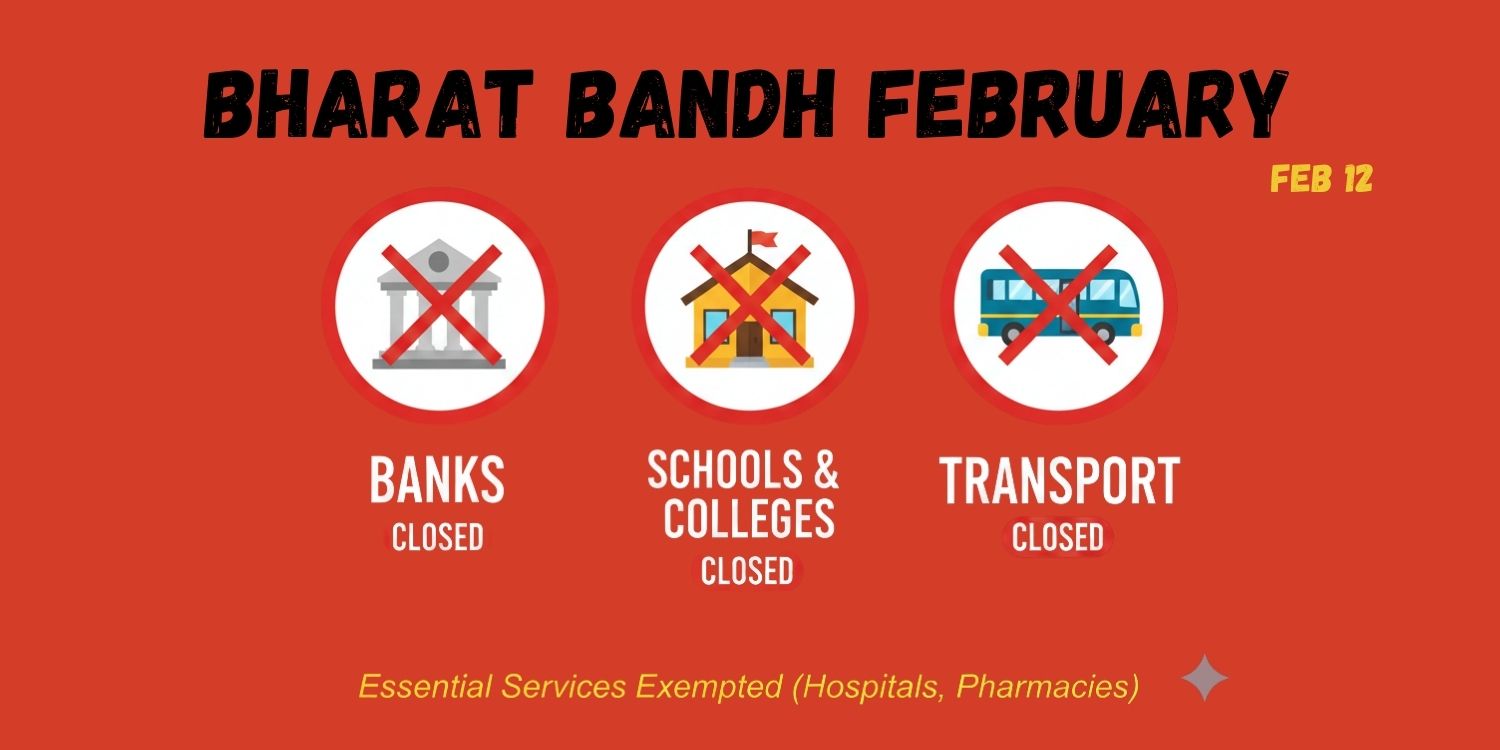
India is bracing for widespread disruption on Thursday, February 12, as central trade unions and farmers’ organisations have called a nationwide Bharat Bandh (general strike) that is expected to impact daily life across many states. The strike is being organised as a protest against recently implemented labour codes and a proposed India-US trade deal, drawing participation from millions of workers, agricultural labourers and bank employees.
The joint call for the strike comes from a platform of around ten central trade unions, including the All India Trade Union Congress (AITUC), the Centre of Indian Trade Unions (CITU) and others, many of which have announced that workers across sectors will walk out of work in protest. Organisers have claimed that around 30 crore workers could participate in the bandh, exceeding the scale of past nationwide general strikes in the country.
Public sector banks are among the major services expected to see disruption. Several employee unions and associations have issued strike notices for February 12, and institutions such as the State Bank of India (SBI) have alerted customers that services may be affected, although precise details on closures or limitations remain fluid and likely to vary by region.
Across the country, the impact is expected to extend beyond banking. Public transport systems could face blockades or delays in some areas as protest marches and traffic disruptions unfold. Markets and shops in cities and towns where protests are active may stay closed or have limited hours, and government offices in states where labour groups have strong influence could see reduced attendance or closures. Schools and colleges may also remain shut in localities where organisations back the bandh or where transport services are disrupted.
Despite the potential disruptions, essential services such as hospitals, medical facilities, airports and emergency utilities are expected to continue operating, even if access and transport to these services are slowed by road blockades or demonstrations. Authorities in several states have mobilised police and administrative resources to manage law and order and to minimise inconvenience to commuters and the public.
The Bharat Bandh reflects ongoing discontent among labour and farmer organisations with a range of policy decisions. Protesters argue that the new labour codes weaken workers’ rights and job security, and that the proposed trade agreement with the United States could harm domestic agriculture and dairy sectors by exposing them to increased international competition. In many regions, demonstrations and human chains are planned for February 12 as part of the bandh, with participants voicing demands that the labour codes be rolled back and that agricultural protections be strengthened.
As the country prepares for the strike, members of the public are being advised to check with local authorities and institutions on whether specific services such as schools, banks and transport run on February 12, and to plan travel and essential activities accordingly.