
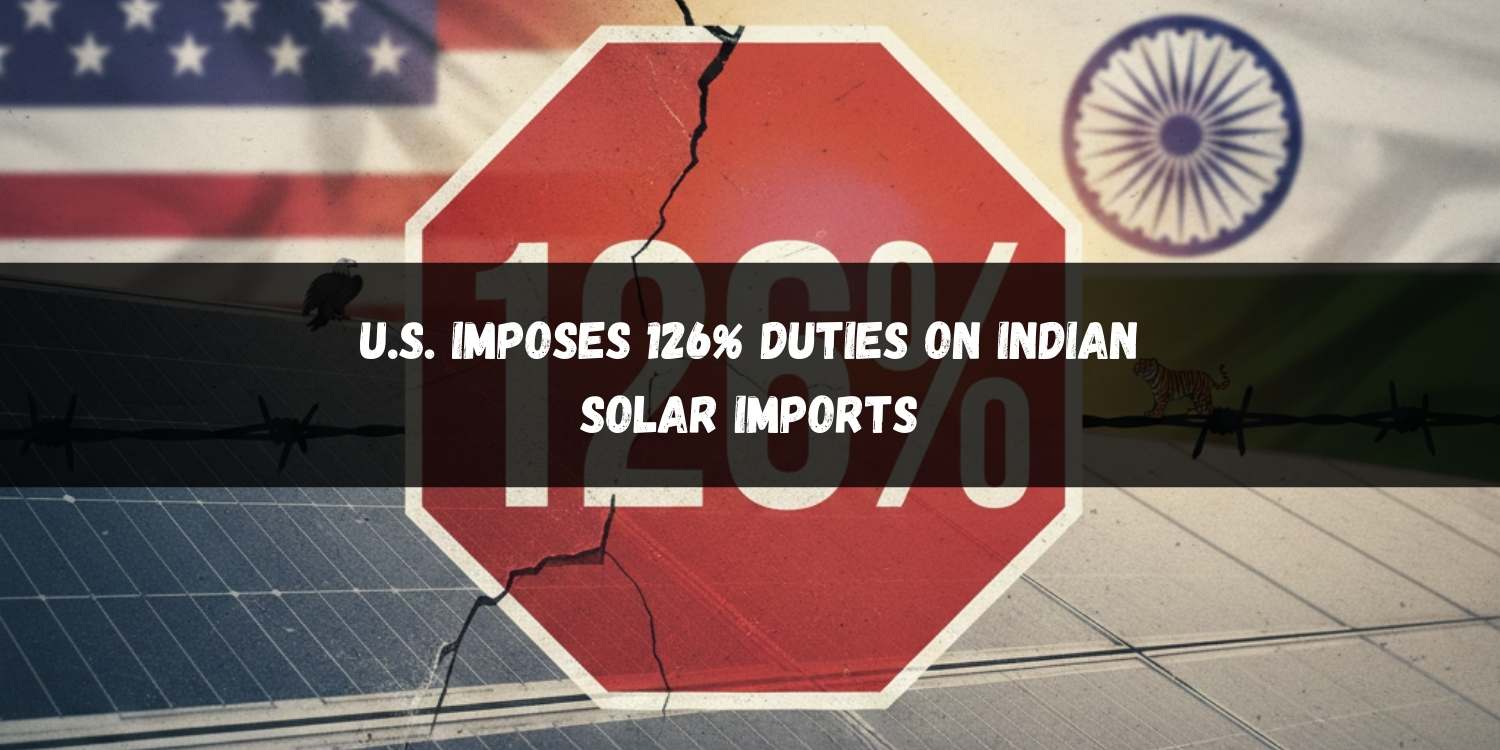
In a significant escalation of trade tensions, the United States Department of Commerce has announced preliminary countervailing duties of up to 126% on solar cells and modules imported from India. The move, part of a broader investigation into alleged government subsidies, also includes high duties on solar goods from Indonesia and Laos, with rates ranging between roughly 81% and 143% depending on the country and company.
U.S. authorities say these duties aim to address what they consider unfair subsidies that have enabled foreign producers to undercut American solar manufacturers, potentially harming domestic industry and jobs. Solar imports from India to the U.S. surged to about $792.6 million in 2024.
Market and Industry Reaction
The announcement rattled financial markets: stocks of Indian solar companies like Waaree Energies and Premier Energies fell sharply, with some dropping up to 15% on the initial news of the duties.
However, some investors later saw a partial rebound after analysts clarified that certain tariff applications (e.g., on cell origins) could moderate the immediate impact.
Manufacturers in Gujarat and elsewhere are reportedly reassessing export strategies, exploring alternative supply chains and local production options to adapt to the new duties.
Political and Public Reaction in India
In India, the tariff move has sparked significant political and public backlash. Voices across political lines have criticized the U.S. decision as unjustified and harmful to bilateral trade. Some commentators and leaders argue that such steep duties, coming soon after the India-U.S. trade deal negotiations, may reflect deeper tensions in the trading relationship.
For context: last year, a diplomatic and trade dispute between the two countries escalated when the U.S. first imposed high reciprocal tariffs on Indian exports, leading to strong condemnation from New Delhi. India described those earlier tariffs as unjustified and unreasonable.
There was also notable public outrage in India when earlier 16% tariffs on a range of Indian exports to the U.S. were introduced (and later moderated) as part of trade negotiations, seen by critics as punitive steps that hinder Indian businesses. That episode sharpened Indian concerns over how U.S. trade policy might be used strategically against Indian exports. (Analysts and public commentators have drawn parallels between that controversy and the current solar duties, suggesting the possibility that U.S. trade measures are being used not just for fair-trade enforcement, but to protect domestic industry and leverage negotiating power.) This context has fueled debate in India about wider fairness in the U.S. trading system and its impact on emerging exporters.
Can This Be a Broader Strategic Trade Tactic?
Many analysts argue that while the United States frames these tariffs as remedying unfair subsidies, the effect is to sharply disadvantage Indian solar exporters in a key export market, effectively making U.S. access economically unviable. The timing and scale of the duty, shortly after new India-U.S. trade discussions, have led some commentators to interpret the move not only as trade enforcement but also as a strategic attempt to slow Indian export growth in clean technology sectors.
Critics see this as part of a broader pattern where trade remedies, such as antidumping or countervailing duties, are used by large economies like the U.S. to shield domestic industries and shape international competition, sometimes at the expense of emerging exporters. However, defenders of the duty argue that it is based on legitimate concerns about subsidies and market distortions, a standard tool within international trade law.