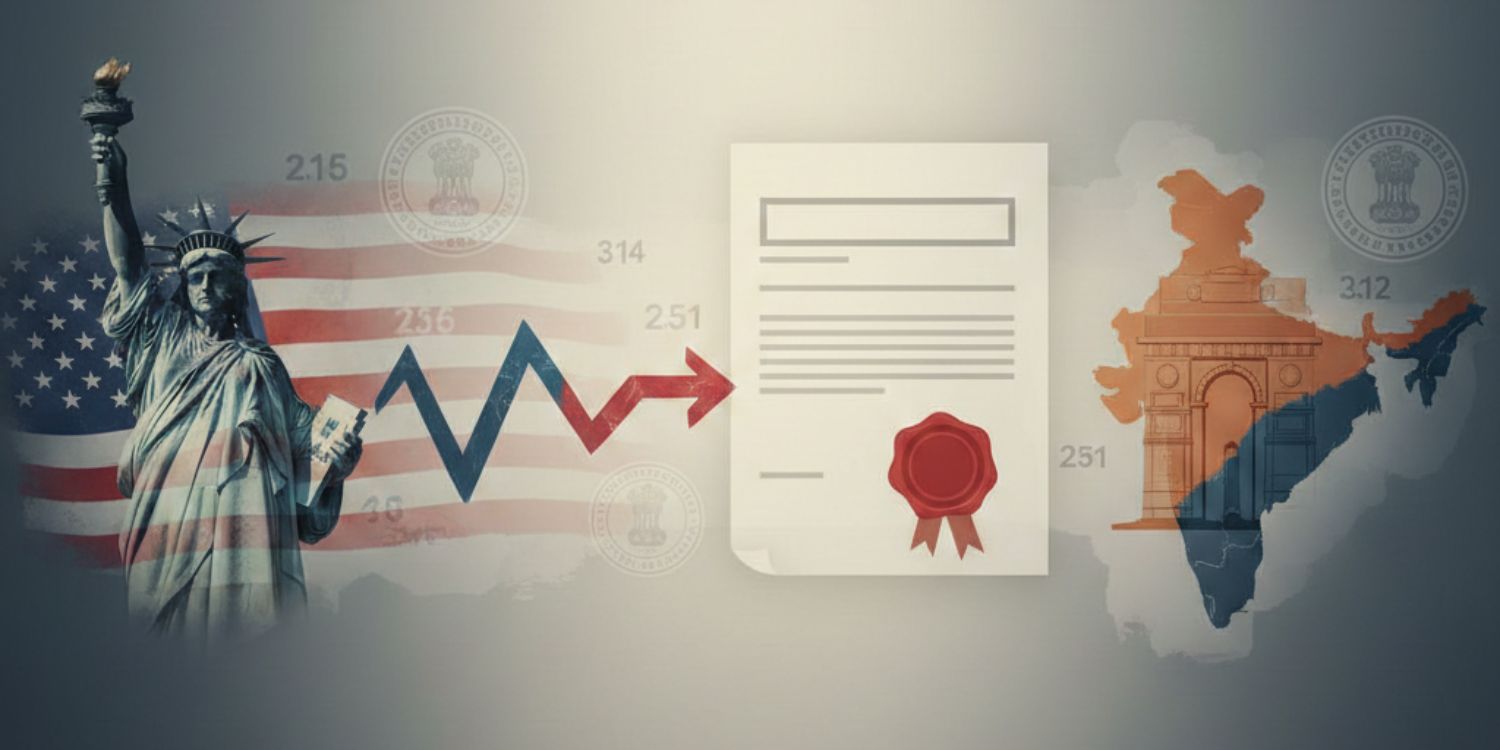
New Delhi: For a growing number of Indian students, tech professionals and business travellers, the most frightening moment in the U.S. visa process now comes not from a rejection stamp, but from a single line on a white slip: “Refused under Section 221(g).”
Section 221(g) of the U.S. Immigration and Nationality Act is officially described as a “temporary refusal”. It allows a consular officer to pause a visa decision if further verification, documentation or background checks are required. In theory, it is an administrative tool. In practice, it has quietly evolved into a shadow denial system opaque, open-ended and increasingly linked to social-media scrutiny.
The Economic Times recently reported a noticeable spike in 221(g) referrals for Indian applicants, particularly those seeking F-1 student visas and H-1B work visas, as U.S. missions in India tighten digital vetting norms. What was once a routine disclosure requirement has now turned into a full-scale examination of applicants’ online lives, often with life-altering consequences.
From Paperwork to Profiling
The trigger lies in post-2019 U.S. State Department rules that mandate visa applicants to disclose all social-media usernames used over the past five years. Until recently, this field on the DS-160 form was treated as a formality. Now it has become an active filter.
Indians are increasingly being sent into administrative processing because they failed to list a dormant Reddit account, forgot an old Instagram handle, or had LinkedIn details that did not perfectly match their visa application. In several reported cases, visas have been delayed or revoked not due to criminal records or document fraud, but because of online posts, comments, or technical omissions.
What makes this shift unsettling is not merely the scrutiny itself, but the absolute lack of transparency surrounding it. Applicants are rarely told which post, comment or account triggered the hold. There is no defined standard of what constitutes “problematic” speech. There is no formal appeal mechanism. And under the doctrine of consular non-reviewability, there is virtually no legal recourse to challenge a decision once a visa officer invokes 221(g).
Is Social Media Private Anymore?
This has ignited a deeper controversy: is social media a private space, or has it now become fair game for immigration policing?
For millions of Indians, platforms like Instagram, X, Reddit and Facebook function as personal diaries, informal discussion boards or professional networking tools, not intelligence dossiers. Yet U.S. consular officers are increasingly treating these digital traces as part of an applicant’s permanent immigration file.
Legally, Washington defends this practice on the grounds that visa issuance is a privilege, not a right, and that constitutional free-speech protections do not extend to foreign nationals outside U.S. territory. That argument may be sound under American law. Ethically and diplomatically, it is far more troubling.
Indians are effectively being told to curate their digital identities years in advance if they hope to travel to the U.S. in the future. Political opinions, academic commentary, satire, activism, even dark humour now carry immigration risk. This is no longer just a security filter. It is an ideological sieve.
What Exactly Is Getting Flagged
Visa lawyers say cases are increasingly being pushed into 221(g) because of undeclared social-media handles, inconsistencies between LinkedIn profiles and official visa forms, posts referencing controversial political movements or geopolitical conflicts, comments interpreted as anti-U.S. or extremist, and private accounts that consular officers cannot access.
What makes the system especially arbitrary is that there is no publicly defined list of disqualifying content. Standards are internal, discretionary and entirely non-transparent. Applicants often learn something is wrong only after their visa is already stuck in indefinite limbo.
From an Indian civil-liberties perspective, the policy sits uneasily with global privacy norms.
Applicants are pressured to make private accounts public. There is no clear consent framework explaining how their data is stored, shared or retained. There is no mechanism to correct contextual misunderstandings. There is no right to explanation for why a case was referred for 221(g) processing in the first place.
It amounts to surveillance without accountability, disproportionately affecting Indians because they form the single largest group of foreign students and H-1B workers in the U.S.
The Cost to Indian Mobility
The consequences are already visible.
Students are reconsidering U.S. universities because visa timelines have become unpredictable. Employers are struggling with delayed onboarding of Indian tech professionals. Families are stuck in months-long administrative purgatory. Academic intakes, job offers and travel plans are being derailed not by substantive ineligibility, but by algorithmic suspicion and digital profiling.
At a time when Washington publicly frames India as a strategic partner and a talent ally, its visa policy tells a different story, one of distrust, procedural opacity and digital overreach.
When Free Speech Hits a Visa Wall
Section 221(g), designed as a bureaucratic safeguard, is now functioning as a soft denial weapon powered by social-media trawling and shielded from legal scrutiny.
For Indian applicants, the message is stark and unmistakable. Your qualifications matter less than your digital footprint. Your credentials matter less than your comment history. And your freedom of expression ends where U.S. immigration suspicion begins.
This is no longer merely a visa issue.
It is a test of how far digital surveillance can be normalised before it corrodes the democratic values the United States claims to champion.