
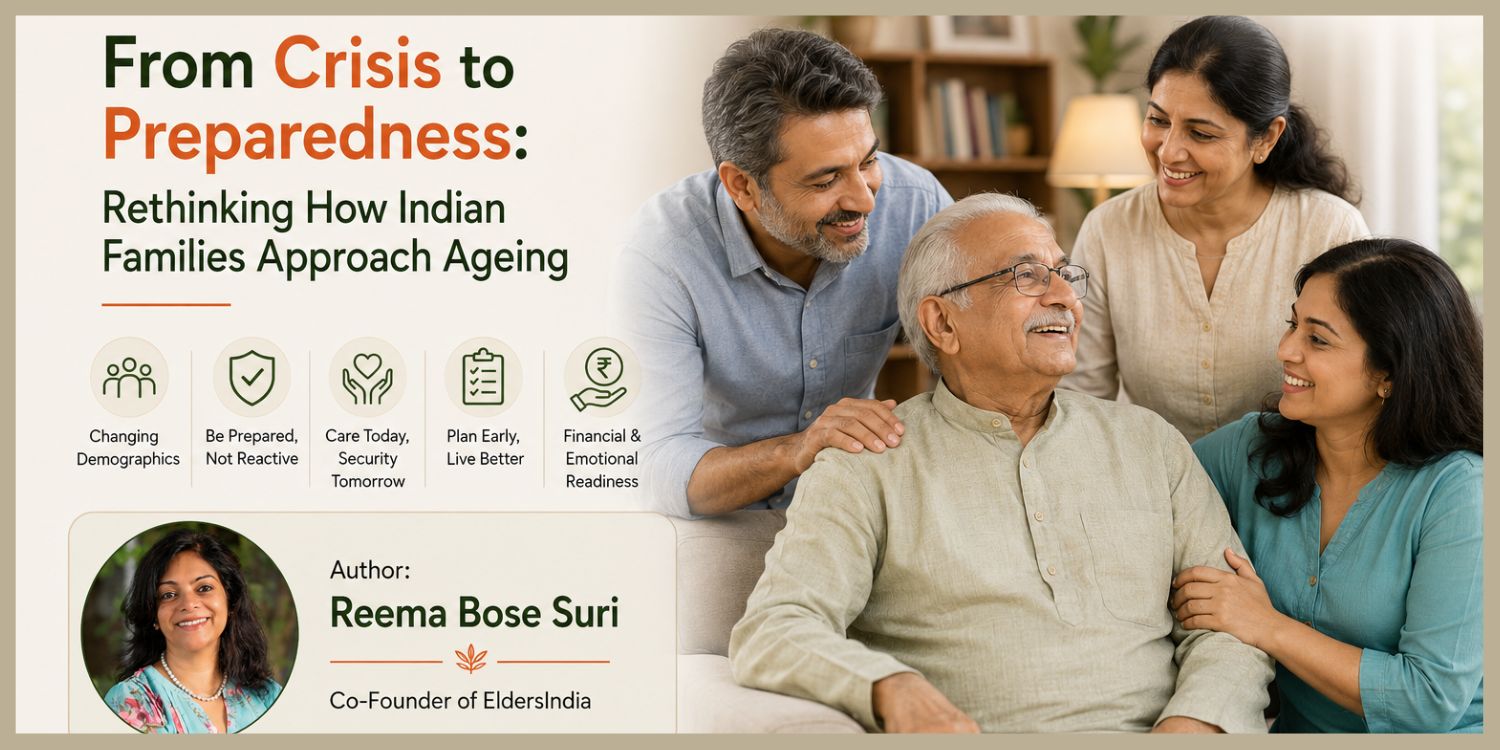
Reema Bose Suri is Co-Founder of EldersIndia, where she works with families and organisations on the challenges of ageing, caregiving and longer lives. A HR leader for the first 18 years of her career, her interest in this space grew from engaging with employees on these issues and navigating her own parents’ ageing journey while balancing professional and family responsibilities. She is particularly focused on helping families move from crisis-driven responses to greater preparedness — enabling older adults to live longer lives with independence, dignity and purpose.
*********************************************************************************************
A mid-level manager in his early forties is at work, balancing a demanding role with two school-going children. His parents live in another city. He speaks to them regularly and keeps an eye on their health, but like most of us, assumes that if something serious happens, the family will figure it out.
Then comes the phone call: his father has had a stroke.
Within hours, he is arranging travel, choosing a hospital, speaking to relatives, understanding insurance and making decisions about his father’s care, often without knowing what questions he should be asking.
A few days later, the immediate crisis begins to recede, but a new reality emerges. His father may need support at home for a few weeks or months. He must find reliable help, co-ordinate care from another city and eventually return to work. Meetings are rescheduled. His attention is divided between work, his children and a parent whose needs have suddenly changed.
The crisis may pass. The need to care may not.
The problem is not always a lack of services. Hospitals, doctors, home-care providers, insurance and senior-living options exist. What families often lack is clarity about what they may need, where to begin and whom to turn to when circumstances change.
This points to a larger issue: we are still thinking about ageing through the family model we grew up with, even though that model is under considerable strain.
Perhaps it is time to think differently, not about replacing the family but about preparing it better.
# The family remains at the centre. But the old model is changing.
For generations, much of elder care in India was managed within the family.
Children and parents often lived nearby, with siblings or extended family able to step in when needed.
That reality has changed. Children are moving across cities and countries for work. Families are smaller. Both spouses may have demanding careers. Parents are living independently for longer. And people are living longer, often with health conditions that require attention over years rather than through one-off interventions.
The family remains the most important source of support, but that does not mean being able to do everything alone.
The challenge is not that families have stopped caring. The circumstances in which they provide that care have changed. The old model is being stretched.
# The real issue starts before “care” is required
When we talk about elder care, we tend to begin when care is visibly needed — after a fall, a diagnosis or a hospitalisation.
Are my parents managing comfortably on their own? Is their medical history documented? Are important documents organised? What happens if one parent suddenly becomes unavailable? What are their preferences about where and how they would like to live if they become less independent?
These may not feel like “care” questions, which is precisely why they are often left unaddressed. By the time a family is looking for a caregiver or dealing with a hospital discharge, there may already be too much to manage.
# Preparedness asks us to start earlier — not because we expect something to go wrong, but because ageing is a process and circumstances can change.
# The question needs to change
Most families approach ageing with a perfectly reasonable question: “What will we do if something happens?”
The problem is that it often gets asked when something has already happened.
A more useful question is: “Are we ready if something happens?”
Being ready might mean knowing which hospital a parent would prefer, having important documents accessible, understanding the financial implications of care, knowing who can step in when you are in another city, and discussing parents’ preferences in advance.
It means making sure the family isn’t starting from zero.
# Professional support should complement the family, not replace it
Professional support should not be seen as an alternative to family involvement. The family should remain at the centre.
Children know their parents in a way that no professional can. But families may not always have the time, expertise or local presence to coordinate everything themselves — particularly when they live in another city or country.
Professional support can help families understand what is needed, evaluate providers, coordinate services and navigate decisions as needs change.
The role is not to take decisions away from the family but to make them easier.
The right professional support can give families the information and coordination they need to remain in control, rather than leaving them to navigate a complicated system alone.
# From Care to Longevity
This is also why we need to broaden the conversation beyond care itself.
Preparing for the years ahead cannot be limited to thinking about illness, hospitalisation or dependence. Preparedness also means recognising that ageing is about much more than managing declining health. Longer lives also raise questions about emotional wellbeing, purpose, social connection and financial security.
How will a parent stay engaged as routines and relationships change? What gives them a sense of purpose? How can they maintain emotional wellbeing? Are they financially prepared for a longer life? What does ageing well look like for them?
These are conversations worth having while parents are still independent and life is going well.
This is where the care system needs to evolve: from crisis response towards a more holistic approach to longevity that helps families prepare for the years ahead.
Longevity is not simply about adding years to life. It is about making those years healthy, purposeful, connected and financially secure.
That is the shift we need to make: from asking “What will we do if something happens?” to asking “Are we ready for the years ahead?”
Perhaps that is what preparedness should really mean: not preparing for a crisis but preparing for a longer life.