
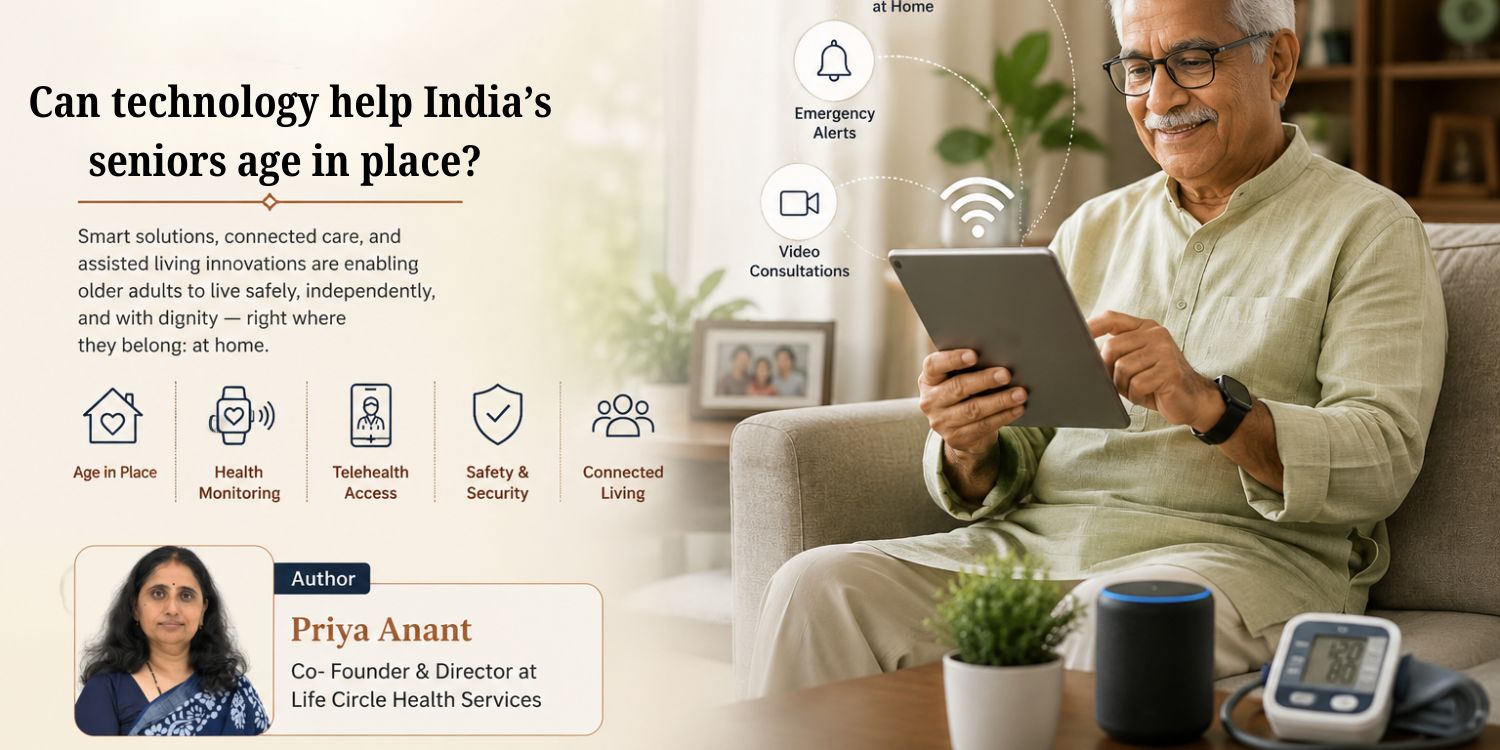
A senior who has just undergone surgical intervention goes home with her family when discharged. At home, the family needs to organize numerous elements of care for the senior. These include purchase, stocking and management of multiple medications, support for activities of daily living, making home amends that prevent accidents (falls, bedsores, etc.), enhancing comfort, observing any setbacks in the recovery, follow-up diagnostics, and conducting doctor visits. Any semblance of normalcy in the home is disrupted. Women carry a disproportionate burden of care for seniors, confirmed by numerous studies including dementia care by LASI where 61% of the caregiving informants were women. Aging in place, which is a choice of the majority of Indian seniors, is strained when faced with the need for specialized care. It could follow hospitalization, an accident, alteration of mobility, diagnosis of a progressive, irreversible health condition. The challenge is not just about physical care but also affects the emotional and mental health of the senior as well as the family.
What was, till about a decade ago, a private problem, handled behind closed doors today is more visible because of the rapidly increasing population of seniors (149 million (10.5%) in 2022 and are projected to reach nearly 347 million (20.8%) by 2050), progress in longevity, increased prevalence of multi- morbidity and willingness of families to seek support to help them care for the aged. COVID changed the way healthcare is viewed and consumed, expanding its provision from institutions to homes. Government issued the Telemedicine Practice Guidelines, 2020, creating a framework for supporting healthcare to be provided in homes.
Alongside the environmental changes affecting the industry, we have seen a growth in the number of organizations that provide geriatric home healthcare. A large part of this market is unorganized. The services of caregivers are pitched to upper middle-class households, provided one on one and are paid for out of pocket. The workforce that is deployed as caregivers could be anyone from an illiterate person to someone who has completed higher secondary school and is a certified caregiver. The price and quality of services vary widely by the provider. Enterprises self-regulate themselves aligned with their own purpose guiding them.
If the caregivers are paid minimum wages as stipulated, there is a thin margin for the rest of the overheads. This is where it makes sense for an enterprise to achieve scale so that economies come into play. Incorporating the thoughts of the senior and the family caregiver, creating a personalized care plan with detailed activities, devices, medicines, senior preferences, sharing the care plan with the family caregiver (and senior if able to engage), supervisor and the professional caregiver ensures that the objective of hiring the caregiver is understood similarly by all the three parties and there is a written document that provides guidance. In creating a plan, there is an opportunity to bring the best practices to ensure quality of care provided. As institutions provide dispersed care, this can be a valuable tool for home healthcare companies to measure their performance and assess if their service is supporting the stated care objectives. Multi morbidity is common among seniors. A recent study concluded the incidence of polypharmacy (defined as 5 or more medicines per day) among seniors in India at 33.7%. Creating a mechanism for tracking medicines reduces the possibility of medication error. Since disparate providers prescribe the drugs, drug-drug interactions may be overlooked. Technology tools integrated into care plans, can help flag potentially inappropriate medications for clinical review.
Multi morbidity among seniors also means that the caregiver must have access to continued learning. Every case where a caregiver works could be a new one, a new combination with different risks and care requirements, even for a senior caregiver. So, availability of learning customized to the personalized care plan and accessible to the caregiver in bit sized modules, in vernacular language, simplified and actionable can improve the caregiver’s confidence, care quality and hence the well-being of the senior. While there are private and public accreditations available for home healthcare enterprises, provider accountability remains one of the biggest challenges in a remotely managed healthcare delivery system. Technology can play a constructive role including by smoothening communication flow between various players in the care context.
Service affordability is the flip side of enterprise viability. Homecare enterprises need to operate at a very high level of efficiency since the gross margins can be quite thin. Deployments of agentic AI for routine jobs, overlaid on daily reports, calls, communications can reduce the need for human interface, thus improving quality, responsiveness and reducing cost.
Access, cost and quality are the three vertices of any healthcare system. Technology has the power to influence all these three vertices. Today support to family caregivers of seniors is available only to those who can afford the high service charges for a one-on-one care. The care at home is disjointed with the care provided by the treating doctor. In more mature health systems, the senior moves from primary care to tertiary care in a continuum with homecare support baked in and connected and supported by primary care close home and tertiary care when in need of medical intervention or specialist medical support. Insurance covers some part of the cost of care. In India, only a small percentage of families use professional caregiving service and insurance coverage for homecare is in its infancy. There is a need and an opportunity to create caregiving support for seniors across economic spectrum. Appropriate geriatric homecare can go a long way in supporting families with aiding ageing in place.
This industry has the potential to create jobs fast, for people with lower educational attainments, at a fraction of the cost compared to long term trainings. There is an opportunity to help them progress from being geriatric caregivers to nurses, from being local caregivers to being international workers. India is also beginning to emerge as a source of trained care workers for ageing societies abroad. Cooperation with countries such as Japan has created pathways for training and deployment of care workers, while demand for Indian caregivers is also emerging in other ageing markets. Along with being leaders in pharmaceuticals and nursing, we also have the potential to be global leaders in geriatric caregiving; along with ensuring better quality ageing in place at home. Technology can be an enabler at multiple points in this journey.
Author:
Priya Anant
Co- Founder & Director at Life Circle Health Services