Once upon a time… a few years ago, while trying to install a smart device in the house of an elderly couple, who did have Wi-Fi, we found they were turning off the Wi-Fi when not using it to do video call with their children or watching shows. For them it is just like their pump or a bulb which you need to switch on and off as per use. As a technology enthusiast this just felt weird, connectivity felt like a basic assumption! For them it was not. And perhaps, this perspective is where we are lacking.
Today, we as a society or country are heading towards a new age of Indian elderly who are as different from the elderly from the 90s or even the early 2000s as the Gen Z are from the millennials. This is the population we need to solve for. But we cannot solve for them using the age old or perceived notions of care or needs. We cannot form an alienated solution or product and try to push market it to them, that simply does not work. Until we bring in and understand their voice right from the ideation stage, the gizmos will remain ignored and unused no matter how feature loaded.
The current and forecasted exponential rise in the number the Indian elderly are not news anymore. From a simple search, there could be a million articles regarding the same, all about the mysterious “Silver Care” market size. However, at a deeper glance, things are much more nuanced. Often, in order to put stronger numbers on the deck to chase a larger round, we entrepreneurs working in the elderly care sector prefer to look at the projected “market” without taking into account real, on-ground factors. The number of the elderly is increasing, sure, but how many of them are equipped or positioned to actually use the products designed for their care? In addition to this, in terms of services offered or while planning what can be deemed as a desired or optimum delivery of care, there is tendency to uncritically follow the West. To challenge these problems, we have to start asking critical questions: Who are we serving? Who are we developing solutions for? What is the perceived/approved quality of care? What is the metric for standardization? Who decides it?
In this day and age of AI, the availability or readiness of technology is not really a problem anymore. However, at the ground level, even with dedicated marketplaces and numerous home care service providing companies operating at multiple levels all over the country, technology absorption in care still remains scarce. The factors at play are not one but many.
- Mindset: In India, care has traditionally been considered remedial, rather than preventative.
- Aversion towards self-care in the elderly: The traditional joint family structure where personal sacrifice was often essential to ensure the best for a struggling family has not survived. But the residues of this tendency to sacrifice personal well-being persists in the new age nuclear elderly. They often do not see the need of a better quality of life or consider such aspirations selfish even when they can afford it. However, the perspective of the same person completely changes when it comes to caring for their children or grandchildren, then it is a no compromise mindset!
- Care App: Snake or Ladder? Almost all companies functioning in the field of elderly care have their own apps. These apps are often highly advertised and their many features celebrated. There is no doubt that the presence of the digital footprint has brought about an increased level of accountability. However, beyond the numerous logins, OTPs, ratings and feedbacks, grassroots level delivery of care is still heavily dependent on the in-person presence of people, and there quality thereof. Sometimes, the apps can become more shackles than structures!
- Cheapest is Best! The value addition done via the inclusion of technology in the care pathway comes at a cost. Especially for innovation, where the scale is yet to be reached, things rarely are complimentary. However, cutting the corners once too many times finally leads to a clear degradation is the quality of care delivered.
- Defining the bar: The level stress or distress at which a typical family arranges for external care usually means that even a decent execution of the bare minimum results in a lot of relief and gratitude for their clients. However, the aim is to rise above the bare minimum and establish an evolved standard of care for the elderly.
Care giving, therefore, remains largely dependent on the presence of family members. In this neo-liberal, globalised socio-economic framework, where people have to spend more and more time earning their living, this creates a care gap. Training and organization of the caregivers have improved. The service of dependable or qualified caregiving professionals comes at a cost not affordable by many. Also, the margin of human errors and lapses in judgement remains high, more so with the rapidly decreasing attention spans, affecting the quality of care.
In this situation, what we need is the development of simple affordable technology that can be absorbed in the context of this scenario. To ensure this, tech-developers, policy makers, gerontologists, caregivers, home care service providers, and doctors must work in a synchronized manner.
Technology is not an alternative to caregivers; it’s a tool to enable caregivers and help make lives a little simpler by sharing their burden. Devices like Smart Pill Boxes that ensure synchronized and automated medication management, are not designed to replace caregivers or restrict their freedom, the optimum utility lies in automating mundane and routine parts of the care delivery so that the caregivers are able to cater to the more humane aspects of care providing.
The need of the hour is to ensure the humane absorption of technology, making them useful in the lived realities of people from different socio-economic classes and regions across India. This is only possible when all the stakeholders come together, not for marketing after the solution is developed, but right from the rough drawing board, well before the point of inception!
Author Bio
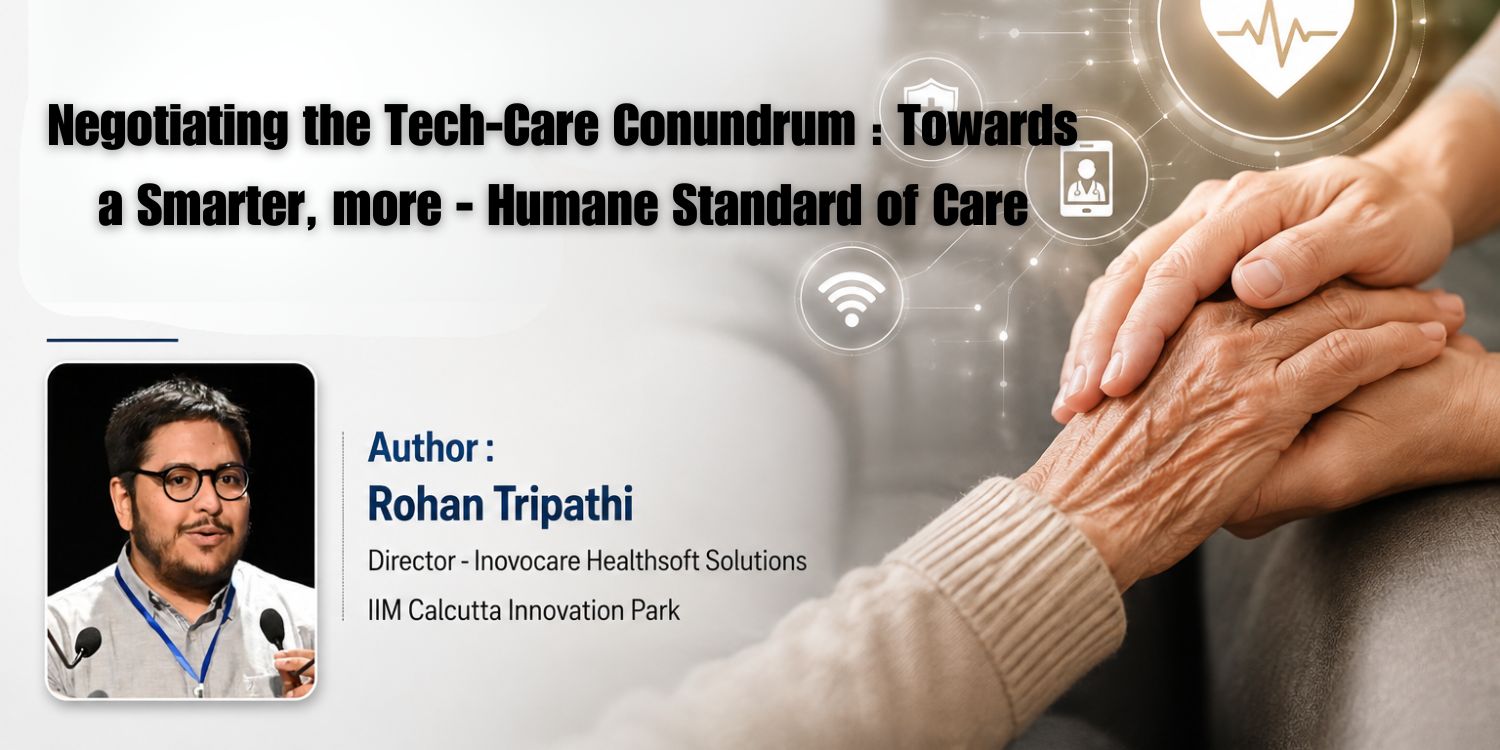
Rohan Tripathi
Director – Inovocare Healthsoft Solutions
IIM Calcutta Innovation Park
Rohan Tripathi is the founder and director of Inovocare Healthsoft Solutions Pvt Ltd., a MedTech startup from IIM Calcutta Innovation Park! Their two patented and CDSCO licenced products include Smart Pill Box MedpeR, which has been reviewed by the NHS UK and the Point-of-Care Neurofunction Testing Device NIBRA-CS which was validated at AIIMS Kalyani. Under his leadership IHS has secured 7+ recognitions and grants from the Govt. of India under DST and DBT. Rohan is an Electrical Engineer by education and has gained experience from prestigious programs like Stanford Seed Spark and Boehringer Ingelheim.