
Elder care has traditionally been a family affair in India, influenced by emotional attachment, culture and a strong sense of duty towards older parents. Although this continues to be one of the strong points of Indian families, the dynamics of caregiving have shifted drastically. Smaller family units, job mobility and complex professional lives are changing modes of caring, and, at the same time, the increase in life expectancy, and a growing burden of chronic diseases implies the need for consistent support going beyond minimal medical assistance. Aging in India is not only an issue of demographics but a new approach to organizing care.
As per the NITI Aayog report 2026, the elderly population in India is expected to reach 347 million by 2050, thereby indicating the rising need for long-term care and advanced caregiving systems. It highlights the need for a more structured and professional caregiving system while providing adequate assistance for family and community caregivers. This emphasizes the importance of moving away from the perception that elder care is solely the responsibility of families. Rather than seeing family caregiving and professional assistance as two opposing facets of elder care, the focus should be on improving family caregiving methods with the help of experienced professionals.
Family remains at the heart of caregiving
There is an aspect of caring for elderly people which cannot be substituted by a healthcare provider or a service. Presence in the company of the family makes a senior feel comfortable, secure emotionally and gives him/her a feeling of belonging. The knowledge for the elderly person that people surrounding them know all about their past, habits, and preferences is as essential for their happiness as a treatment itself. Being surrounded by the family gives seniors the sense of continuity during illness, recovery, and increasing dependence.
However, emotional obligations are poorly matched with caregiving in reality. As people grow old, they increasingly need assistance in moving, medication, treatment, nutrition, and carrying out daily activities. Under such conditions, the family turns into the caregiver while having neither training nor financial resources. However, the above reflections do not reduce the significance of familial caregiving.
Professional care should strengthen families, not replace them
Professional caregiving should be regarded as an extension of familial care and not as a substitute. This is because nurses, caregivers and physiotherapists have special knowledge and offer continuity in service provision for elderly persons encountering chronic illnesses, recuperation from diseases, mobility issues, etc. Their services relieve families of the burden of care during the day while still being able to take part in important decisions, offer emotional support and care for their loved ones.
The difference matters as it means that the use of professional services does not limit the involvement of families in the matter of care. Rather, it may allow for greater involvement on the part of families.
The home must become a stronger part of the care continuum
The healthcare system remains predicated on hospitals; however, this understanding may be significantly limiting, as many elderly do not spend their entire lives in hospitals. A major part of the care path of an elderly person occurs at home, during the gaps between consultations, after they leave the hospital. Thus, home care is becoming an increasingly important part of modern elder care.
Home care allows the elderly to enjoy all the benefits and comforts of familiar surroundings while having access to the necessary professional help. Nursing, physiotherapy, medical consultations and monitoring of one’s health along with support in one’s daily life help seniors preserve their independence and avoid unnecessary complications. More importantly, home care allows medical workers to understand the specifics of one’s life.
In the case of India, improving home care can lead to a more effective healthcare system overall. Hospitals still remain vital for emergency cases, but not all processes related to old age require hospital care. Ensuring a seamless transition from hospitals and clinics to homes will allow for more effective help and relieve families of the necessity to cope with the healthcare system independently.
India needs a continuum rather than a binary choice
Discussions about family and caregiving should stop being seen as a simplistic choice between one option or another since the needs depend on age and health of the patient. While at one time, an elderly person may be totally able to lead an independent life, later on he or she may need to see a doctor or even require nursing care.
In India, therefore, the care system should offer a wide range of services which include the cooperation of family members and professionals and various forms of technologies to provide the necessary communication and consultation procedures. The aim of such services should be the delivery of relevant bookkeeping for the patient while maintaining continuity of care agents.
Redefining what it means to care
There needs to be a change in mindsets to move towards the next stage of elder care in India. Hiring professionals should be looked at as a positive way of ensuring that the elderly are cared for appropriately and effectively, and not regarded as lacking in family obligations. The family will play an integral role in caregiving, but one cannot expect them to do it all alone. Relieving members of the family of caregiving responsibilities through other collaborations is key to a sustainable model.
The future of elder care lies in co-operation. Families contribute the trust and emotional continuity, doctors/health care professionals provide the technical and legal expertise, while technology integrates both these aspects of the process.
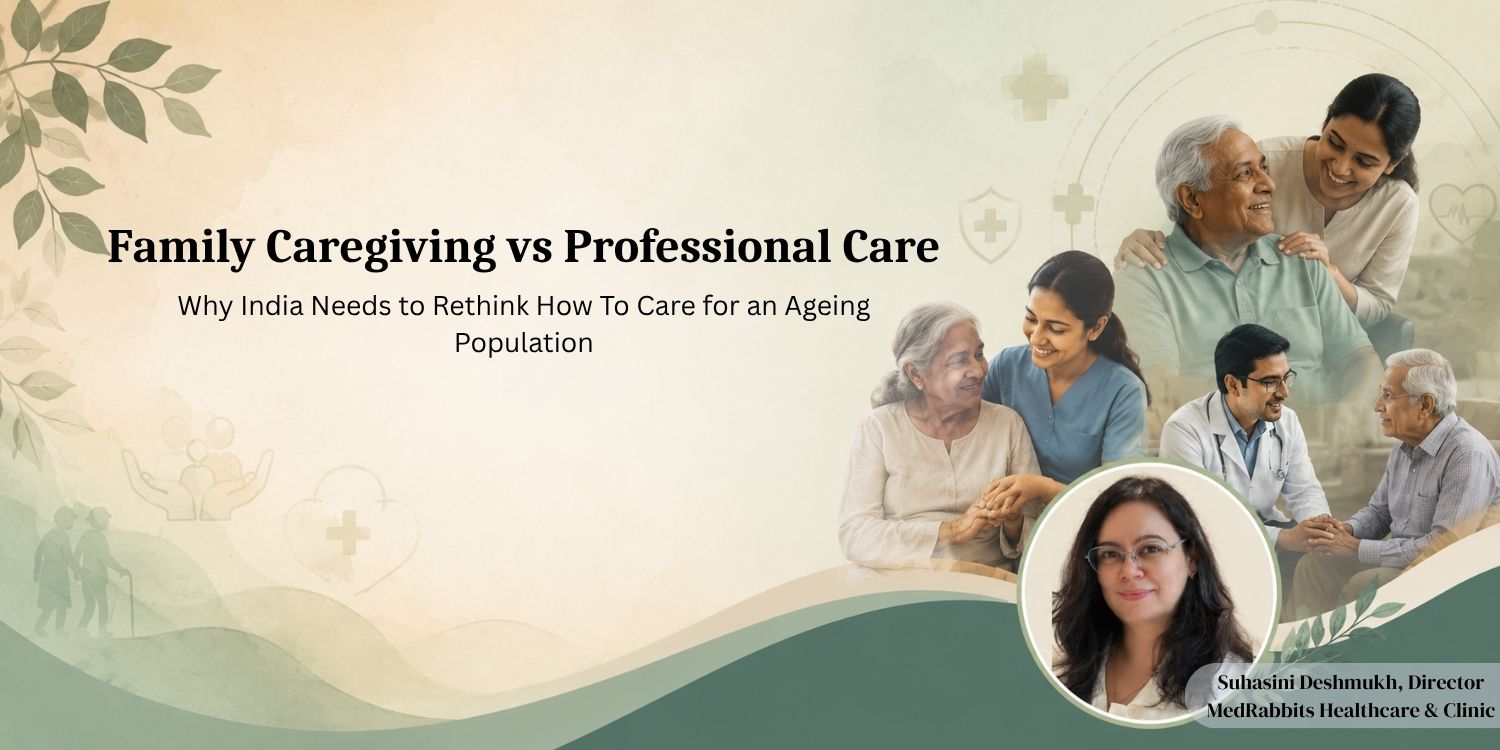
By Suhasini Deshmukh, Director, MedRabbits Healthcare & Clinic