

Knee replacement surgery in India costs between ₹1.5 lakh and ₹4 lakh for one knee in 2026, with a national average of about ₹2.5 lakh. Robotic knee replacement costs ₹2.5–5 lakh, replacing both knees costs ₹2.2–3.7 lakh or more, and eligible patients can get the surgery cashless under Ayushman Bharat.
If you or your parents have been told “you need a new knee,” the first worry is usually money. How much will it really cost? Why do two hospitals quote such different prices? Will insurance pay for it?
This guide answers all of these questions in simple language. You will learn what knee replacement is, the cost of each type of surgery, the government-fixed price of knee implants, how insurance and Ayushman Bharat help, and what recovery looks like.
| Knee replacement option | Estimated cost in India (2026) |
| Partial knee replacement | ₹1–2 lakh |
| Total knee replacement (one knee) | ₹1.5–4 lakh |
| Both knees (bilateral) | ₹2.2–3.7 lakh+ |
| Robotic knee replacement | ₹2.5–5 lakh |
| Under Ayushman Bharat (PM-JAY) | Cashless for eligible patients |
Last updated: 5 November 2026. All amounts are estimates; confirm them with your hospital and insurer.
Table of Contents
- What Is Knee Replacement Surgery?
- Who Needs a Knee Replacement?
- Types of Knee Replacement Surgery in India
- How Much Does Knee Replacement Surgery Cost in India?
- Is Knee Replacement Safe in Government Hospitals Like AIIMS?
- Knee Implant Price in India 2026: Price Caps and Types
- Does Health Insurance or Ayushman Bharat Cover Knee Replacement?
- Knee Replacement Recovery Time: Week-by-Week Timeline
- Frequently Asked Questions (FAQ)
- Final Word: Plan Your Knee Replacement Cost
What Is Knee Replacement Surgery?

Knee replacement is an operation where a surgeon removes the worn-out surfaces of your knee joint and fits smooth metal and plastic parts in their place. These parts are called the knee implant or prosthesis. Think of it like resurfacing a damaged road so the car (your leg) can move smoothly again.
The surgery usually takes 1–2 hours. Most patients stand and walk with a walker within a day or two and go home in 3–5 days.
Who Needs a Knee Replacement?
Doctors may recommend knee replacement surgery when knee pain makes everyday activities difficult, and medicines, injections and physiotherapy no longer give relief. The most common reasons are:
- Osteoarthritis: the cartilage that cushions the knee wears away, so bone rubs against bone. It is the most common reason for knee replacement, especially after age 50.
- Rheumatoid arthritis: the body’s immune system attacks the joint, causing swelling, pain and damage.
- Old knee injuries: a past fracture or ligament tear can damage the joint over time and lead to arthritis.
When should you see an orthopaedic surgeon for knee pain?
Book a consultation if you notice any of these signs:
- Knee pain even while resting or sleeping
- Difficulty climbing stairs or walking for 10–15 minutes
- A knee that looks bent or bow-legged
- Stiffness that does not improve
Looking for an experienced specialist? Explore our list of India’s Top Orthopaedic Doctors & Surgeons 2026.
Types of Knee Replacement Surgery in India
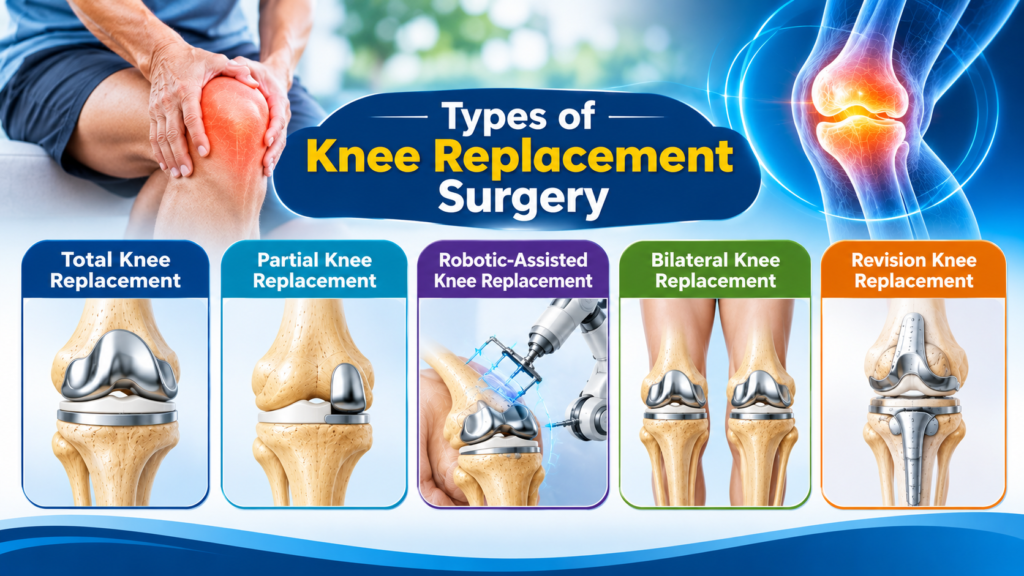
There are five main types of knee replacement surgery. The right one for you depends on how much of the knee is damaged, your overall health and your surgeon’s advice. Knowing the type also helps you understand your cost estimate, because each type is priced differently.
| Type of knee replacement | What it means | Usually suggested when |
| Total knee replacement (TKR) | All the damaged joint surfaces are replaced | Arthritis affects the whole knee (most common) |
| Partial knee replacement | Only the damaged part (compartment) is replaced | Damage is limited to one side of the knee |
| Robotic-assisted knee replacement | A robotic system helps the surgeon plan and position the implant | Higher precision is wanted and the budget allows |
| Bilateral knee replacement | Both knees are replaced, in one operation or two | Both knees are badly damaged |
| Revision knee replacement | An old implant is replaced or repaired | The earlier implant has worn out, loosened or got infected |
How Much Does Knee Replacement Surgery Cost in India?
The type of surgery changes the bill more than anything else. Partial knee replacement is the cheapest, and revision surgery (redoing an old replacement) is the most expensive.
Total vs partial knee replacement cost in India (2026)
| Type of surgery | Starting cost | Average cost | Upper range |
| Partial knee replacement | ₹1,00,000 | ₹1,50,000 | ₹2,00,000 |
| Total knee replacement (one knee) | ₹1,50,000 | ₹2,00,000 | ₹4,00,000 |
| Bilateral (both knees) replacement | ₹2,20,000 | ₹3,00,000 | ₹3,70,000 |
| Robotic-assisted knee replacement | ₹2,50,000 | ₹3,75,000 | ₹5,00,000 |
| Revision knee replacement | ₹3,00,000 | ₹5,50,000 | ₹8,00,000 |
Is replacing both knees together cheaper than two separate surgeries?
Yes. When both knees are replaced in one operation, you pay once for the operation theatre, anaesthesia and hospital stay. That is why both-knee surgery usually costs around 1.6 to 1.75 times the cost of one knee, not double .
Whether both knees can be done at the same time depends on your age, overall health and your surgeon’s advice.
Is robotic knee replacement worth the extra cost in India?
Robotic knee replacement helps the surgeon plan the operation using a 3D model of your knee and position the implant more precisely. The surgeon stays in control throughout; the robot does not operate on its own.
It usually costs ₹50,000 to ₹1.5 lakh more than conventional surgery. The main benefits are more precise implant placement and better planning. Some patients also recover faster, but results vary, and robotic surgery does not guarantee less pain.
Bottom line: it depends on your knee condition, budget and surgeon. A conventional knee replacement done by an experienced orthopaedic surgeon also gives excellent results. Discuss both options, and their total cost, with your surgeon before deciding.
Is Knee Replacement Safe in Government Hospitals Like AIIMS?
Yes. Government hospitals are the most affordable option for knee replacement in India, and many of them perform a high number of joint replacements with senior surgeons.
For example, AIIMS Nagpur reported 550 joint replacements in three years under the PM-JAY and state health schemes . AIIMS Bilaspur now also offers robotic knee replacement .
The main drawback is the waiting list, which can stretch for weeks or months. If your pain is severe, ask about both the government and private options.
Knee Implant Price in India 2026: Price Caps and Types
A standard cobalt chromium knee implant set costs about ₹76,474, and a premium titanium or oxidised zirconium set about ₹1,07,136, including GST. These figures cover only the implant parts, not the full cost of the surgery.
The National Pharmaceutical Pricing Authority (NPPA) has capped knee implant prices in India since August 2017, which made them far more affordable . Check the latest NPPA notifications for current ceiling prices.
Knee implant price list by component
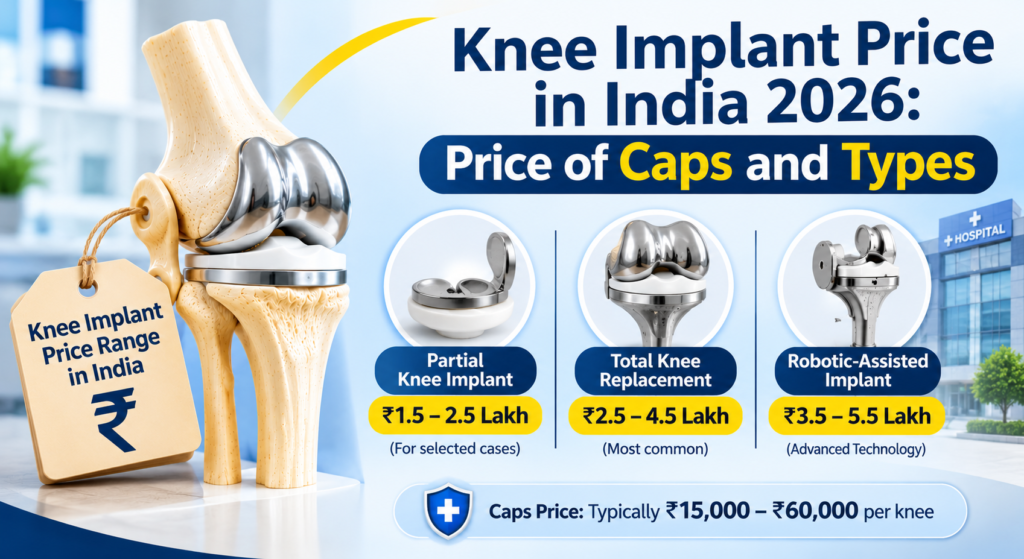
A knee implant has four main parts. These prices come from Apollo Hospitals’ published list, updated 20 January 2025.
| Knee implant part | Cobalt chromium (standard) | Titanium / oxidised zirconium (premium) |
| Femoral component (thigh bone side) | ₹33,667 | ₹54,141 |
| Tibial tray (shin bone side) | ₹23,744 | ₹33,933 |
| Polyethylene insert (plastic cushion) | ₹13,347 | ₹13,347 |
| Patellar component (kneecap) | ₹5,716 | ₹5,716 |
| Total implant cost (incl. GST) | ≈ ₹76,474 | ≈ ₹1,07,136 |
Prices may change; confirm current rates with your hospital.
A full revision knee implant set, used when an old implant must be replaced, costs about ₹1.59 lakh on the same list. The final amount depends on the parts needed and your condition.
Which knee implant is best for me?
- Cobalt chromium: the most widely used and proven material. It suits most patients above 60.
- Titanium or oxidised zirconium: costs about ₹30,000 more. It is often suggested for younger, active patients or people with a metal allergy.
Ask your surgeon which implant fits your age and lifestyle. After surgery, ask for the implant sticker and bill; you have a right to see the MRP.
Does Health Insurance or Ayushman Bharat Cover Knee Replacement?
Yes. Most health insurance plans and the government’s Ayushman Bharat scheme cover knee replacement when a doctor says it is medically needed. How much you finally pay depends on the points below.
Does health insurance cover knee replacement surgery in India?
- Waiting period: knee replacement for arthritis is usually treated as a planned surgery or pre-existing condition. Many policies pay only after 1–4 years of cover.
- Sub-limits: some policies cap joint replacement at a fixed amount, such as ₹1.5 lakh, even if your sum insured is higher.
- Room rent limit and co-pay: choosing a room above your limit can reduce the whole claim. Senior citizen plans often have a 10–20% co-payment.
- Cashless claim: pick a network hospital and apply for pre-authorisation 3–7 days before surgery.
Is knee replacement free under Ayushman Bharat (PM-JAY)?
Yes, for eligible patients. Total knee replacement, including revision surgery, is covered under PM-JAY, as the government confirmed in Parliament . At empanelled hospitals the scheme pays about ₹80,000–90,000 per knee, and the patient pays nothing.
- Who is eligible: families listed under PM-JAY, and all senior citizens aged 70 and above under the expanded scheme. Check at pmjay.gov.in.
- Both knees: packages are usually per knee, so a one-sitting bilateral surgery may need a small top-up.
- State schemes: many states run their own schemes too, such as Maharashtra’s MJPJAY.
Other ways to pay for knee replacement surgery
- CGHS and ECHS: central government employees, pensioners and ex-servicemen can get the surgery at approved rates.
- Medical EMI: many hospitals and lenders offer no-cost or low-cost EMI over 6–24 months.
- Tax benefit: health insurance premiums can lower your taxable income; ask your tax adviser how this applies to you.
Knee Replacement Recovery Time: Week-by-Week Timeline
Most people walk with support within 1–2 days, return to daily routines in about 6 weeks, and feel fully recovered in 3–6 months. Regular physiotherapy is the biggest factor in how fast you recover.

| When | What usually happens |
| Day 0–1 | Surgery; you sit up and move your leg in bed |
| Day 1–2 | First steps with a walker, guided by a physiotherapist |
| Day 2–5 | Practise stairs; go home if there are no problems |
| Week 1–2 | Walker at home; daily exercises; stitches or staples removed |
| Week 2–4 | Move from walker to walking stick; knee bends more |
| Week 4–6 | Most daily tasks; outpatient physiotherapy |
| Week 6–8 | Back to desk work; some people can drive again |
| Month 3–6 | Long walks, light exercise, near-normal life |
How long does a knee implant last?
Modern knee implants often last 20–25 years or more. Keeping a healthy weight, staying active with low-impact exercise such as walking and cycling, and avoiding high-impact sports all help your new knee last longer.
What is the success rate of knee replacement in India?
Indian hospitals report success rates above 90%, which means most patients get major pain relief and better movement. More than 2.5 lakh knee replacements are done in India every year, including many for international patients.
Frequently Asked Questions About Knee Replacement Cost in India
1. What is the average cost of knee replacement surgery in India in 2026 ?
About ₹2.5 lakh for one knee. It ranges from roughly ₹1.5 lakh in smaller cities to ₹4 lakh or more in premium metro hospitals.
2. What is the cost of both knee replacement in India ?
Bilateral knee replacement usually costs ₹2.2–3.7 lakh, and more in premium hospitals. It costs less than two separate surgeries because theatre and stay charges are shared.
3. How much does robotic knee replacement cost in India ?
Between ₹2.5 lakh and ₹5 lakh for one knee, depending on the city, hospital and robotic system.
4. What is the price of a knee implant in India ?
A standard cobalt chromium implant costs about ₹76,500, and a titanium or oxidised zirconium implant about ₹1.07 lakh, including GST.
5. Is knee replacement free under Ayushman Bharat ?
Yes, for eligible patients at empanelled hospitals. The treatment is cashless and covers surgery, implant and hospital stay. Seniors aged 70 and above are also eligible.
6. Does health insurance cover knee replacement surgery ?
Most plans do, usually after a waiting period of 1–4 years. Check your policy for sub-limits, room rent limits and co-payment.
7. Which city is cheapest for knee replacement in India ?
Tier 2 cities such as Jaipur, Lucknow, Indore, Nagpur and Coimbatore average about ₹2.1 lakh, around ₹1 lakh less than metro cities.
8. What is the best age for knee replacement surgery ?
There is no fixed age. Most patients are between 55 and 80. The decision depends on pain, X-ray findings and how much daily life is affected.
9. How many days is the hospital stay after knee replacement ?
Usually 3–5 days for one knee and 6–8 days for both knees.
10. Can I walk after knee replacement surgery ?
Yes. Most patients take their first steps with a walker within 24–48 hours and walk without support in 4–6 weeks.
Final Word: Plan Your Knee Replacement Cost, Don’t Fear It
Knee replacement in India is one of the most affordable and successful surgeries in the world, costing about ₹2.5 lakh on average in 2026. Government price caps on implants, Ayushman Bharat cover and wide insurance support have put it within reach of many more families.
Your next steps are simple:
- See an orthopaedic surgeon and confirm which type of surgery you need.
- Get two or three written quotes that name the implant, room type and number of nights.
- Check your health insurance, Ayushman Bharat or CGHS/ECHS eligibility.
- Choose the surgeon with the most experience, not just the lowest price.
Disclaimer: This article is for general information only and is not medical or financial advice. Costs are indicative estimates and vary by hospital, city, surgeon, implant and your health. Please consult a qualified orthopaedic surgeon and get a written estimate from the hospital before making decisions.