
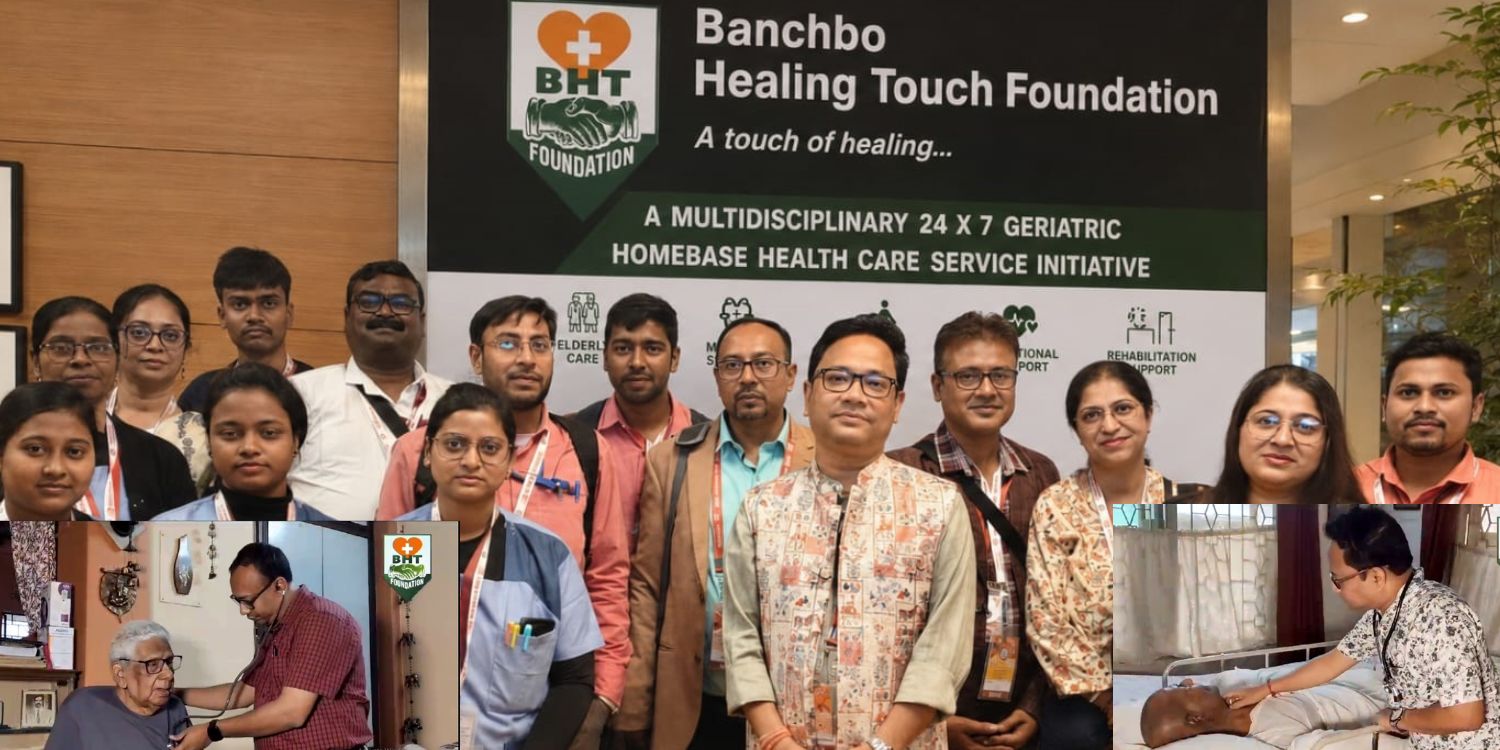
India has long upheld the cultural principle of “Mata Pitro Devo Bhava,” where caring for one’s parents is regarded as a moral and familial responsibility. As a result, the idea of structured healthcare services specifically designed for senior citizens remained largely underdeveloped for decades. However, as age-related health conditions become more complex, the need for professional intervention becomes increasingly critical outweighing the social stigma.
It is within this evolving context Eastern India’s first multidisciplinary geriatric home healthcare provider, the Banchbo Healing Touch Foundation (BHTF), was founded in 2007 by Dr. Dhires Kumar Chowdhury, emerged as an early and structured response to a significant gap in elderly healthcare.
Bridging Care and Home
BHTF began on uncertain footing at a time when organized home-based healthcare for senior citizens was largely unheard of, particularly in Eastern India. During his early medical years, Dr. Chowdhury encountered a recurring pattern: elderly patients required not only episodic medical attention but sustained care, supervision, and emotional support within their homes.
Some of the early concerns rooted around financial sustainability and scalability. However, Dr. Dhires sustained effort, professional trust, and receives continued support from patients, well-wishers, and members of the medical community. Over time, this collective backing allowed BHTF to evolve into a consistent and uninterrupted service, now continuing for more than 19 years.
Reframing Elderly Support
At its core, BHTF operates as a 24×7 multidisciplinary geriatric home healthcare service, positioning itself as a “one-stop” solution for elderly care. Unlike other care providers in the region, the organisation prioritizes continuity of care within the patient’s home environment. The organization also opens supporting doors through 24×7 emergency call support for the families where dedicated Emergency Medical Unit assure prompt assistance whenever required.
Its service framework integrates both medical and non-medical support systems, including physician visits, nursing care, physiotherapy, diagnostic services, medication management, and assistance with daily living activities. BHTF provides a specialized Dementia Home Care Support to address one of the most challenging and rapidly growing healthcare needs in old age. Care plans are structured around individual patient profiles, accounting for chronic conditions, mobility limitations, cognitive health, and social circumstances.
Structured Growth in Geriatrics
BHTF provided exemplary and uninterrupted service delivery during the COVID-19 pandemic and with over nearly two decades of operation, BHTF has transitioned from a localized initiative to a structured service network, primarily operating across South Kolkata, Salt Lake, New Town, and adjoining areas.
As of April 2026, BHTF has enrolled over 1,800 members and delivered more than 181,000 hours of service. Its clinical engagement includes tens of thousands of scheduled doctor visits, home-based diagnostic tests, emergency responses, and specialist consultations conducted within patients’ homes.
The organisation functions through a coordinated team of empanelled doctors, nurses, caregivers, and allied health professionals.
Formalising a Non-Profit Structure
A significant structural milestone for BHTF was its transition into a Section 8 company in 2024, formalizing its status as a not-for-profit healthcare organisation. The organisation is recognized by NITI Aayog and holds institutional affiliation with the Geriatric Society of India, Additionally, its recent recognition with a regional social impact award highlights its positioning within the non-profit healthcare ecosystem.
BHTF’s model extends beyond direct patient services into training and workforce development, addressing one of the most significant gaps in Indian geriatric care; the shortage of trained personnel. The organisation independently as well as in collaboration with Ramakrishna Mission Vidyamandira, conducts skill development programs aimed at building a workforce equipped to manage elderly patients in home settings. This includes training caregivers and support staff in both clinical assistance and patient interaction, emphasizing dignity, safety, and continuity of care.