
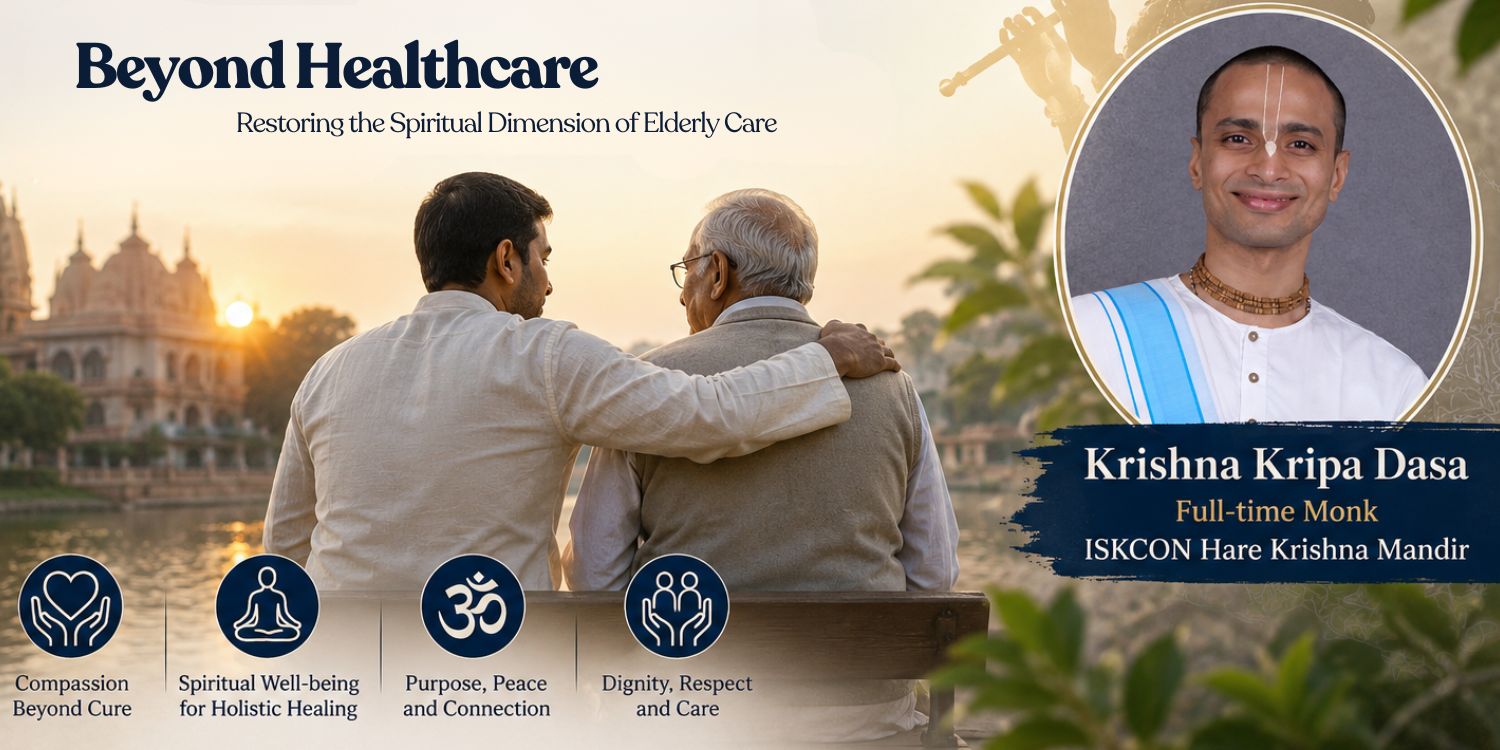
Old age is one appointment none of us can cancel. We may manage disease, remain active and benefit from advances in medical science, but ageing itself remains unavoidable. Yet most conversations on elderly care focus almost entirely on the body: medicines, mobility, safety, nutrition and comfort. All of these are essential. But are they complete?
The Vedic tradition asks a deeper question: when the body is ageing, who is the person we are actually caring for?
The Bhagavad-gita explains that the same conscious self passes through childhood, youth and old age, and continues beyond death (2.13). The body changes, but the person within remains.
This does not make healthcare less important. A.C. Bhaktivedanta Swami Prabhupada, the founder-acharya of the International Society for Krishna Consciousness (ISKCON) and a renowned commentator on the Bhagavad-gita and Srimad-Bhagavatam, repeatedly emphasized that the body should be properly maintained so that human life can be used for its higher spiritual purpose.
Physical care, therefore, is a duty—but it is not the whole of care.
For an elderly person, this understanding can transform the meaning of ageing. The later years of life need not be viewed merely as a period of decline. Vedic wisdom presents them as an opportunity for what Prabhupada called “spiritual regeneration”—a gradual shift from material responsibilities towards reflection, self-realization and preparation for the next stage of existence.
Instead of asking only, “How can I live a little longer?” one can also ask, “How should I use the life that remains?”
The Srimad-Bhagavatam gives a striking example in Dhritarashtra. In advanced age, his body was deteriorating, yet he remained deeply attached to security and material comfort. His brother Vidura intervened forcefully, reminding him of the reality of old age and approaching death.
His words were severe—even comparing Dhritarashtra’s dependence to that of a household dog—but their purpose was not humiliation. They were meant to awaken him.
The intervention changed the direction of Dhritarashtra’s remaining life. He gave up his attachments, entered a spiritually conducive environment, disciplined his mind and senses, and fixed his consciousness upon the Supreme Lord.
There is an important lesson here: sometimes genuine care means helping an elderly person address realities that physical comfort alone cannot solve.
A gentler model appears in Devahuti and her son, Lord Kapila. Kapila remained with His mother and provided something beyond material security: spiritual knowledge. Through His guidance, she progressed towards self-realization and freedom from fear.
For families today, the principle is significant. Caring for ageing parents certainly includes food, medicine, safety, companionship and dignity. But it can also include helping them deepen their relationship with God.
The story of Ajamila makes the importance of the holy name of God especially powerful.
After spending much of his life away from spiritual principles, Ajamila reached the point of death and helplessly called out the name “Narayana.” That utterance of the Lord’s holy name became a turning point. Given another opportunity, he seriously pursued spiritual life and ultimately attained spiritual perfection.
Ajamila also regretted having abandoned his own elderly parents when they had no one else to care for them. His story therefore teaches both sides of elderly care: children have a responsibility towards ageing parents, and no person should ever be considered spiritually “too old” or “too late.”
This is why chanting the holy names of God can have an important place in spiritual elderly care.
Within the Krishna bhakti tradition, particular emphasis is given to chanting the Hare Krishna maha-mantra:
Hare Krishna, Hare Krishna, Krishna Krishna, Hare Hare
Hare Rama, Hare Rama, Rama Rama, Hare Hare.
The practice is simple. It requires no complex physical ability, expensive equipment or elaborate arrangement. An elderly person may chant personally, hear family members chant, or simply listen to the holy names in a peaceful environment.
For a family rooted in Krishna bhakti, spiritual care can therefore be very practical: reading the Bhagavad-gita or Srimad-Bhagavatam together, chanting the Hare Krishna maha-mantra, keeping sacred images of the Lord nearby, offering prasadam and charanamrita, arranging temple visits or pilgrimages when health permits, and providing uplifting spiritual association.
As the end of life approaches, the atmosphere can remain peaceful and devotional, allowing the person to hear the holy names and remember God.
This is not a substitute for medicine, pain management or professional care. Spiritual care should complement physical care, not compete with it.
The Bhagavad-gita gives particular importance to consciousness at the time of death. Krishna says, “Whoever, at the end of his life, quits his body remembering Me alone at once attains My nature” (8.5). Such remembrance is not expected to appear magically at the final moment; it is cultivated through a life of hearing, chanting and remembering God.
There is also a comforting truth for an elderly person facing loneliness. The Bhagavad-gita explains that Krishna is present within the heart of every living being as Paramatma, the Supersoul (18.61).
Family members may live far away. Friends may depart. Physical abilities may diminish. Yet from the Vedic perspective, the Supreme Lord remains the constant companion within the heart.
Bhishmadeva offers one more important lesson. As he lay approaching death on a bed of arrows, he was not regarded merely as a patient. Krishna, Yudhishthira and great sages gathered around him to hear his wisdom. Even near the end of life, he was still able to guide another generation.
An elderly person, therefore, should not be viewed merely as a recipient of care. He or she may remain a reservoir of experience, wisdom, blessings and spiritual insight.
A complete model of elderly care should care for the body with competence, the emotions with affection, the person with dignity, and the soul with spiritual opportunity.
We plan retirement funds because old age is coming. We arrange health insurance because illness may come. Perhaps we should also prepare for the one transition that no insurance policy can prevent.
The question is not whether we should care for the body. We certainly should.
The deeper question is whether our care ends with the body.
The body will eventually have to be left behind. Compassionate elderly care should therefore help a person live the remaining years meaningfully—and, when the final moment arrives, face it with medical support, loving family, spiritual clarity, remembrance of God and the sound of His holy names.
References:
Bhagavad-gita As It Is: 2.13; 8.5–6; 18.61.
Srimad-Bhagavatam: 1.9; 1.13; 2.1.16; 3.24–33; 6.1–2; 7.6.5.
A.C. Bhaktivedanta Swami Prabhupada, Bhaktivedanta Book Trust.
Author:
Krishna Kripa Dasa is a full-time monk serving at ISKCON Hare Krishna Mandir, Ahmedabad
Bio:
Krishna Kripa Dasa is a full-time monk serving at ISKCON Hare Krishna Mandir, Ahmedabad, with over a decade of spiritual service. A B.Tech graduate in Electronics Engineering and a college topper trained in network security and ethical hacking, he transitioned from a career path in technology to a life dedicated to Krishna consciousness. Today, he shares timeless Vedic wisdom through talks, writings, and digital outreach, and is a prominent spiritual content creator associated with “Hare Krishna Sanga”, reaching over 1 million subscribers and followers worldwide.