
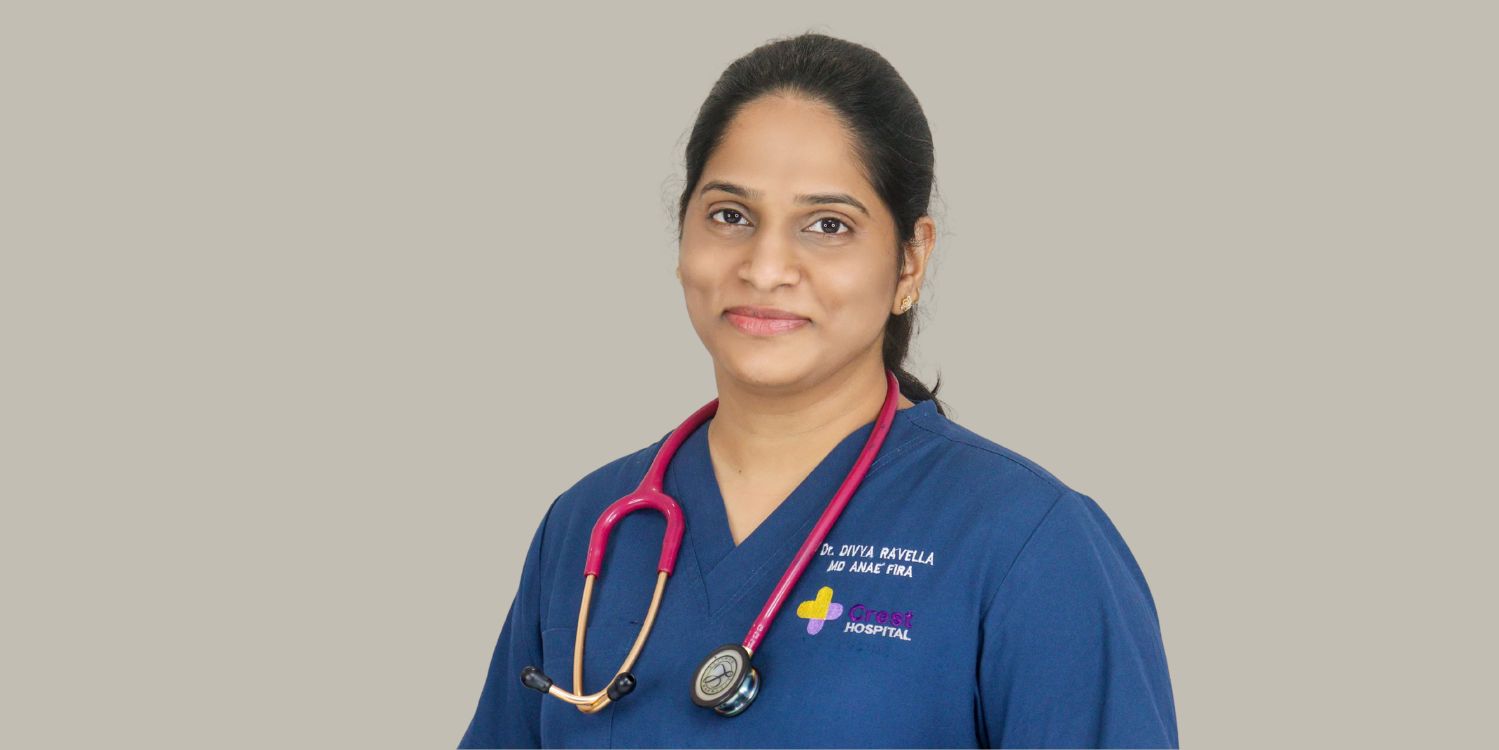
For most patients, the anaesthesiologist is a fleeting presence, a few reassuring words before the lights dim, and someone they may never consciously meet again. Dr. Divya Ravella, Anaesthesiologist and Acute Pain Physician at Crest Hospital, Vijayawada, has built an 11-year career precisely inside that fleeting window, turning it into one of the most consequential relationships in a patient’s surgical journey.
A Choice, Not a Chance
Dr. Divya Ravella is emphatic that medicine was never an accident of circumstance. “Medicine was always a field of interest to me,” she says, “because it was always something where innovations are happening all over the world, and you can get to use them when you have the access to it.” That early fascination with science eventually narrowed into a very specific pull toward the operation theatre, and, within it, toward anaesthesiology.
What drew her in wasn’t the technical precision alone, but the intensity of the decision-making. “We need to know a lot about the patient and make a customised plan and make critical decisions… there’s no time to make a decision. You just have to do the best for the patient then and there.” It was only during her residency that the fuller shape of the specialty revealed itself to her, not merely the hours spent inside the OT, but the entire arc of perioperative care, from the moment a patient is wheeled into the 48–72 hours that follow.
Learning the Language of Reassurance
One of the more candid parts of her reflection is how uncomfortable she initially found the human side of the job. “Initially, choosing the words were difficult for me,” she admits. It was watching her seniors and consultants counsel frightened patients and families that taught her what textbooks couldn’t, how to translate clinical complexity into language a frightened patient could actually hold onto.
Over time, in the ICU and through her postgraduate training, that discomfort gave way to a defined philosophy – those few pre-operative minutes with a patient, however brief, however easily forgotten by the patient afterward, shape their entire emotional state going into surgery, and by extension, their recovery. “We are the middlemen there,” she says simply.
The Case She Carries With Her
Asked to recall a defining moment from her practice, Dr. Divya didn’t reach for routine success, she reached for a crisis. A young woman, 31, came in for an emergency C-section after the baby’s heart rate dropped during labour. The delivery itself went smoothly. But soon after, her vitals collapsed, witnessing a sudden, severe postpartum haemorrhage.
Massive transfusion protocol was activated, the general surgical team was pulled in, and Dr. Divya Ravella found herself running contingency plans in real time from “plan A, B, C”, while managing haemodynamics and keeping the surgical team in closed-loop communication. When conservative measures failed to control the bleeding, the team made the difficult call to perform a hysterectomy. The patient ultimately required roughly double her blood volume in transfusions before stabilising. She was discharged within four days.
For Dr. Divya, the case crystallised a principle she now treats as a professional belief – “In anaesthesia, preparation is often the most sophisticated form of intervention. The best outcomes frequently depend on what the team has anticipated and prepared before the crisis actually unfolds.”
This same anticipatory instinct defines her approach to the cardiac and critically ill patients she frequently manages, a core part of her practice alongside obstetric, bariatric, paediatric and orthopaedic anaesthesia. “There’s no such thing as a one-size-fits-all approach in anaesthesia,” she says.
A Specialty Shedding Its Old Image
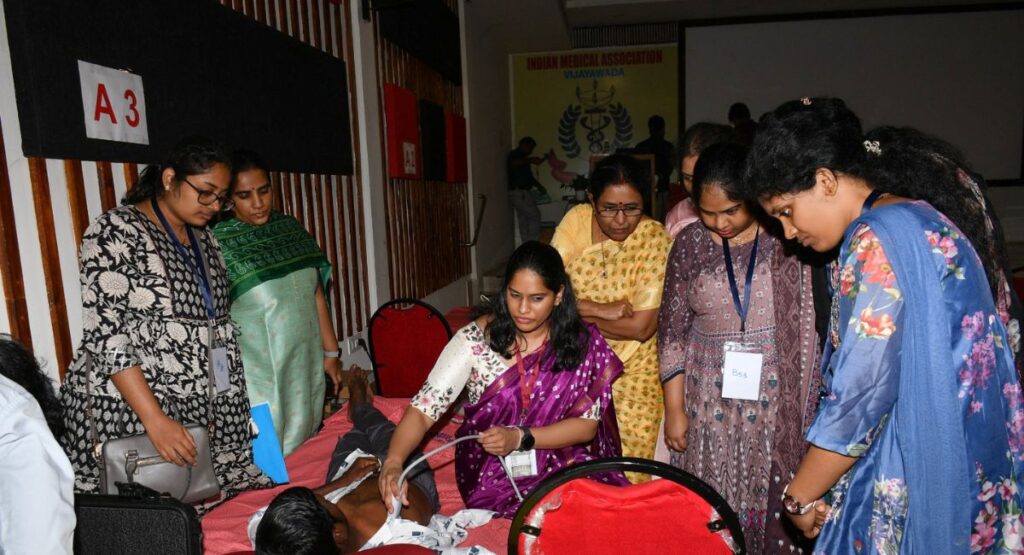
Dr. Divya Ravella through this feature sheds light about the misconceptions still attached to her field. “People still assume it’s like someone who stays in the operation theatre, and that’s it,” she says, but that perception, she insists, is outdated. Anaesthesiology today branches into critical care, chronic and acute pain management, cardiac and neuroanaesthesia, and paediatric anaesthesia, each offering a distinct path for young doctors to specialise in. Her advice to students eyeing the field is direct: it demands speed, adaptability, and constant learning, “jack of all trades, but master of none… but oftentimes better than the master of one.”
This diversification is also visible in her own academic life. She currently serves as Honorary Secretary of the Vijayawada Society of Anaesthesiologists and is a regular faculty speaker at national conferences. Last year, she co-authored an internal audit-style research paper examining patient comfort and satisfaction scores under regional anaesthesia across 23 hospitals, work she describes as a natural extension of preparing for conference lectures.
Staying Grounded in a Demanding Field
Off the clock, Dr. Divya Ravella is unusually forthright about what sustains her through a specialty she describes as inherently unpredictable. Two anchors, she says: family and physical fitness. “Behind every professional milestone, there is often a family that has quietly absorbed all the pressures.” Regular workouts, reading self-help books, and short breaks away from clinical life round out a routine she treats not as indulgence but as necessity. “You cannot pour from an empty cup.”
On India’s Anaesthesia Landscape
Looking at the field nationally, Dr. Divya doesn’t see a technology gap, she believes India’s equipment, drugs, and training infrastructure are on par with the West, and in terms of workload, ahead of it. What she does see is a persistent gap in equity of access and its comparatively thin research output, though she notes it’s been improving steadily over the past decade or so.
Ever the physician even outside the OT, she closes with practical advice for readers: women, she suggests, should begin routine health checkups and bloodwork by their early-to-mid 30s, alongside regular screenings as they age, because, in her words, “anything diagnosed early can be treated,” while lifestyle conditions like diabetes and hypertension, if caught early, can often be managed with modest changes rather than allowed to compound into worse outcomes.