
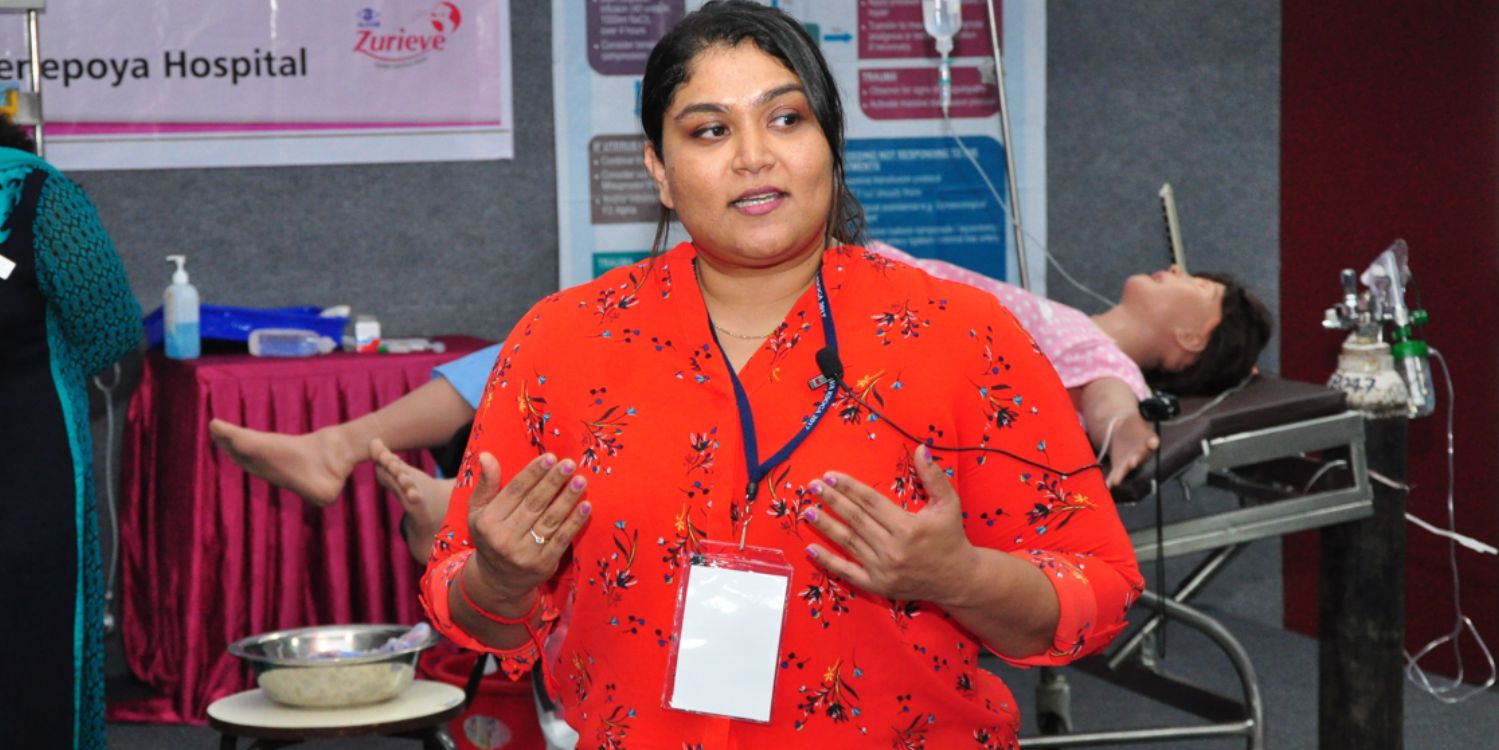
Most anaesthesiologists are measured by the patients they’ve safely carried through crisis. Dr. Meghna Mukund, Professor at Yenepoya Medical College Hospital, Mangaluru, has built her name doing something rarer – recreating those crises deliberately, inside the actual emergency department, with the actual clinical team, so that the real version never has to happen. Under her leadership, Yenepoya’s simulation centre became the first in India to be accredited by ASPiH, the UK’s Association for Simulated Practice in Healthcare, a distinction that places her work in a small, specific category anaesthesiologists who treat patient safety not as a habit to instil in individuals, but as a system to be stress-tested and rebuilt.
Chasing the Adrenaline, Then Chasing the Cause
Dr. Meghna Mukund is disarmingly direct about what first drew her to anaesthesiology. “I thrive on adrenaline,” she says. “I wanted a specialty where things could change within seconds, where you had to think quickly, act decisively, and yet remain calm when everyone around you was anxious.” What kept her in the field, though, was its unexpected breadth. “An anaesthesiologist can relieve pain, anaesthetise a patient, manage an airway, respond to an emergency, care for a critically ill patient, and often become the person coordinating a crisis,” she says. “I realised that anaesthesiology allowed me to remain a complete doctor.”
Over time, her definition of what made a good anaesthesiologist shifted. It was no longer only about the patient in front of her, but a broader question that now drives much of her work: “How can I make the system safer for the next patient?”
From Clinical Medicine to Systems Thinking
Her professional path has been shaped, in her words, by three threads – clinical medicine, teaching, and patient safety. Clinical anaesthesia, with exposure to critical care and emergency medicine, gave her the foundation. Working in a teaching hospital surfaced a second calling entirely, education, and a realisation that in an emergency, knowing the correct answer is only part of the job. Communication, teamwork, leadership, and decision-making under pressure matter just as much.
That insight pulled her toward simulation-based medical education, and eventually toward a further, more ambitious question – could simulation be used not just to train people, but to test the healthcare system itself? “That led me towards using simulation as a quality-improvement tool,” she says, “identifying communication gaps, workflow problems and system vulnerabilities, redesigning processes, and then testing whether those changes actually made care safer.”
Taking the Simulation Out of the Classroom
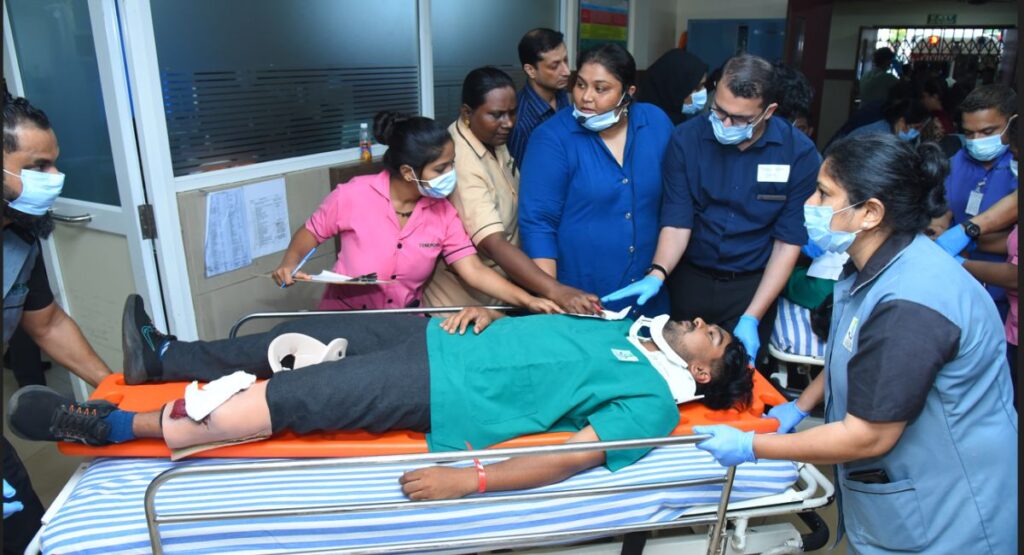
Dr. Meghna Mukund’s in-situ simulations in the Emergency Department recreate recent near-miss events, debrief participants without blame, and use what surfaces to write new standard operating procedures. Code yellow drills test mass-casualty preparedness. A low-cost, 3D-printed cricothyrotomy model makes airway-emergency training accessible without expensive equipment. “If a system is supposed to work in a particular way,” she says, “I believe we should be able to simulate it, stress-test it, and identify where it breaks down before that failure affects a real patient.”
Her outreach has pushed well past hospital walls. She has led CPR and first-aid training for police personnel, auto-rickshaw drivers, and surfers. “The first responder may not be a doctor,” she says. “So why should CPR education be limited to doctors?”
What Stays With Her
Rather than pointing to a single defining case, Dr. Meghna describes a recurring kind of moment, where a patient’s condition suddenly shifts, and the anaesthesiologist steps in to assess, secure the airway, support circulation, and coordinate the team in real time. “The goal is not to become comfortable with chaos,” she says. “The goal is to become so prepared that you can bring order to chaos.” Some of her most satisfying moments, though, happen outside the OT entirely, watching a student who once faced a simulated crisis respond with real confidence when a similar situation occurs in practice, or watching a team realise that a problem wasn’t one person’s error, but a system quietly allowing errors to happen. “That is when simulation becomes much more powerful,” she says. “It gives us an opportunity to find the error before it reaches the patient.”
A Measured View on AI
Dr. Meghna Mukund sees artificial intelligence as a tool for addressing human factors, not replacing clinical judgment. “Even the most experienced clinician can be affected by fatigue, cognitive overload, distraction, or incomplete information,” she says. She envisions AI as “the anaesthesiologist’s second set of eyes,” helping predict difficult cases and flag risk before it materialises. Her broader ambition, admittedly aspirational rather than a literal claim, is unambiguous – “Safe anaesthesia. Safe anaesthetists. Safer systems.”
Advice, and a Life Outside Medicine
Her message to young doctors entering the field is simple but direct – “Learn to communicate. Learn to teach. Learn to lead. Learn how systems work. And learn from every error.” She urges them to look beyond their own specialty, noting that some of the most important safety improvements happen when different professions train together.
Off the clock, Dr. Meghna Mukund has trained in Bharatanatyam and competed in dance and choreography, a practice she describes as offering something medicine can’t. “It allows me to be creative, energetic, and completely in the moment,” she says. Family keeps her similarly grounded, offering a version of herself that exists apart from the white coat. “Stepping away from medicine is not a sign that you are less committed to it,” she says. “Sometimes you need to step away, dance, laugh, spend time with family, and recharge, so that when you return, you can give your patients the very best version of yourself.”