
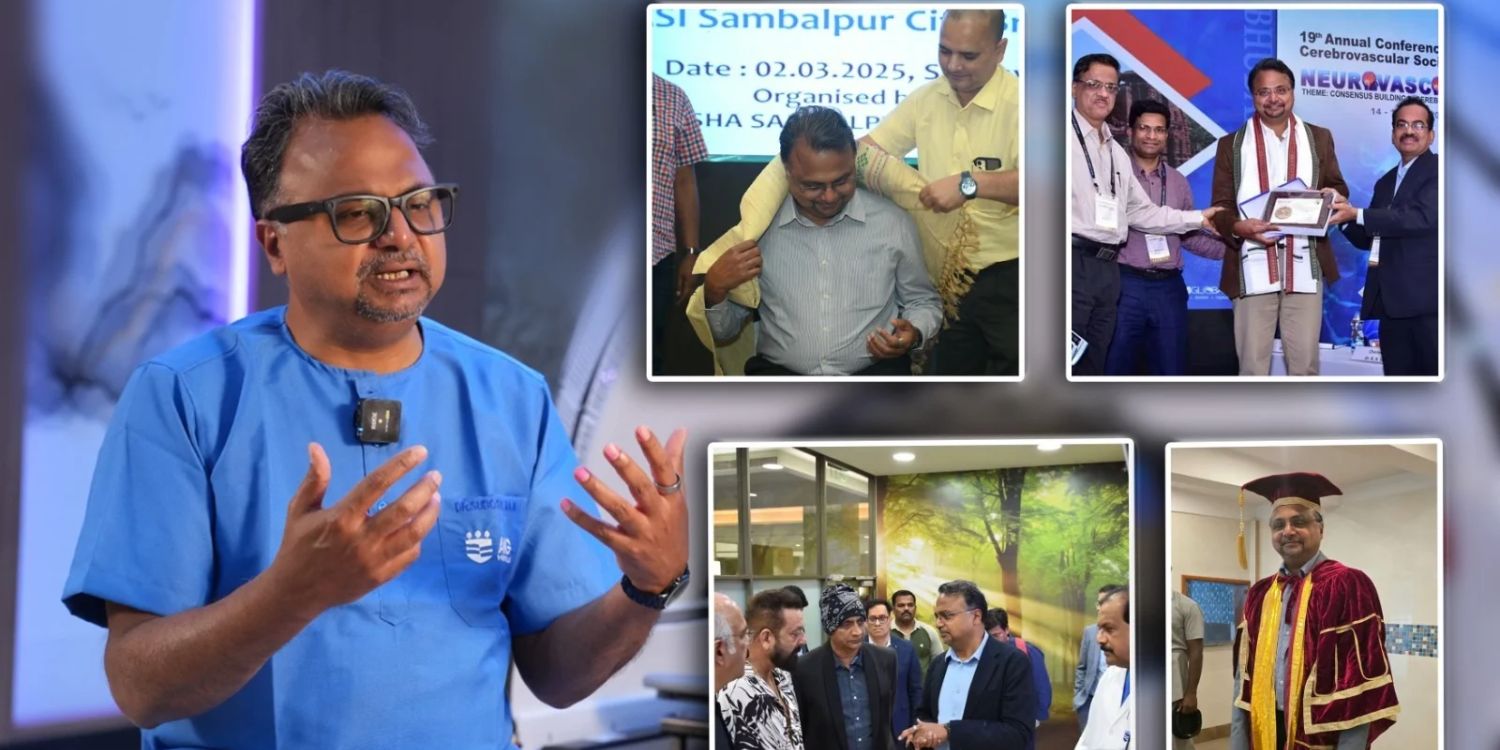
There’s a persistent myth around medicine that it demands rote memorisation, the mugging up of impossibly thick textbooks, page after page committed to memory through sheer repetition. Dr. Subodh Raju never quite subscribed to that myth, and perhaps that’s precisely why he excelled. Physics, not biology, was his first love as a student; he was, by his own admission, chasing an analytical, mathematical way of seeing the world. But when destiny (and a medical entrance exam) redirected him toward medicine, he carried that same lens with him.
That analytical instinct found its truest calling in neurosurgery, a field he describes as being “more like mathematics” than conventional medicine, a discipline of precision, pattern, and problem-solving under pressure. Over more than two decades, that instinct has translated into a career spanning pioneering endoscopic brain surgery, a rare early commitment to the once-neglected field of paediatric neurosurgery, and a body of research spanning 35-plus publications. As Director & Head of Department for Neurosurgery, Spine Surgery, and ZAP-X Neuro Radiosurgery at AIG Hospitals, Dr. Subodh Raju represents a blend of the surgeon’s precision and the scientist’s curiosity, which is exactly why we’re proud to feature him among India’s Most Distinguished Leaders in Neurosurgery 2026.
A Calling Toward Neuroscience
Dr. Subodh Raju’s roots trace back to Rourkela, an industrial town in Orissa, a setting far removed from the corridors of premier medical institutions he would later walk. It was during his years studying medicine that his curiosity gravitated toward neuroscience, drawn in by its mathematical, almost architectural quality. Whether that curiosity would lead him toward neurosurgery or neurology remained unclear for a while, but by the end of his internship, the answer had crystallised. Neurosurgery was the path he chose, and there was no looking back from that point.
He went on to complete his master’s, then prepared rigorously for the entrance examination that would take him to AIIMS, New Delhi. The transition from a state background to a central institute of that stature was no small leap. He describes it candidly as one of the bigger challenges of his early life, entering unfamiliar territory with no real frame of reference for what lay ahead. Yet he pushed through, secured his place, and it was there that his neurosurgical career truly began to take shape.
According to Dr. Raju, his move to Hyderabad was never a planned decision, arriving instead as another turn of fate after he completed his training at AIIMS and spent a brief stint in Vijayawada. Since settling in Hyderabad in 2003, the city has shaped him considerably, and he has approached every circumstance he’s encountered there with the same commitment to giving his best.
What sets his practice apart, even amid a demanding clinical career, is that academics has never taken a back seat. He remains actively involved in training DNB students, delivering lectures at conferences, and conducting workshops aimed at mentoring the next generation of surgeons. For him, clinical practice and academic engagement are meant to progress hand in hand, not as separate pursuits.
A Lesson in Humility
Long before paediatric neurosurgery found its footing as a recognised specialty, Dr. Subodh Raju had already staked his claim in it. Back in 2005 to 2006, he noticed a gap that few were addressing – a steady stream of young patients whose neurological conditions came with challenges distinct from those of adults.
Widely regarded as among the first in Hyderabad to have taken up this niche in earnest, two decades on, paediatric cases still make up roughly a fifth to a third of his overall practice. “It requires more skill, more patience, and more technique,” he says of the discipline, adding that this complexity is exactly what keeps him invested in it. Beyond his own caseload, he counts among his contributions the students he’s mentored along the way, several of whom have gone on to build their own practices in paediatric neurosurgery.
Ask him for a standout memory, and he doesn’t struggle for options. Children he’s operated on have grown into adulthood, and in a handful of cases, grateful parents have even named their child after him. One story stands out in particular, where a young patient with a sizable brain tumour, born to parents who were themselves doctors. Nearly two decades later, that child continues to thrive. On the adult side, he points to marathon tumour surgeries stretching eight to nine hours, treating patients who travel from across the country, often through techniques he specialises in, such as endoscopic and minimal access brain surgery, that yield outcomes he describes as genuinely rewarding.
But it’s a lesson from his own professor that seems to anchor his approach to success and failure alike. “If you do something good as a surgeon, there’s no extra credit or commendation for it, because that’s what’s expected of you as a doctor,” he explains. “But if an outcome isn’t as expected, or something goes wrong, that’s when you have to introspect and look back.”
Dr. Subodh Raju specifically sheds light about the split-second decisions surgery demands, and if bleeding occurs mid-procedure, the instinct has to be patience, not panic. Within seconds, he says, you need to reboot mentally rather than turning jittery or losing confidence, because neurosurgery deals with such delicate structures that composure itself becomes a clinical skill.
Keeping Pace
Medical technology, in Dr. Subodh Raju’s view is advancing at the same pace as the broader technological landscape. His own approach has been to stay aligned with every emerging advancement rather than fall behind.
He is candid about the cost implications which come along. Investing in better, safer surgical tools inevitably carries a price, yet he doesn’t see this as an added burden on patients overall. Shorter hospital stays and safer procedures translate into fewer days lost from work and livelihood. Endoscopic spine surgery serves as a fitting example, where a patient admitted in the morning can often walk out by evening, aided by navigation systems, robotics, lasers, and microscopy working parallelly. AIG’s most recent addition, ZAP-X radiosurgery, extends this philosophy further, offering a non-invasive, same-day treatment option for small brain tumours, functional tumours, and neuralgias. He credits the hospital’s leadership for consistently backing this continuous investment in emerging technology.
His outlook on artificial intelligence follows a similar logic. Much like computer literacy became a non-negotiable skill in an earlier era, he believes AI fluency is fast becoming equally essential for practising physicians. While the technology itself cannot replace a doctor’s judgment, he acknowledges that those who resist adopting it risk being left behind by those who do.
Life Beyond the Operating Theatre
For all the intensity that neurosurgery demands, Dr. Subodh Raju has held firmly to a boundary he set for himself right at the start of his career. He made a conscious decision early on not to be a physician who practices deep into the night, endlessly stretching OPD hours and evening clinics. Instead, he committed to wrapping up his working day by 7 PM, a discipline he has maintained without exception for 25 years now.
Surgery may occupy the largest share of his life, but it has never been the entirety of it. His evenings are reserved for tennis, and away from the hospital, he nurtures a quieter passion for painting and singing. His wife Dr. Srilata is a Practicing Anaesthesiologist and heads the department at Nizams Institute of Medical Sciences. It’s a shared understanding of the profession’s demands that has likely made the balancing act easier. Their children, meanwhile, have charted paths of their own: their daughter is pursuing architecture, and their son is studying for a BBA. Dr. Subodh speaks of this with visible ease, letting his children pursue their own passions and interests rather than steering them toward medicine.
Family trips and short getaways punctuate his schedule regularly, alongside a continued commitment to charitable work. His social circle extends well beyond medicine too, with many close friends drawn from entirely unrelated fields, through whom he stays curious about startups and emerging technologies outside his own domain.
For Dr. Subodh Raju, this equilibrium isn’t incidental, but deliberate. “Maintaining a healthy work-life balance is very important, because it helps you deliver better in your own field too,” he says, framing it not as a departure from professional excellence but as a contributor to it.