
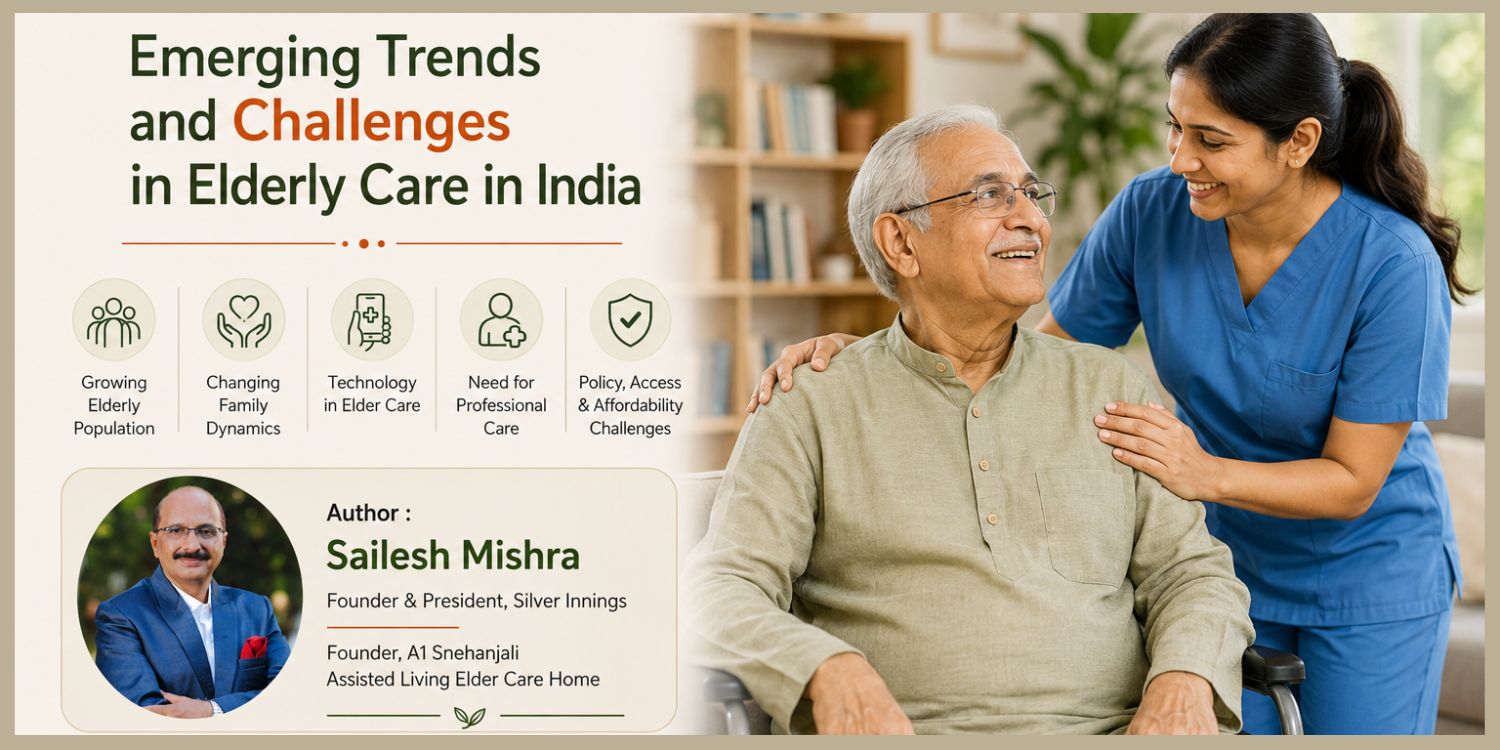
India is entering a defining phase of demographic change. The country is not only becoming more populous and urbanised; it is also ageing rapidly. According to the UNFPA India Ageing Report 2023, the proportion of Indians aged 60 years and above is projected to increase from 10.5% in 2022 to 20.8% by 2050. The population of people aged 80 and above is expected to grow particularly rapidly.
This demographic transition presents both a challenge and an opportunity. Elderly care can no longer remain primarily a family responsibility or be addressed only when a medical crisis occurs. India needs to move towards an integrated ecosystem of healthcare, long-term care, social support, technology, housing, financial security and community participation.
From “Old Age Homes” to a Continuum of Care
One of the most significant changes emerging in India is the gradual shift in the understanding of elder care.
For decades, institutional care was often associated with abandonment or the absence of family support. Today, the landscape is changing. With smaller families, migration, dual-income households and children increasingly living in different cities or countries, families are looking for professional support while still wanting their parents to remain connected with their communities.
This is creating demand for a continuum of care—from ageing at home and home-care services to day-care centres, assisted living, respite care, rehabilitation, palliative care and specialised dementia care.
The future is therefore unlikely to be about choosing between “family care” and “institutional care”. It will be about creating flexible models that allow families and professional caregivers to work together.
Dementia and Long-Term Care Will Become Central
India’s ageing population will inevitably bring greater attention to dementia, Alzheimer’s disease, Parkinson’s disease, frailty and other age-related conditions.
These conditions require care that goes beyond medicines and hospitalisation. Families need trained caregivers, behavioural support, safe environments, rehabilitation, nutrition, meaningful engagement and respite.
The Government’s National Programme for Health Care of the Elderly recognises the need for accessible, affordable and comprehensive healthcare, including long-term and rehabilitative services.
However, implementation and capacity must grow much faster. India needs more geriatricians, nurses, physiotherapists, occupational therapists, psychologists, dementia-care professionals and trained caregivers. Caregiving itself must become a recognised professional skill and career pathway.
Home and Community-Based Care Will Grow
Most older people would prefer to remain in familiar surroundings for as long as possible. Consequently, ageing in place and community-based care will become increasingly important.
Technology can support this transition through teleconsultation, remote health monitoring, emergency response systems, medication reminders and digital health records. But technology should remain an enabler, not a replacement for human connection.
A senior living alone may need someone to help with a hospital appointment, banking, grocery shopping, mobility or simply companionship. The emerging elder-care sector must therefore combine technology with the human touch.
Assisted Living Is Evolving
India’s assisted-living sector is also moving beyond the traditional concept of a retirement home.
The next generation of senior living will increasingly focus on independence, dignity, safety, wellness and purpose. Good assisted living should not feel like a hospital or an institution. It should feel like home, while providing professional support when required.
Design will play a major role. Homes and communities will need accessible bathrooms, non-slip flooring, adequate lighting, handrails, lifts, dementia-friendly layouts, emergency systems and spaces for social interaction.
The principle should be simple: design for ageing before ageing creates a crisis.
Technology, AI and the Silver Economy
Technology presents enormous possibilities for India’s ageing population.
Artificial intelligence, wearable devices, health-monitoring systems and digital platforms can help families monitor health, coordinate care and identify risks earlier. AI may increasingly assist in care planning, medication management, fall detection and personalised engagement.
At the same time, India must avoid creating a digital divide. Many older adults still struggle with smartphones, online payments, digital documentation and healthcare platforms.
The opportunity is therefore not merely to build technology for older people, but to build age-friendly technology that older people can actually use.
This is also where the concept of the Silver Economy becomes important. Older adults are not merely beneficiaries of services. They are consumers, professionals, entrepreneurs, mentors, travellers, investors and contributors to society.
The Caregiver Challenge
Perhaps the biggest challenge facing elder care is the shortage of trained and compassionate caregivers.
Caregiving is physically and emotionally demanding. Yet it is often poorly recognised, inadequately trained and undervalued.
India needs national standards for caregiver training, certification, recruitment and working conditions. Families also need greater awareness about how to select and supervise professional caregivers.
Equally important is support for family caregivers. A daughter or son caring for an ageing parent while managing employment and their own family responsibilities can experience significant emotional and physical stress.
Caregiving must become a shared responsibility—not an invisible burden placed on one family member.
The Challenge of Affordability and Equity
India’s elder-care market is growing, but affordability remains a serious concern.
Premium retirement communities and private healthcare services may be accessible to a relatively small section of society. Millions of older Indians, particularly those with limited savings or without formal pensions, will need affordable and accessible services.
The future therefore requires a three-sector partnership between government, private enterprise and civil society.
Government must strengthen policy, social security, healthcare and regulation. Private players can bring investment, innovation and professional services. Civil society organisations can contribute community outreach, advocacy, awareness and last-mile support.
From Ageing as a Problem to Ageing as an Opportunity
India’s ageing population should not be viewed simply as a demographic burden.
It represents an opportunity to build new healthcare services, jobs, technologies, housing models and social enterprises. More importantly, it offers an opportunity to rethink how society values longevity.
The question we must ask is not simply, “How will we take care of our elderly?”
It should be:
“How can we create a society where people can age with dignity, independence, security, purpose and joy?”
The answer will require investment, innovation and policy reform—but also a change in mindset.
India’s future elder-care ecosystem must move from crisis response to prevention, from institutionalisation to choice, from dependency to empowerment, and from treating older people as recipients of care to recognising them as active participants in society.
Ageing is not a problem to be solved. It is a stage of life to be supported, respected and celebrated.
Author:
Sailesh Mishra
Founder & President, Silver Innings | Founder, A1 Snehanjali Assisted Living Elder Care Home
Bio:
Sailesh Mishra is a social entrepreneur and elder-care advocate who founded Silver Innings in 2008 with a vision of creating an Elder and Dementia Friendly World, and serves as its Founder & President. He also founded A1 Snehanjali Assisted Living Elder Care Home in 2013, which provides 24×7 assisted living and specialised care for older adults, including those living with dementia, Alzheimer’s, and Parkinson’s.