
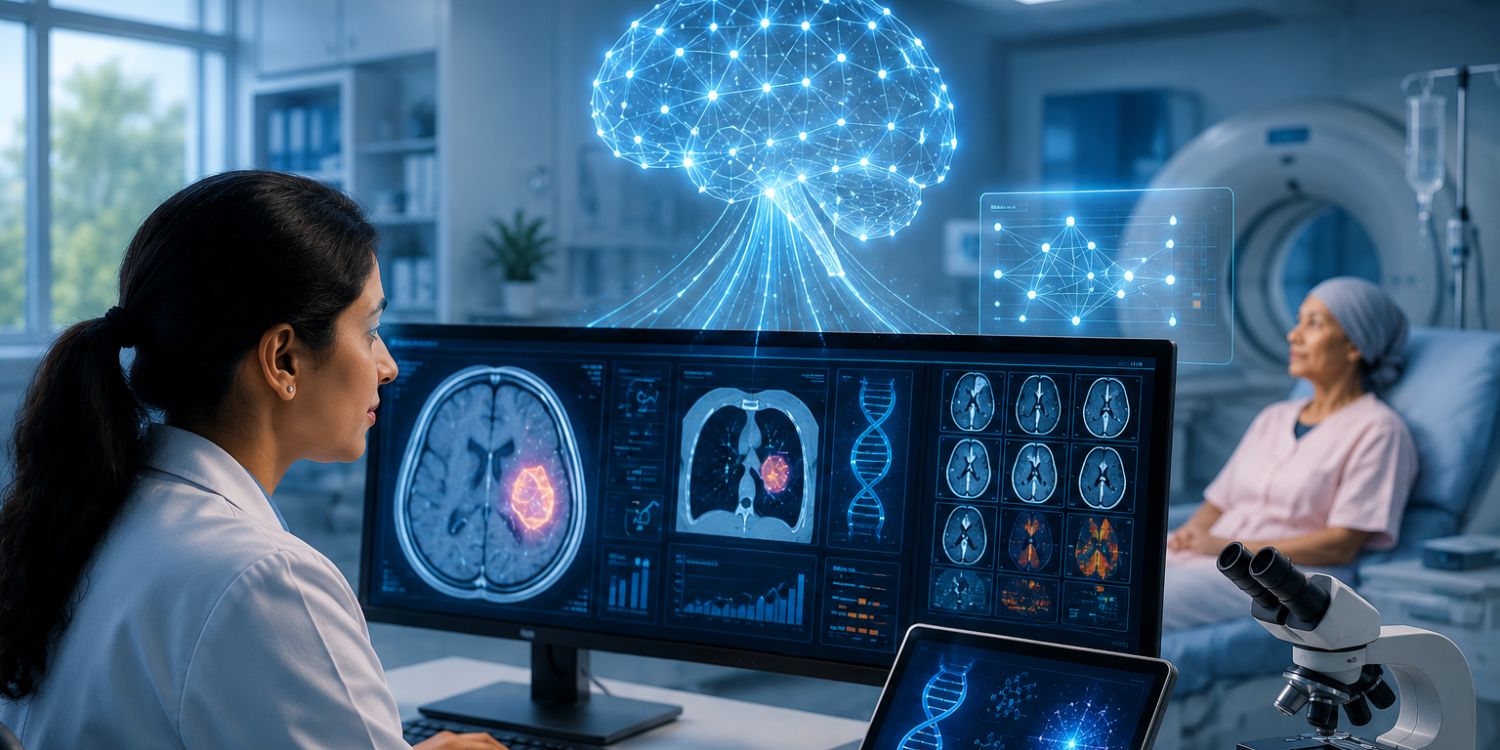
For decades, cancer diagnosis relied almost entirely on the trained eye. A radiologist scanned a mammogram for a shadow. A pathologist studied a slide for abnormal cells. It took years of training to make that kind of judgment reliably. That process has not disappeared, but it now has help. In 2026, artificial intelligence has moved from research labs into everyday oncology practice. It is changing how early, and how accurately, cancer is caught.
From Pattern Recognition to Prediction
The biggest shift this year is scale. Oncology AI systems are no longer narrow tools built for one scan type or one cancer. Pathology AI has reportedly reached close to 94% diagnostic accuracy across major cancer types. Some radiology systems are now detecting tumors earlier than experienced human radiologists.
Two studies published earlier this year show how far the field has moved. Researchers at the Hong Kong University of Science and Technology introduced PRET, a pathology system that can recognize 18 distinct cancer types from just a handful of tissue slides. It does not need retraining for each new hospital or patient population. In a separate study, Mayo Clinic researchers built an AI system that detected pancreatic cancer from routine CT scans up to three years before clinical diagnosis. It nearly doubled the detection rate of radiologists working without AI support. Pancreatic cancer is often caught late. A tool that pushes detection years earlier could meaningfully improve survival odds.
Liquid biopsies have also matured. These are blood tests that look for fragments of tumor DNA in the bloodstream. Machine learning models filter out genetic noise from a simple blood draw. They can flag dozens of cancer types at Stage I or II, often before any symptoms appear.
India’s Own AI Moment
This is not only a Western story. India is becoming one of the more important testing grounds for AI-driven cancer screening. Its diagnostic gaps are large, so the need is real. Lung cancer remains one of India’s leading causes of cancer death. Late diagnosis, limited access to CT scans, and a shortage of radiologists all contribute, especially in smaller towns.
Chest X-rays are far more widely available than CT scans in India. Several Indian companies have built AI tools around that fact. One platform, DecXpert, screens for lung nodules with reported accuracy above 95% in under a minute. DeepTek’s AI-powered chest X-ray tool identifies nodules and 22 other thoracic abnormalities. It has been validated on more than 500,000 X-rays and holds approvals from CDSCO, CE MDR, and the US FDA.
Government support has followed. In April 2026, AstraZeneca Pharma India signed an agreement with the Telangana government to roll out AI-enabled lung cancer screening across the state’s public hospitals. District hospitals elsewhere have deployed AI tools for cervical and breast cancer screening, with reported accuracy above 90%. Radiology turnaround times that once took weeks have dropped sharply. Analysts expect India’s AI-in-diagnostics market to roughly triple by 2030.
Institutions are moving too. AIIMS Delhi has developed an oncology AI tool for early cancer detection, now being rolled out to district hospitals. Singapore-based Qritive has partnered with Metropolis Healthcare, Rajiv Gandhi Cancer Institute, and CORE Diagnostics to bring AI-powered pathology tools into their diagnostic workflows.
Guardrails Are Catching Up
Regulation has had to move quickly to keep pace. India now treats AI-based cancer detection software as a regulated medical device under CDSCO norms. The goal is to prevent inflated accuracy claims and ensure tools are properly validated before reaching patients. One AIIMS clinician summed up the mood well in comments to the press. AI shows real promise in cancer screening, but oversight has to keep pace with adoption.
AI is also reaching other parts of cancer care. Some surgical tools now offer real-time analysis of tumor margins during operations. AI-optimized radiation therapy planning is already in clinical use, balancing tumor coverage against sparing healthy tissue. Large language models are being tested too. They can pull structured staging information out of pathology reports. They can also translate radiology findings into simpler, multilingual language for patients. That matters in a country with as many languages as India.
The Caveat Nobody Skips
Despite the momentum, researchers are careful not to oversell it. Cancer is not one disease. It is hundreds of biologically distinct diseases, each with its own diagnostic signals. AI works best not as a replacement for oncologists and pathologists, but as support against specific, real bottlenecks. Chronic radiologist shortages. Slow reporting times. In India, the sheer distance between patients and specialist care.
AI will not decide whether to biopsy, operate, or treat. But increasingly, it is the reason that decision gets made months, or years, sooner than it once would have.