
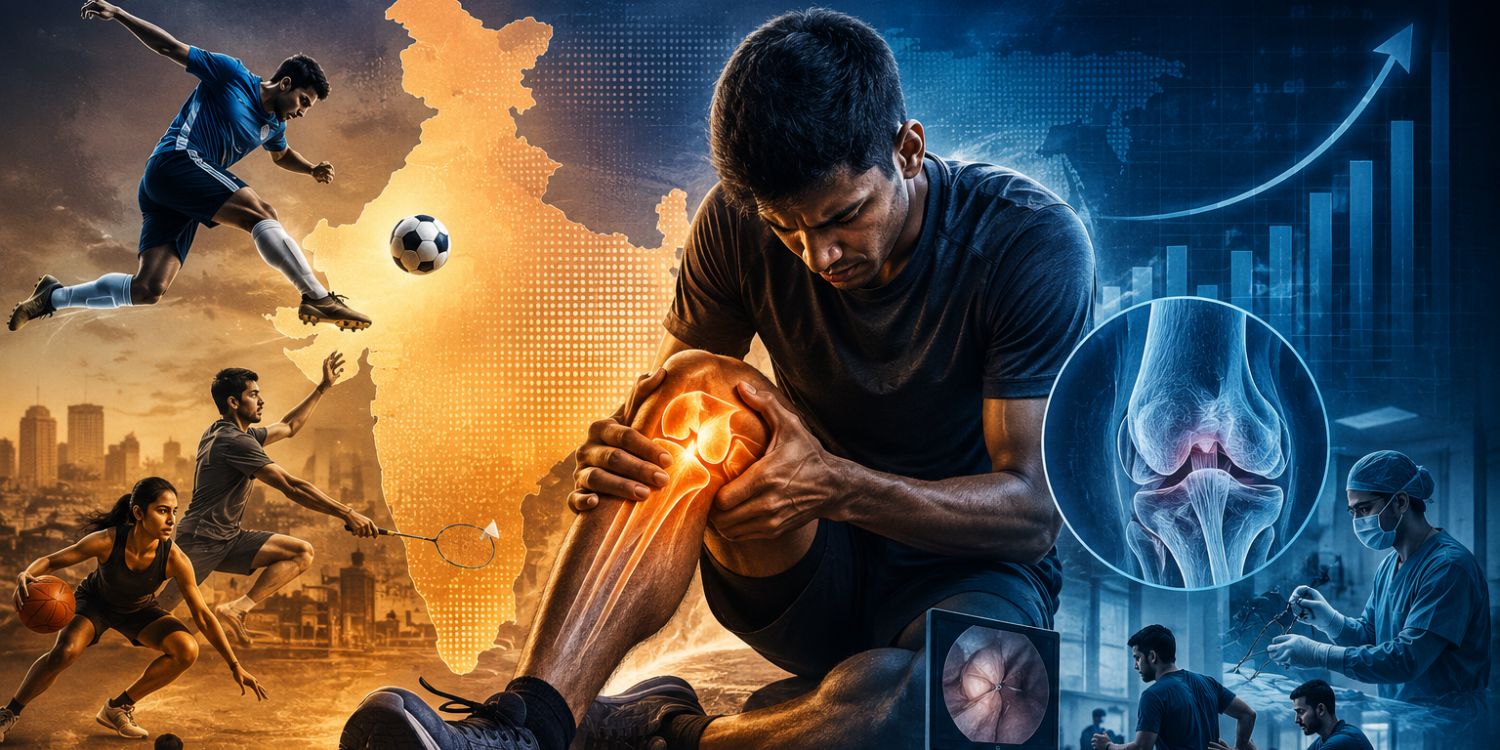
A decade ago, an ACL tear was something you associated with professional athletes, footballers on television clutching their knees in visible agony. Today, it’s just as likely to be your weekend badminton partner, the marathon runner training for their first half, or the twenty-something who tore a ligament playing five-a-side football on a Sunday evening. India’s sports medicine specialists are witnessing a genuine surge in ligament injuries, and it says as much about the country’s changing lifestyle as it does about its orthopaedic capabilities.
The rise isn’t hard to explain. Urban India has fallen in love with fitness in a way it never had before. Gyms, running clubs, recreational football leagues, trekking groups, and CrossFit-style training have exploded across metros and tier-two cities alike. More people are pushing their bodies harder, often without the conditioning, warm-up discipline, or technique training that professional athletes rely on. The result is predictable: a rise in ACL tears, meniscus injuries, and rotator cuff damage among otherwise healthy, active adults who simply asked more of their joints than their bodies were prepared for.
What has changed for the better is how these injuries get treated. Arthroscopic ACL reconstruction, once a lengthy and invasive procedure, has become minimally invasive, precise, and remarkably routine in India’s better-equipped hospitals. Recovery timelines that once stretched close to a year have shortened considerably, thanks to refined surgical techniques and more structured rehabilitation protocols. Surgeons are also increasingly personalizing graft choices and reconstruction techniques based on a patient’s specific sport, age, and activity level, rather than applying a one-size-fits-all approach.
This shift has fed a broader professionalization of sports medicine as its own orthopaedic sub-specialty in India, distinct from general joint replacement or trauma care. Hospitals are building dedicated sports injury units. Physiotherapy has evolved from generic post-op care into sport-specific rehabilitation, designed to return a cricketer, a runner, or a footballer to their exact movements and demands, not just to general mobility.
There’s also a cultural shift worth noting: injuries that once ended amateur sporting participation altogether are now seen as manageable setbacks. Patients return to the field, the court, and the trail with a confidence that simply didn’t exist a generation ago.
India’s ACL boom is, in many ways, a good problem to have. It’s the price of a more active population, and the reward is a sports medicine specialty finally coming into its own.