
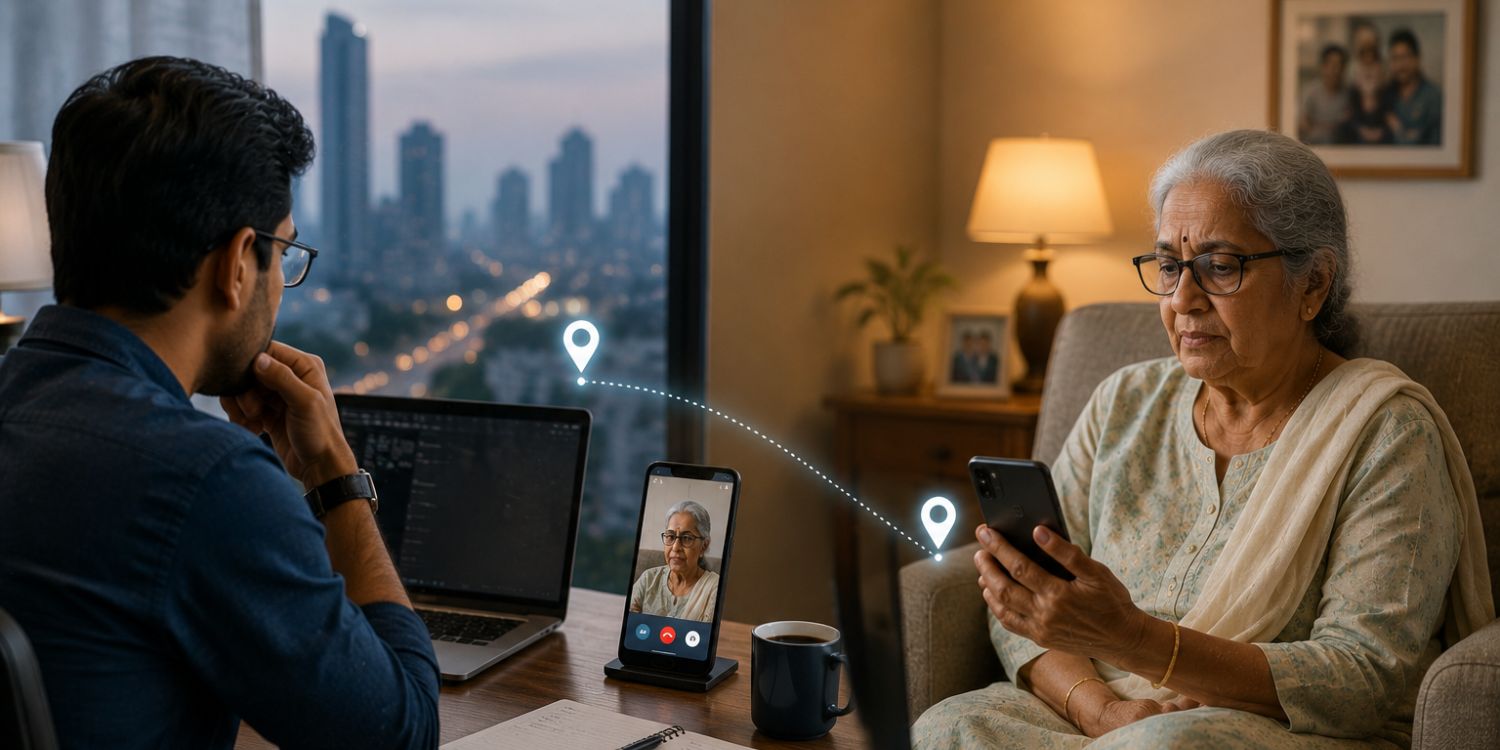
There is a particular kind of guilt that has become common among urban, upwardly mobile Indians. It shows up in a phone call that starts with “How are you, Amma?” and ends with a quiet ache after hanging up, the knowledge that a parent is managing alone in a house several hundred, or several thousand, kilometers away. This is the emotional undercurrent of one of India’s fastest-growing but least discussed elder care challenges: long-distance caregiving.
For generations, Indian families operated on the assumption of proximity. Children grew up, married, and often stayed close enough to check in daily, if not live under the same roof. That assumption no longer holds for a large and growing share of Indian households.
A Generation on the Move
India’s economic growth has been built on mobility. Young professionals move from small towns to cities like Bengaluru, Pune, and Hyderabad for opportunity. Others move further still, to the Gulf, North America, Europe, and Australia, chasing careers that simply do not exist back home. This migration has been transformative for individual families and for the Indian economy as a whole, but it has also quietly rewritten the terms of elder care.
Parents who once expected a child nearby now often have children scattered across three or four time zones. The caregiver who used to live down the hall now lives a flight, and sometimes an international one, away. Distance has stopped being an occasional inconvenience and become a permanent feature of family life.
The Anxiety of Not Knowing
For adult children living far from aging parents, the hardest part is often not the distance itself but the uncertainty it creates. Did Baba take his medication today? Is Amma eating properly? What happens if something goes wrong at two in the morning, and who finds out first? These questions can weigh heavily on someone thousands of kilometers away, unable to simply walk into the next room to check.
This anxiety has practical consequences too. Long-distance caregivers often find themselves making major decisions, choosing a doctor, approving a procedure, hiring a caregiver, based on secondhand information relayed over phone calls, without the ability to see a situation firsthand. It is a difficult way to manage something as important as a parent’s health and safety.
A New Kind of Caregiving Economy
This gap has created real demand for services that did not exist a generation ago. Professional home care providers now offer structured caregiving plans that families abroad can arrange and monitor remotely. Care coordinators act as an on-ground presence, visiting parents, accompanying them to appointments, and reporting back to children who cannot be there themselves. Emergency response systems and remote health monitoring, discussed in more detail in our piece on tech-enabled elder care, have become essential tools for exactly this kind of family arrangement.
In many ways, long-distance caregivers are not opting out of their responsibilities. They are outsourcing the parts they physically cannot perform while trying to remain emotionally and financially present in every other way. A monthly video call, a shared calendar of medical appointments, and a trusted local caregiver have become the new architecture of filial duty for millions of Indian families.
The Emotional Cost That Services Cannot Fully Solve
Even the best care coordination cannot fully replace the comfort of a familiar face walking through the door. Many long-distance children describe a persistent sense of having outsourced love itself, even when they know, rationally, that the arrangement is the most responsible one available to them. This tension is unlikely to disappear, because it is not really a logistics problem. It is the emotional cost of a country modernizing faster than its family structures can adjust.
What This Means for Providers
For India’s elder care industry, long-distance families represent one of the most consistent and fastest-growing sources of demand. But serving them well requires more than efficient logistics. It requires clear, frequent communication that can ease the anxiety of not being there, and a level of trust that allows an adult child abroad to feel genuinely informed rather than simply updated.
The families driving this shift are not choosing distance over duty. They are trying to hold both together, across geographies that make the old model of caregiving impossible, and the providers who understand that emotional reality, not just the operational one, are the ones building the most meaningful relationships with India’s long-distance caregivers.