
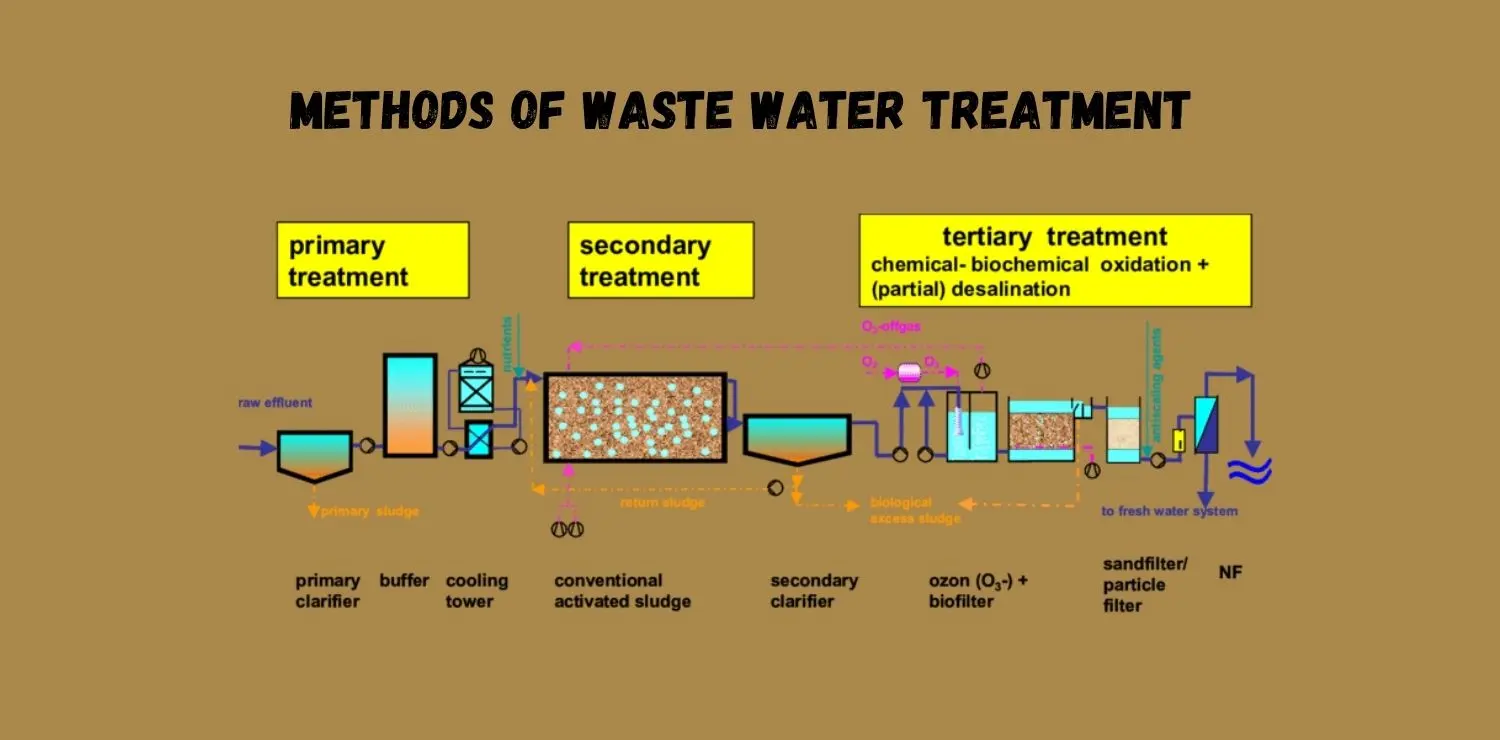
Wastewater treatment is the process of removing contaminants and pollutants from wastewater—water that has been used and is no longer suitable for its original purpose. This process is essential for protecting public health, preserving the environment, and ensuring that water can be safely returned to the ecosystem or reused for various applications. Treating waste water is an essential and the methods by which waste water can be treated are as follows:-
1. Primary Treatment
This stage focuses on the physical removal of solids from wastewater.
- Screening : Large objects (e.g., sticks, leaves, plastics) are removed using screens or grates.
- Coagulation and Flocculation – Coagulation involves adding chemicals (coagulants) to water to destabilize suspended particles.
Flocculation follows, where gentle mixing encourages these particles to clump together into larger aggregates called flocs. This processes are used to remove suspended solids, turbidity, and some pathogens from water.
- Sedimentation – After coagulation and flocculation, the water is allowed to sit in a sedimentation tank. The heavier flocs settle to the bottom, forming sludge, while clearer water remains on top. It’s purpose is to separate solid particles from water, reducing turbidity.
- pH Adjustment – Chemicals (such as lime or sulfuric acid) are added to adjust the pH of the water to optimal levels for treatment processes and to prevent corrosion in distribution systems. It is used to enhance the effectiveness of coagulation, disinfection, and to protect infrastructure.
In some cases, pH adjustment is performed during primary treatment to optimize conditions for coagulation and flocculation. Adjusting the pH can enhance the effectiveness of coagulants, helping to remove suspended solids and other contaminants more efficiently.
2. Secondary Treatment
This stage involves biological processes to degrade organic matter.
- Activated Sludge Process – Wastewater is aerated in a tank to promote the growth of microorganisms that consume organic pollutants. The mixture is then settled to separate the treated water from the sludge.
- Trickling Filters – Wastewater is distributed over a bed of rocks or plastic media, where biofilms of microorganisms break down organic matter as the water trickles through.
- Biofilm Reactors – Similar to trickling filters, but often use submerged media to support microbial growth.
- Sequencing Batch Reactors (SBR) – A fill-and-draw activated sludge process that treats wastewater in batches, allowing for better control of treatment conditions.
- pH Adjustment -Chemicals (such as lime or sulfuric acid) are added to adjust the pH of the water to optimal levels for treatment processes and to prevent corrosion in distribution systems.
pH adjustment can also occur during secondary treatment, particularly in biological treatment processes. Maintaining an optimal pH is crucial for the health and activity of microorganisms that break down organic matter in processes like activated sludge or biofilm reactors
3. Tertiary Treatment
This stage provides additional treatment to remove remaining contaminants and improve water quality.
- Filtration– Water passes through various filter media (sand, gravel, activated carbon, or membranes) to remove remaining suspended solids, bacteria, and some chemicals.It is used to further purify water by removing smaller particles and improving clarity.
- Disinfection-This process involves using chemical agents (like chlorine or chloramines), ultraviolet (UV) light, or ozone to kill or inactivate pathogens in the water. This process ensures the water is safe for human consumption by eliminating harmful microorganisms
- Nutrient Removal– Processes like denitrification and phosphorus removal are used to reduce nitrogen and phosphorus levels, which can cause eutrophication in receiving waters.
- Reverse Osmosis (RO)– Water is forced through a semi-permeable membrane that allows water molecules to pass while blocking larger molecules and contaminants, including salts and heavy metals. It is used to remove dissolved solids, impurities, and contaminants, making water suitable for drinking or industrial use.
- Ion Exchange– A process where undesirable ions (like calcium and magnesium) in water are exchanged for more desirable ions (like sodium) using resin beads. It’s purpose is to soften water and remove specific contaminants, improving water quality for various applications.
- Activated Carbon Treatment– Water is passed through activated carbon filters that adsorb organic compounds, chlorine, and other contaminants due to the large surface area of the carbon. It is used to improve taste and odor and remove certain chemicals and pollutants.
- Desalination– The process of removing salt and other impurities from seawater or brackish water, typically using reverse osmosis or distillation. it’s purpose is to provide fresh water in arid regions or where freshwater resources are limited.
4. Advanced Treatment
In some cases, additional advanced treatment methods may be employed, especially for water reuse applications.
- Advanced Oxidation Processes (AOPs)– Techniques that generate highly reactive hydroxyl radicals to break down complex organic pollutants. Common methods include ozonation and UV/H2O2. It is used to treat wastewater and remove persistent organic contaminants that are difficult to degrade.
- Constructed Wetlands: Engineered systems that use natural processes involving wetland vegetation, soils, and associated microbial assemblages to treat wastewater.
Conclusion
Wastewater treatment is a critical process that transforms polluted water into a safe and reusable resource which is necessary for protecting public health and the environment while promoting sustainable water management practices. Hence, treating waste water is of utmost importance.

Discussion about this post