
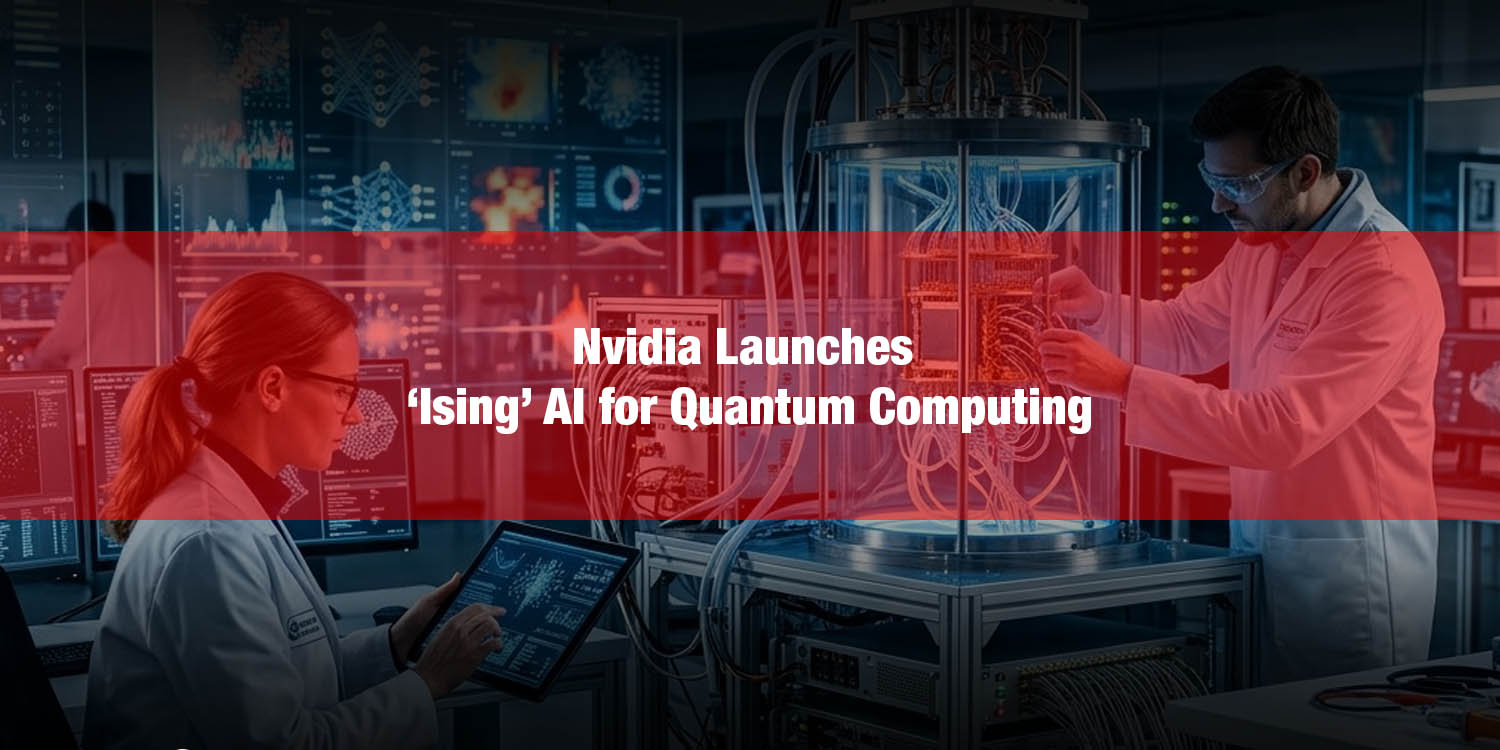
Nvidia has announced a new set of open-source artificial intelligence models, termed “Ising,” aimed at addressing persistent technical challenges in quantum computing.
Quantum systems, while powerful in theory, face practical limitations due to the instability of qubits and the complexity involved in maintaining their accuracy. Nvidia’s newly released models are designed to assist in managing these issues by improving error correction mechanisms and simplifying the calibration of quantum processors.
Unlike mainstream AI models built for language or visual tasks, the Ising models are tailored for optimisation problems commonly found in scientific computing. By automating intricate processes such as system tuning and error decoding, the models aim to enhance the efficiency and reliability of quantum operations.
The decision to make these tools open source reflects Nvidia’s broader strategy to foster collaboration within the emerging quantum ecosystem. By enabling researchers and developers to access and build upon these models, the company is positioning itself as a key contributor to the foundational infrastructure supporting quantum technologies.
Rather than directly manufacturing quantum hardware, Nvidia appears to be focusing on integrating AI capabilities into the development pipeline, potentially accelerating progress toward scalable and commercially viable quantum systems.
The move has also drawn attention in financial markets, with renewed interest in quantum-related firms, signalling growing optimism around advancements in the field.
As the industry continues to work toward overcoming fundamental limitations, Nvidia’s initiative represents a targeted effort to bridge existing gaps between experimental research and practical application.